
Testing the spirits
How each tradition tells a true sign from fear or from wishing.

How do the traditions of the spirit realm teach a person to test whether an experience is real?
What it is
Every tradition that speaks of spirits also teaches that experiences must be tested. The First Letter of John says to test the spirits and not to believe every one. The Christian discipline that grew from this, the discernment of spirits, judges an inner movement by its fruits: whether it leaves peace, honesty and care for others, or agitation, pride and secrecy. Islam, Judaism and Buddhism have rules of the same kind. The shared core is that vividness proves nothing. What counts is where an experience leads.
The teaching
As the discipline of discernment in Christianity, Judaism, Islam and Buddhism teaches it.
Test the spirits
The rule is scriptural and old: “Beloved, believe not every spirit, but try the spirits whether they are of God: because many false prophets are gone out into the world.” The First Letter of John gives its own first test, whether a spirit confesses that Jesus Christ has come in the flesh. The Law of Moses gives two more: a prophet whose sign comes true but who says, let us go after other gods, is not to be heard, and a word that does not come to pass was not spoken by the LORD.
The Gospels give the test beneath all the others: “Ye shall know them by their fruits.” Paul names the fruit of the Spirit as love, joy, peace, longsuffering, gentleness, goodness, faith, meekness and temperance, and warns that Satan himself can take the form of an angel of light. A vision, a voice or a sweet feeling proves nothing by its brightness. What counts is where it leads.
The desert: watching the thoughts
The monks of the Egyptian desert made a close study of how thoughts arrive. Evagrius named eight that assail the soul: gluttony, lust, avarice, sadness, anger, listlessness, vainglory and pride. The monk's work is watchfulness: to see each thought at its first suggestion, before he has agreed to it, and to answer it with a word of scripture.
Antony, as his life tells it, taught his disciples how to tell visions apart. The coming of the holy ones is quiet and gentle, and joy, gladness and courage rise in the soul after it. The approach of the evil ones comes with crashing and shouting, and leaves terror, confusion, gloom and a hatred of the ascetic life. If a first fear gives way to joy, he said, the visitor is from God; if the fear remains, it is from the enemy.
John Cassian told the monks to be like good money changers, who test every coin: they weigh a thought, ask whether its metal is pure gold, and look at whose image it bears, for a counterfeit can carry the king's face on base metal. Above all the virtues Abba Moses set discretion, the gift of measure. He told of a monk who fasted and kept vigil beyond all bounds, trusted a vision of an angel of light, threw himself into a well at its word and died, and of a young monk who was freed from a hidden fault the moment he confessed it to his elder. A thought kept secret, the desert taught, is the enemy's; brought into the open, it loses its hold.
Ignatius: consolation and desolation
Ignatius of Loyola gave the discipline its classic rules. He calls spiritual consolation every inner movement that kindles love of God, every increase of faith, hope and charity, and every joy that draws the soul toward heavenly things and leaves it quiet and at peace. Desolation is the reverse: darkness and turmoil of soul, a pull toward low and earthly things, restlessness, temptation and a loss of faith, hope and love, so that the soul feels lazy, lukewarm, sad and as if cut off from its Creator.
His rules for the time of desolation are the best known. In desolation never make a change, but hold firm to the resolutions made before it came. Push against it with more prayer and more honest self-examination. Remember that it passes, be patient, and know that consolation will return. In consolation, think ahead to how the next desolation will be borne, and stay humble.
He describes the enemy's ways in three pictures. The enemy is weak when faced boldly and fierce when given ground. He is like a false lover who wants his suggestions kept secret and is dismayed when they are told to a wise confessor. And he is like a captain who studies a fortress and attacks it at its weakest point.
Ignatius: the angel of light
For those already serving God, Ignatius warns, the enemy comes disguised as an angel of light. He begins with holy and good thoughts that suit a devout soul and then draws it little by little toward his own ends. So the whole course of a thought must be watched, its beginning, middle and end. If all three are good and tend to good, it is from the good spirit; if it ends in something evil or distracting, or less good than the soul had first meant to do, or if it weakens, disquiets or troubles the soul and takes away its peace, it is from the enemy.
His image for the difference is of water. In souls going from good to better, the good spirit touches them sweetly, lightly and gently, like a drop of water soaking into a sponge, and the evil spirit touches them sharply, with noise and disturbance, like a drop of water falling on a stone. In souls going from bad to worse it is the other way about, for each spirit enters quietly where it finds the house its own.
The Jewish tests
Jewish teaching keeps the tests of the Law and adds that even a voice from heaven does not settle what is right. In a famous story of the Talmud, Rabbi Eliezer calls on a carob tree, a stream, the walls of the house of study and at last a heavenly voice to prove him right, and the sages answer that the Torah is not in heaven: it was given to human beings, to be decided by their reasoning together.
Maimonides adds the tests of a prophet. He must be wise and of strong character, master of his desires; and if he foretells good and it does not come, he is false, though a prophecy of evil may be turned aside by repentance.
The Islamic tests
Islam teaches that two kinds of touch reach the heart. A hadith says that Satan has a touch on the son of Adam and the angel has a touch: Satan's promises evil and denies the truth, and the angel's promises good and confirms the truth. Whoever finds the second should know it is from God and praise him, and whoever finds the first should seek refuge in God from Satan. The Qur'an says the same: Satan threatens poverty and commands what is shameful, while God promises forgiveness and bounty.
The Sufi masters sorted the passing thoughts of the heart into those from God, from the angel, from the self and from Satan, and set one rule over them all, in the words of al-Junayd: this knowledge of ours is bound to the Book and the Sunna. An inspiration that calls for what the law forbids is false, however holy it feels. Of dreams the Prophet taught that a good dream is from God and a bad one from Satan, and that one who has a bad dream should spit lightly three times to the left, seek refuge in God, turn over and tell no one, and it will not harm him.
The Buddhist tests
Buddhist teachers warn that the practice itself throws up wonders. The Zen schools call the lights, voices, visions of Buddhas and strange sensations of deep sitting makyo, the realm of illusion, and tell the student neither to cling to them nor to fear them, but to go on. Linji's saying, if you meet the Buddha, kill the Buddha, teaches the same: no image, however holy, is to be held.
The Theravada manual called the Path of Purification lists ten corruptions of insight, all of them pleasant: light, knowledge, rapture, tranquillity, bliss, resolve, exertion, mindfulness, equanimity, and a subtle delight in them. They become corruptions when the meditator takes them for the goal. The Shurangama Sutra describes fifty such states and warns that whoever mistakes one for sainthood falls into error.
The tests gathered
The traditions agree more than they differ. Each judges an experience by its fruit and by the whole of its course, not by its brightness. Each holds that the true leaves peace, humility and care for others, and the false leaves agitation, pride, secrecy and fear. Each sends the one who is troubled to an elder, a confessor or a teacher, and forbids great decisions in a dark hour. And each refuses a voice that commands harm, whatever name it gives itself. The directors who teach these rules today add that a voice that commands, or a fear that will not lift, is first a matter for a doctor.
How it is practised
The tests can be written on a card. Does the experience leave me calmer and kinder, or frightened and special? Does it ask for anything that harms me or someone else, or that must be kept secret? Would I tell it to a steady friend, a pastor or a doctor? Is it still persuasive after a week of ordinary sleep and food? Ignatius adds: decide nothing important in a dark mood. An experience that commands, threatens or does not stop is a reason to see a doctor, not a spirit to obey.
Where it comes from
Paul lists the discerning of spirits among the gifts in First Corinthians. The desert monks of fourth-century Egypt, whose teaching was gathered by Evagrius and John Cassian, worked out close observations of how thoughts arrive and deceive. Ignatius of Loyola wrote the classic rules in his Spiritual Exercises, printed in 1548, describing consolation and desolation and warning against changing course in a dark hour. Zen teachers gave the name makyo to visions that arise in meditation, and told students to let them pass.
What is known, and what is not
The rules of discernment are documented in the texts named, and they are rules for judging experience, not proof of what lies behind it. Medicine recognises that hearing a voice or sensing a presence is common, especially in grief, at the edge of sleep and under strain, and that it usually passes. It also recognises when such experiences are a sign of illness. The traditions and the doctors agree on the practical point: an experience that isolates or frightens a person calls for help from other people.
Its words
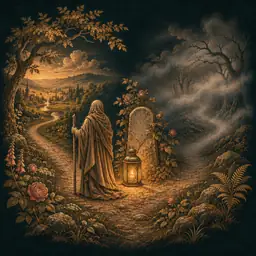 Discernment of Spirits
- The Christian discipline of judging an inner movement by where it leads, set out in rules by Ignatius of Loyola.
Ask the Oracle further
What rules did Ignatius give for testing the spirits, in plain words?How do I tell a true sign from the spirit realm from my own fear or wishing?
Before you practise
The Oracle tells what the traditions say of spirits and names whose account it is. It does not speak for the dead, and it cannot tell you that a spirit is with you. If you hear voices or feel commanded, please see a doctor.
Its other branches
Angels and their ordersThe jinnThe ancestorsDaimons and intelligencesThe elementalsGhosts and hauntingsMediums and SpiritualismShamans and spirit journeysThe fair folkDemons in the old booksThe whole artSearch the tree

