
The jinn
Islam’s beings of smokeless fire, with wills of their own.
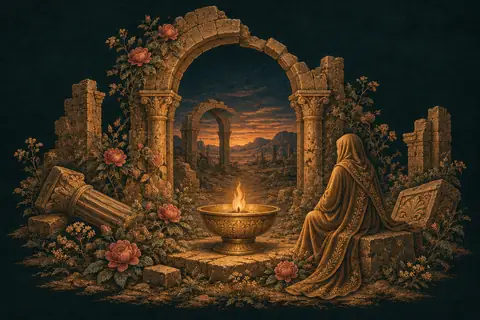
What does Islam teach about the jinn of the spirit realm?
What it is
In Islamic teaching the jinn are a third kind of creature beside angels and humans. The Qur'an says they were made from smokeless fire, as humans were from clay. They are normally unseen, they eat, marry and die, and they have free will: some are believers and some are not, and they are judged as people are. Iblis, who refused to bow to Adam, is counted among them in the Qur'an. A jinni is thus closer to a hidden neighbour than to a demon or a ghost.
The teaching
As Islamic tradition from the Qur'an onward teaches it.
What the jinn are
The jinn are a third kind of creature, beside angels and human beings, and they were made before Adam. The Qur'an says that God created humankind from clay like the potter's and created the jinn from a smokeless flame of fire, and in another place from the fire of the scorching wind. Their name comes from a root that means to hide or to cover, the root of janin, the child hidden in the womb, and majnun, one whose mind is covered. They are hidden from human sight, and the Qur'an says of Iblis and his tribe that they see people from where people do not see them.
Like human beings the jinn are made to worship God, and the Qur'an joins the two in that one purpose. They have reason and a will of their own and are bound by the law. The Qur'an speaks of messengers coming to them; most scholars take these to be the prophets of humankind, whom the jinn follow as well. On the Last Day they are judged as people are, for Paradise or the Fire. The chapter called the All-Merciful speaks to both at once, asking again and again which of their Lord's favours the two of them will deny.
Iblis and the devils
When God commanded those in his presence to bow down to Adam, all bowed except Iblis, who said: I am better than he; you created me from fire and created him from clay. For that pride he was driven out. He asked for respite until the Day of Resurrection and was granted it, and he swore to come at human beings from before and behind, from their right and from their left. The Qur'an says plainly that he was one of the jinn, and that he has no authority over God's sincere servants.
A few of the early commentators held that Iblis had been an angel, of a tribe of angels called the jinn; most follow the verse that names him of the jinn and say he lived among the angels without being one of them, since angels do not disobey. A shaytan, a devil, is any rebel: the Qur'an speaks of devils among humankind and among the jinn alike. On the Last Day, it says, Satan will tell those who followed him that he had no power over them except to call, and they answered.
Their life and their kinds
The jinn eat and drink, marry, have children and die. A hadith tells that a company of them came to the Prophet asking for provision, and he told them that every bone over which God's name has been said is their food, and the dung of animals fodder for their beasts; for that reason Muslims do not clean themselves with bone or dung. They dwell in deserts, ruins and wild places, and also in houses. Some of them are believers and some are not, for the jinn say of themselves in the Qur'an that they follow differing ways.
One hadith gives three kinds: one with wings that flies through the air, one that takes the form of snakes and dogs, and one that halts and then journeys on. Because some take the form of snakes, the Prophet told his companions to warn a snake found in the house for three days before killing it, and told of a young man who killed one in his house at once and died. Later learning and storytelling add further names: the 'ifrit, a powerful and cunning jinni like the one who offered to bring the Queen of Sheba's throne to Solomon; the marid, the rebel; and the ghul of the desert roads, whose power to lead travellers astray a hadith denies.
The companion and the whisperer
Every person, says a hadith, has been given a companion from among the jinn, the qarin. When his companions asked whether this was true of him too, the Prophet said yes, but God had helped him against his own and it had submitted, so that it urged him only to good. The work of the devils is waswasa, whispering: the suggestion of evil, doubt and dread into the heart. The last chapter of the Qur'an seeks refuge in the Lord of humankind from the whisperer who withdraws, who whispers in the hearts of people, of the jinn and of humankind.
The tradition is careful to say what the jinn cannot do. They do not know the unseen: the Qur'an tells that they laboured on at the hard work Solomon had set them, not knowing he had died, until a creature of the earth gnawed through the staff he leaned on and he fell. The news they once stole by listening at the edge of heaven is now guarded with flames, which are the shooting stars. And whatever a devil whispers, the choice stays with the person: the whisper invites, and the will answers.
The jinn who heard the Qur'an
The seventy-second chapter, which bears their name, tells how a company of jinn heard the Qur'an recited and said to their people: we have heard a wondrous recitation that guides to the right way, and we believe in it, and we will never make anyone a partner with our Lord. They confess that they once sat in places in heaven to listen and now find it filled with guards; that the foolish among them used to speak lies about God; and that men of humankind used to seek refuge with men of the jinn, which only added to their burden.
From that verse the scholars draw a firm rule. To seek help from the jinn, to call on them, to bargain with them or to make offerings to them is forbidden, and sorcery is counted among the gravest of sins. A hadith says that whoever goes to a fortune-teller and believes what he says has denied what was revealed to Muhammad, and the Prophet explained that a soothsayer may catch a word a jinni overheard and mix a hundred lies with it.
The words of refuge
The protection this tradition teaches is the remembrance of God, and it belongs to ordinary days. Before reciting the Qur'an a Muslim says: I seek refuge in God from Satan the accursed. Coming into the house and sitting down to eat, they say the name of God, and a hadith says that Satan then tells his followers there is no lodging and no supper for them there. Entering the washroom, a place the jinn are said to frequent, they ask God's refuge from the male and female devils.
At night the Prophet's custom was to cup his hands, recite into them the last three chapters of the Qur'an, the chapters of Sincerity, the Daybreak and Humankind, blow lightly into them and pass them over his body, three times. The Throne Verse, the two hundred and fifty-fifth verse of the second chapter, is said before sleep, and a hadith promises that whoever says it has a guardian from God through the night. A house in which the whole of the second chapter is recited is one, the Prophet said, from which Satan flees.
Many scholars hold, from a verse of the second chapter that speaks of one whom Satan has touched into madness, that a jinni can trouble a person, and some have denied it. For a person who is unwell the tradition allows ruqya, the recitation of the Qur'an and of the Prophet's own prayers over the sick, so long as it uses God's words and names, in words that are understood, and with the knowledge that any help comes by God's leave and not from the words themselves. The same tradition tells the sick to seek treatment, since God sent down no illness without sending down its cure, and many of its scholars warn against blaming the jinn for what has an ordinary cause.
How it is practised
For Muslims the practical teaching is brief: jinn are real, they are not to be sought out, feared beyond measure or bargained with, and protection lies in ordinary prayer and in reciting the closing chapters of the Qur'an. For a reader outside Islam the fair approach is to learn the account as believers hold it, from the Qur'an and from scholars, and to keep it apart from the wish-granting genie of films, which is a European story.
Where it comes from
Belief in jinn is older than Islam. Arabs before the Prophet held that they haunted deserts and ruins and inspired poets and soothsayers. The Qur'an kept the beings and changed their standing, making them creatures under God, and its seventy-second chapter describes a company of them listening to the recitation and believing. Later folklore sorted them into kinds such as the ghul and the ifrit. The tales of the Thousand and One Nights carried the word into Europe, where the French translator rendered it génie, the source of the English genie.
What is known, and what is not
That the Qur'an and the hadith teach the existence of jinn is plain from the texts, and most Muslim scholars through history have taken them literally, though some modern thinkers read them figuratively. No physical evidence of such beings exists. Experiences blamed on jinn, including sleep paralysis and sudden changes of behaviour, have medical explanations that many Muslim physicians and imams now consider first. Voices, or a feeling of being commanded, are for a doctor.
Its words

Ask the Oracle further
Are the jinn of Islam the same as demons, or something different?How did the jinn of Arabia become the genie of the Thousand and One Nights?
Before you practise
The Oracle tells what the traditions say of spirits and names whose account it is. It does not speak for the dead, and it cannot tell you that a spirit is with you. If you hear voices or feel commanded, please see a doctor.
Its other branches
Angels and their ordersThe ancestorsDaimons and intelligencesThe elementalsTesting the spiritsGhosts and hauntingsMediums and SpiritualismShamans and spirit journeysThe fair folkDemons in the old booksThe whole artSearch the tree

