

Mystical systems
Angelic Hierarchy
Direct answer
Angelic Hierarchy: The angelic hierarchy is the ordering of angels into ranks, best known in the Christian scheme of nine choirs arranged in three triads, from seraphim down to angels.
$0 today, then $19/month after 7 days. Cancel anytime.
At a glance
- Also called
- nine choirs of angels, hierarchy of angels, orders of angels, celestial hierarchy
- Found in
- Mystical Systems
- Related
- Seraphim, Cherubim, Archangel, Thrones
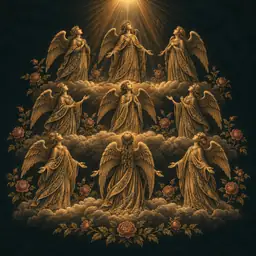

The angelic hierarchy is the ordering of angels into ranks, best known in the Christian scheme of nine choirs arranged in three triads, from seraphim down to angels.
A lineage map for books and systems; it avoids presenting symbolic traditions as literal fact.
Understand the chapter you are in.
Your life’s turning points, measured from your birth.
Walk through Alex’s whole example first


Prefer to explore first?
 The Road of AgesThe turning points of your whole life, from your own chart
Walk my road
What are the nine choirs of angels?
The angelic hierarchy is the idea that angels are ranked. The form most people know has nine choirs in three groups of three. Nearest to God are the seraphim, cherubim and thrones. In the middle are the dominions, virtues and powers. Nearest to humankind are the principalities, archangels and angels. The names are all taken from scripture, where they appear singly and without any ranking.
The arrangement comes from The Celestial Hierarchy, written about 500 CE under the name of Dionysius the Areopagite. Other faiths order angels differently. Maimonides lists ten ranks in Jewish tradition, and Islamic writers name particular angels by their tasks more often than by rank.
On the tree of the hidden arts: The spirit realm.
What sets Angelic Hierarchy apart
The scheme is built on the number three, which its author took from the Platonist Proclus as much as from scripture: three triads, each handing light down to the one below, so that no rank acts on humanity except through the ranks beneath it. A curious result is that archangels, the best known of all, sit second from the bottom. The two great lists disagree in the middle ranks, where Gregory the Great sets the principalities higher than Dionysius does.
- Source: Pseudo-Dionysius, The Celestial Hierarchy, about 500 CE
- First triad: seraphim, cherubim, thrones
- Second triad: dominions, virtues, powers
- Third triad: principalities, archangels, angels
- Rival order: Gregory the Great, about 600, exchanges the virtues and the principalities
- In poetry: Dante's Paradiso, canto 28: nine circling rings of light
Often mistaken for something else: The archangels of popular devotion are treated as the greatest angels; in the hierarchy of Dionysius the archangel is a low rank, eighth of nine.
The story behind Angelic Hierarchy
Paul's letters mention thrones, dominions, principalities and powers, and Isaiah and Ezekiel describe seraphim and cherubim. Pseudo-Dionysius joined these into nine orders about 500 CE. Pope Gregory the Great gave a slightly different order around 600, and Thomas Aquinas followed Dionysius in the thirteenth century. Dante set the nine choirs as nine circling rings of light in the Paradiso.
Why Angelic Hierarchy matters
Angelic Hierarchy shows which ideas about angels are scripture and which are a later arrangement, a difference most popular writing on angels blurs.
How to read Angelic Hierarchy
Readers turn to it to place a name such as thrones or principalities, and to check whether a claim about angels has any old source behind it.
Angelic Hierarchy in practice: an example
Asked what a seraph is, a careful reader says: the highest of the nine choirs in the list Dionysius drew up, and a six-winged being in the sixth chapter of Isaiah.
Where readings of Angelic Hierarchy go wrong
The nine choirs are one theologian's scheme and were never made binding doctrine; no rank is assigned to any person or birth date.
Sources and editorial method
This entry summarizes the tradition in the Almanac's own words; where no source is listed, it is an editorial summary rather than a primary text, and symbolic readings are named as the tradition's, not as fact.
- Source
- The Great Almanac Dictionary
- Category
- Mystical Systems
- Aliases
- nine choirs of angels, hierarchy of angels, orders of angels, celestial hierarchy, choirs of angels
- Last updated
- 2026-09-26
See Angelic Hierarchy in your personal almanac
A definition tells you what it is; your own birth chart tells you what it means for you. The Oracle casts your real chart and answers for your love, your work, and your year ahead, in conversation. It opens with the 7-day Oracle trial.
Speak with the OracleRelated terms
More in Mystical Systems
From the reference page to your own chart
Every word here
is in your own chart.
- Your life’s turning points, measured from your birth
- A practical next step to consider
- It opens with 7 days free: the AI Oracle on thirty hidden arts, and your daily horoscope
$0 today, then $19/month after 7 days. Cancel anytime.
Common questions
What are the nine choirs of angels?
In order: seraphim, cherubim and thrones; dominions, virtues and powers; principalities, archangels and angels. The list comes from Pseudo-Dionysius, writing about 500 CE.
Is the angelic hierarchy in the Bible?
The names are, scattered through Isaiah, Ezekiel and the letters of Paul. The ranking into nine orders is not; it was worked out by a later Christian writer.
Which angels are highest?
In the scheme of Dionysius the seraphim are highest and nearest to God. Archangels, despite their fame, stand eighth of nine, just above the ordinary angels.


