Aspect PatternsThe T Square, the Grand Trine and the Yod
An aspect pattern is three or more placements whose angles form a closed figure. Three of them do most of the work in a reading, and each describes a way pressure moves through a chart.
Direct answer
Short version
A T square is two planets in opposition, both square a third; the third is the focal point and carries the pressure. A grand trine is three planets in trine, forming a closed triangle usually in one element. A yod is two planets in sextile, both quincunx a third. Each is read as a shape that organises tension, not as a promise or a sentence.
What does your own chart say about you?
Choose love, work or purpose for a personal insight and a useful next step. Your reading uses your own birth details.
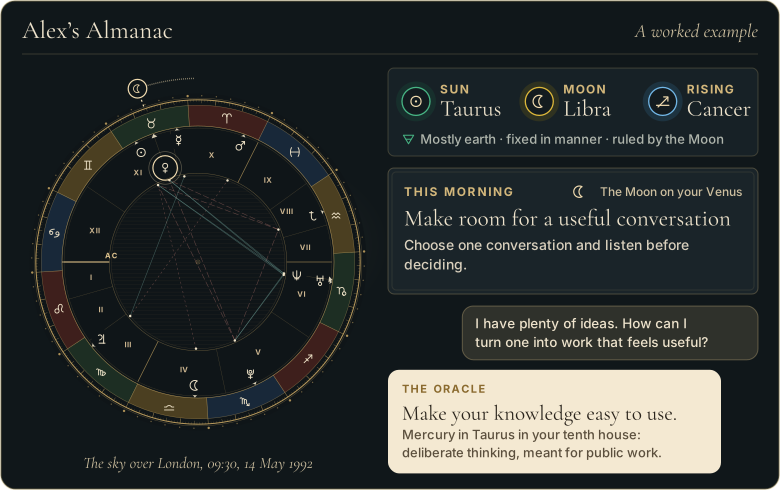
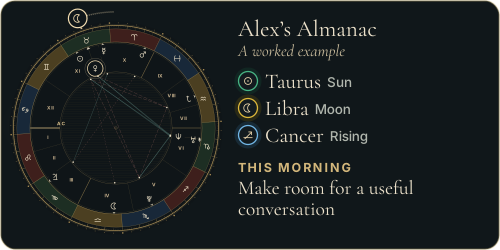
Walk through Alex’s whole example first
 The Road of AgesSee the turning points of your whole life, from your birth date
Free first look
The Road of AgesSee the turning points of your whole life, from your birth date
Free first look
Prefer to explore first?
 The Road of AgesThe turning points of your whole life, from your own chart
Walk my road
The Road of AgesThe turning points of your whole life, from your own chart
Walk my road
Visual guide
Aspect Patterns: The T Square, the Grand Trine and the Yod
What makes a pattern
A pattern is a closed figure: three or more placements whose aspects to each other form a shape rather than a list. That closure is what practitioners take to matter, because each planet is then in relationship with every other one in the group, so pressure has somewhere to travel rather than staying between two points. The threshold is the orb, and it is where patterns are most often manufactured: a figure allowed eight or nine degrees at every corner will appear in almost any chart. Say your orb, keep it tight, and most charts will show one pattern or none.
The T square
Two planets opposite each other, both square a third. The third planet, the focal point, is where the opposition discharges, and the tradition reads it as the busiest place in the chart: the point a person keeps returning to, often with more force than the situation needs. It is read as productive rather than unfortunate, because an opposition with nowhere to go tends to oscillate, and a T square at least gives it a direction. The empty degree opposite the focal point is sometimes read as what the pattern is missing, though that reading is a modern addition rather than an old one.
The grand trine and the yod
A grand trine is three planets in trine, generally in one element, forming a closed triangle. It is read as ease that circulates without needing effort, and the common caution is that ease unexercised becomes ease unused: a talent that has never met resistance is often a talent that was never developed. A yod, two planets in sextile both quincunx a third, is read as an awkward adjustment, since the quincunx joins signs that share neither element nor mode. It is the most over-diagnosed of the three, because a wide orb produces yods everywhere.
What a pattern does not decide
It does not make a chart harder or easier than another, and it does not predict what will happen. A pattern is a description of how tension moves through a particular arrangement of planets, and the planets involved matter far more than the name of the figure: a T square focused on Saturn and one focused on Venus are not the same experience and should not be described in the same words. Treat the name as shorthand for a geometry you can check, and then read the actual planets, which is where anything useful will be.
Concrete examples
| Example | What it means in practice |
|---|---|
| A T square focused on Saturn | Pressure discharging through duty, limit and standard. Read Saturn first, the shape second. |
| A grand trine at nine degrees of orb | Probably not a pattern. Tighten the orb and see whether the figure survives. |
| A yod nobody had mentioned before | Check the orbs before rereading a life around it. The quincunx is the easiest aspect to over-allow. |
Prayerful reflection
Let me work with the shape I was given rather than looking for a name that explains me to myself.
Related Almanac guides
More from the journal
Sources and editorial method
Research and editorial references used for this page include:
- Astrodienst: Transits - Used for the basic definition of transits as current planetary passages over birth positions.
- Astrodienst: The four Elements - Used for the traditional grouping of zodiac signs by element.
This guide distinguishes traditional symbolism from calculated positions. Examples illustrate possible reflections, not predictions about a particular person.
From the reference page to your own chart
Every word here
is in your own chart.
- Your chart and numbers, read for you in about a minute
- Ask the Oracle anything about them
- Every personal tool and daily guidance
Free reading, no card needed. Optional membership: payment details required, 7 days free, then $12/month. Cancel before it renews and you pay nothing.
Common questions
How tight should the orbs be for a pattern?
Tighter than for single aspects, because the error compounds at every corner. Many practitioners allow no more than five or six degrees and some considerably less. A wide figure is a faint one.
Is a grand trine lucky?
It is read as ease rather than luck, and the standard caution is that unexercised ease tends to stay unexercised. Nothing in the figure delivers anything on its own.
What if I have no patterns at all?
That is common and means nothing is wrong. A chart without a closed figure is simply one where the pressure is distributed rather than concentrated.