Progressions, and How They Differ From Transits
A transit is the real sky touching your chart. A progression is a symbolic clock built from the days after your birth. They answer different questions and are easiest to use when you keep them apart.
Direct answer
Short version
Secondary progressions take one day of ephemeris after your birth to stand for one year of your life, so your chart at thirty days old describes your thirtieth year. The progressed Moon moves about one degree a month and changes sign roughly every two and a half years, which makes it the most legible part of the technique. Nothing is observed: the sky was not doing this to you.

What does your own chart say about you?
Choose love, work or purpose for a personal insight and a useful next step. Your reading uses your own birth details.
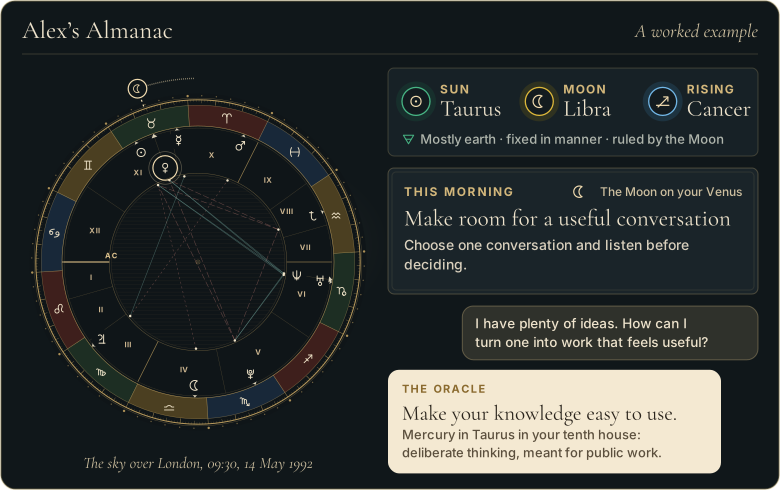
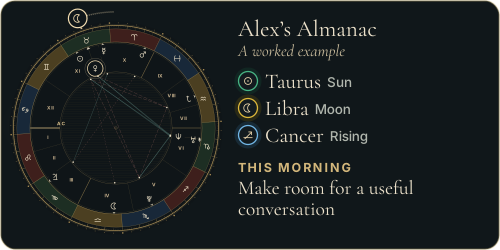
Walk through Alex’s whole example first
 The Road of AgesSee the turning points of your whole life, from your birth date
Free first look
The Road of AgesSee the turning points of your whole life, from your birth date
Free first look
Prefer to explore first?
 The Road of AgesThe turning points of your whole life, from your own chart
Walk my road
The Road of AgesThe turning points of your whole life, from your own chart
Walk my road
Visual guide
Progressions, and How They Differ From Transits
What a progression is
Secondary progression is a symbolic correspondence, not an observation: a day of the ephemeris after your birth is taken to describe a year of your life. If you were born on the first of a month, the chart for the second describes your first year, the chart for the thirty first your thirtieth. The Sun advances about a degree a year, the Moon about a degree a month, and the outer planets barely move at all, which is why almost all of the technique is Sun, Moon, Mercury, Venus and Mars. The sky itself did nothing on those days that had anything to do with you.
Why the progressed Moon carries most of it
A technique is useful when it moves at the speed of a life. The progressed Moon crosses a sign in about two and a half years and a house in about the same, which lines up with how long a chapter of a life tends to last. Practitioners read a progressed lunar ingress as a change of mood and of what a person needs, and the full progressed lunar return, at about twenty seven and a half years, as the closing of a whole cycle. Whether or not you hold the symbolism, that is a rhythm worth having a name for.
Where it differs from a transit
A transit is Saturn actually being at that degree, on that date, for everybody. A progression is a symbolic offset that exists only for you and only inside the method. That difference matters for how much weight each can carry: a transit can be checked against an ephemeris and predicted centuries out, while a progression can only be checked against the rule that made it. Most practitioners read them together, and the honest way to do so is to say which is which in every sentence, so a reader can tell the sky from the symbolism.
What the technique cannot do
It cannot predict events, and it does not become more reliable for being older or more intricate. There are also several competing progression methods, solar arc among them, which advance the chart differently and produce different answers for the same year; none can be shown to be correct. Used honestly, progression offers a way of naming the season a person is in and asking whether the description fits their own history. Used carelessly, it produces confident statements about a year that rest entirely on a correspondence somebody chose.
Concrete examples
| Example | What it means in practice |
|---|---|
| A progressed Moon ingress | Read as a change of season in what you need. Note the date and read it back in a year. |
| A progressed Sun changing sign | Roughly every thirty years. Slow enough that it describes a long arc rather than an event. |
| A progression and a transit at once | Say which is which. One is the sky, one is a symbolic clock, and they are not the same kind of claim. |
Prayerful reflection
Let me notice the season I am actually in rather than the one I have been telling people about.
Related Almanac guides
More from the journal
Sources and editorial method
Research and editorial references used for this page include:
- Astrodienst: Transits - Used for the basic definition of transits as current planetary passages over birth positions.
- Astrodienst: The four Elements - Used for the traditional grouping of zodiac signs by element.
This guide distinguishes traditional symbolism from calculated positions. Examples illustrate possible reflections, not predictions about a particular person.
From the reference page to your own chart
Every word here
is in your own chart.
- Your chart and numbers, read for you in about a minute
- Ask the Oracle anything about them
- Every personal tool and daily guidance
Free reading, no card needed. Optional membership: payment details required, 7 days free, then $12/month. Cancel before it renews and you pay nothing.
Common questions
Are progressions more accurate than transits?
They are a different kind of claim rather than a better one. A transit is an observable position; a progression is a symbolic correspondence that exists only inside the method that defines it.
How do I calculate my progressed chart?
Count your age in years, add that many days to your birth date, and cast a chart for that day. Most chart software does it for you, and will ask which progression method you want.
What is the progressed lunar return?
The moment the progressed Moon comes back to its natal degree, at about twenty seven and a half years of age and again near fifty five. It is read as the close of a long cycle rather than as an event.