Your Chart Ruler, and What It Actually Governs
The chart ruler is the planet that rules your rising sign. Wherever it sits becomes an unusually important room in the chart, which is why two people with the same rising can read so differently.
Direct answer
Short version
Find your rising sign, then the planet that rules it: Mars for Aries, Venus for Taurus and Libra, Mercury for Gemini and Virgo, the Moon for Cancer, the Sun for Leo, Jupiter for Sagittarius, Saturn for Capricorn, and either the traditional or the modern ruler for Scorpio, Aquarius and Pisces. That planet’s sign, house and condition describe how your whole approach to life is organised.

What does your own chart say about you?
Choose love, work or purpose for a personal insight and a useful next step. Your reading uses your own birth details.
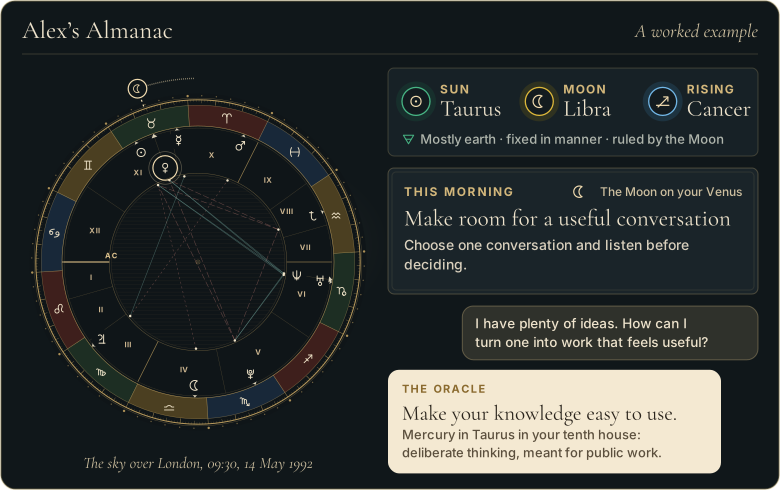
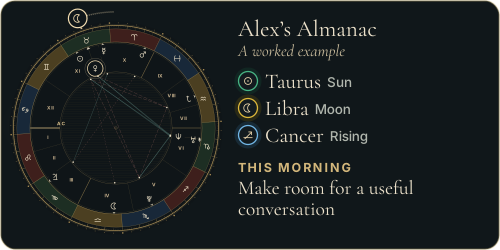
Walk through Alex’s whole example first
 The Road of AgesSee the turning points of your whole life, from your birth date
Free first look
The Road of AgesSee the turning points of your whole life, from your birth date
Free first look
Prefer to explore first?
 The Road of AgesThe turning points of your whole life, from your own chart
Walk my road
The Road of AgesThe turning points of your whole life, from your own chart
Walk my road
Visual guide
Your Chart Ruler, and What It Actually Governs
How the ruler is found
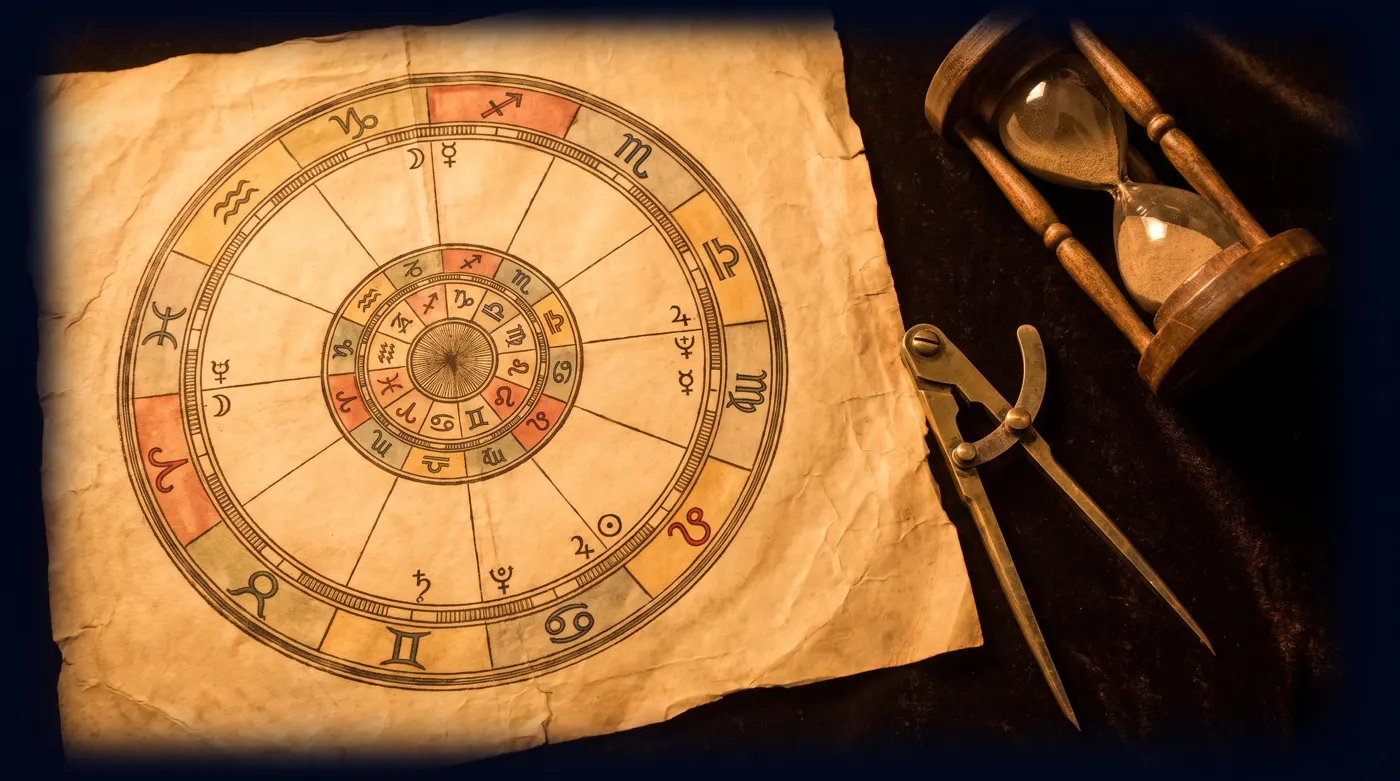
Every sign has a planet assigned to it, an arrangement that predates the discovery of the outer planets and was originally symmetrical around the Sun and Moon. The sign rising at your birth therefore hands the chart to one planet. If Virgo rises, Mercury is the chart ruler; if Capricorn rises, Saturn is. Because the rising sign changes roughly every two hours, so does the chart ruler, which is one of the clearest reasons a birth time matters: two people born on the same day in the same city can hand their charts to different planets entirely.
Why its position carries so much
The chart ruler is read as the manager of the whole chart rather than as one placement among ten. Wherever it sits becomes an unusually loaded room: a chart ruler in the ninth is read as a life organised around study, travel or belief, and one in the seventh as a life organised through partnership. The condition of that planet, its sign, its aspects, whether it is fast or slow, applies to the chart as a whole in a way that no other single placement does. This is why two people with the same rising sign can read so differently. The sign is shared; the ruler’s address is not.
Traditional and modern rulers disagree for three signs
Before Uranus, Neptune and Pluto were discovered, Scorpio was ruled by Mars, Aquarius by Saturn and Pisces by Jupiter. Modern practice reassigns them to Pluto, Uranus and Neptune, and many practitioners now read both. The consequence is concrete: a Scorpio rising has either Mars or Pluto as chart ruler, and those are different planets in different houses saying different things. Neither convention can be proved. What a reading owes its reader is to say which it used, and, where it matters, to read both and note where they agree.
What the chart ruler does not settle
It is not a second Sun sign and it does not override the rest of the chart. A well placed chart ruler does not make a life easy and a difficult one does not make it hard; the placement describes how a life is organised, not how it turns out. It also depends entirely on a birth time being right, so a chart ruler read from a remembered hour is a conclusion built on a guess. Where the time is uncertain, the honest move is to read the planets by sign and aspect first and leave the rulership question open until the hour can be checked.
Concrete examples
| Example | What it means in practice |
|---|---|
| Libra rising, Venus in the sixth | A life organised through daily work, service and the ordinary craft of keeping things running well. |
| Scorpio rising, read twice | Mars in one house and Pluto in another. Read both, say which you used, and note where they agree. |
| A birth time out by two hours | A different rising sign and a different chart ruler. This is the placement that a wrong hour destroys first. |
Prayerful reflection
Let me tend the part of my life that everything else seems to be organised around, rather than treating it as a distraction from the rest.
Related Almanac guides
More from the journal
Sources and editorial method
Research and editorial references used for this page include:
- Astrodienst: Transits - Used for the basic definition of transits as current planetary passages over birth positions.
- Astrodienst: The four Elements - Used for the traditional grouping of zodiac signs by element.
This guide distinguishes traditional symbolism from calculated positions. Examples illustrate possible reflections, not predictions about a particular person.
From the reference page to your own chart
Every word here
is in your own chart.
- Your chart and numbers, read for you in about a minute
- Ask the Oracle anything about them
- Every personal tool and daily guidance
Free reading, no card needed. Optional membership: payment details required, 7 days free, then $12/month. Cancel before it renews and you pay nothing.
Common questions
What if I do not know my birth time?
Then the rising sign, and therefore the chart ruler, cannot be determined. Read the planets by sign and aspect, which do not need the hour, and leave the rulership open rather than guessing.
Should I use traditional or modern rulership?
Either is defensible and only three signs are affected. Many practitioners read both for those signs and say so. What is not defensible is switching between them to get the answer you preferred.
Is the chart ruler more important than the Sun?
They answer different questions. The Sun describes what a person is developing; the chart ruler describes how the whole chart is organised and where a life keeps being run from.