A Discernment Practice for Daily Readings
A daily reading is worth what it forms in you. This is a short practice for testing one: four questions before, a weekly look back, and a clear line for when to stop.
Direct answer
Short version
Before reading, name the decision you actually face. After reading, ask four questions: does this increase honesty, does it leave responsibility with me, does it lead toward a reversible next step, and would somebody wise recognise the fruit as sober. Once a week, read the entries back. Anything that fails those questions repeatedly is not a reading you should keep.

What does your own chart say about you?
Choose love, work or purpose for a personal insight and a useful next step. Your reading uses your own birth details.
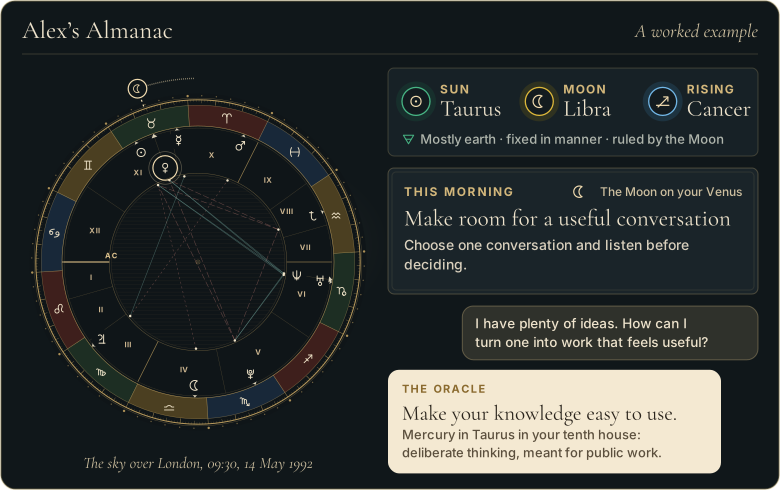
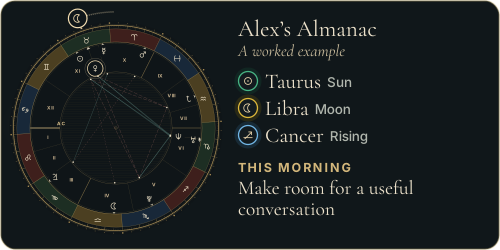
Walk through Alex’s whole example first
 The Road of AgesSee the turning points of your whole life, from your birth date
Free first look
The Road of AgesSee the turning points of your whole life, from your birth date
Free first look
Prefer to explore first?
 The Road of AgesThe turning points of your whole life, from your own chart
Walk my road
The Road of AgesThe turning points of your whole life, from your own chart
Walk my road
Visual guide
A Discernment Practice for Daily Readings
Name the question before you read
The most common failure in a daily practice is not a bad reading but a question written after the fact. If you open a reading with nothing specific in mind, whatever it says will find something to attach to, and afterwards you will remember having wondered about exactly that. Writing one sentence first, naming the decision or the pressure you are actually carrying, costs nothing and changes everything downstream: it gives the reading something it can fail to be about, which is the only condition under which it can genuinely be about something.
The four questions
Does this make me more honest about my situation, or does it give me a more comfortable story? Does it leave the responsibility with me, or does it hand it to a planet, a number or a season? Does it point toward a next step I could reverse, or does it push toward something irreversible on the strength of a symbol? And would somebody wise, who knows me and does not share my enthusiasm, recognise the effect as sober and grounded? A reading that passes all four is worth carrying into the day. One that fails the second or third should be put down where it stands.
The weekly look back
Once a week, read the last seven entries together. Count how often the reading matched, how often it did not, and how many days had nothing to report. That third number is what makes the other two mean anything. Then ask a harder question: across the week, did the practice make you more patient, more truthful and more likely to do the difficult thing, or more anxious, more superstitious and more likely to wait for a sign. Fruit accumulates weekly rather than daily, which is why the week and not the day is the right unit for this review.
When to put it down
There is a clear line and it is worth agreeing to in advance. If the practice starts producing fear, compulsive checking, a sense of superiority, or the postponement of decisions that need making, it has stopped serving you and should stop. The same applies if it begins to replace conscience, prayer, wise counsel or professional help where those are what the situation needs. Nothing about a symbolic practice is worth that cost, and any tradition worth its name says so about itself. Putting it down for a season is not a failure of faith in it; it is the practice working.
Concrete examples
| Example | What it means in practice |
|---|---|
| A reading that names a fear precisely | Useful. Write the fear down plainly and choose one reversible action toward it today. |
| A reading that tells you to wait | Ask what waiting costs and who it costs. Waiting is a decision, and a symbol should not make it for you. |
| Checking a reading four times in a day | The signal to stop. Compulsion is the clearest evidence a practice has turned. |
Prayerful reflection
Let me test what I read by what it makes of me, and let me be willing to put down anything that makes me smaller, harder or more afraid.
Related Almanac guides
More from the journal
Sources and editorial method
Research and editorial references used for this page include:
- Astrodienst: Transits - Used for the basic definition of transits as current planetary passages over birth positions.
- Astrodienst: The four Elements - Used for the traditional grouping of zodiac signs by element.
This guide distinguishes traditional symbolism from calculated positions. Examples illustrate possible reflections, not predictions about a particular person.
From the reference page to your own chart
Every word here
is in your own chart.
- Your chart and numbers, read for you in about a minute
- Ask the Oracle anything about them
- Every personal tool and daily guidance
Free reading, no card needed. Optional membership: payment details required, 7 days free, then $12/month. Cancel before it renews and you pay nothing.
Common questions
Is this a Christian practice?
The four questions are shaped by a tradition that judges a practice by its fruit, and they work for anyone who wants a symbolic practice to stay accountable. Nothing in them requires a particular belief to apply.
How long should the weekly review take?
Five minutes with seven short entries. If it takes longer than that you are probably writing essays rather than notes, and essays are harder to read back honestly.
What if the practice keeps failing the questions?
Then stop, at least for a season. A practice that produces fear, compulsion or avoidance is doing harm, and no reading is worth that. Coming back later with clearer limits is always available.