Genesis 1:14 and the Meaning of Signs and Seasons
Genesis 1:14 gives the lights a purpose: signs, appointed times, days and years. It is the verse quoted on both sides of the question, and it settles less than either side would like.
Direct answer
Short version
Genesis 1:14 says the lights in the expanse are for signs, for appointed times, for days and for years. The Hebrew rendered signs is othot, a mark or token; the word rendered seasons is moadim, appointed times, the same word used of the festivals. The verse gives the lights an office of marking time and meaning. It does not describe a method of reading them, and it neither licenses nor forbids one.

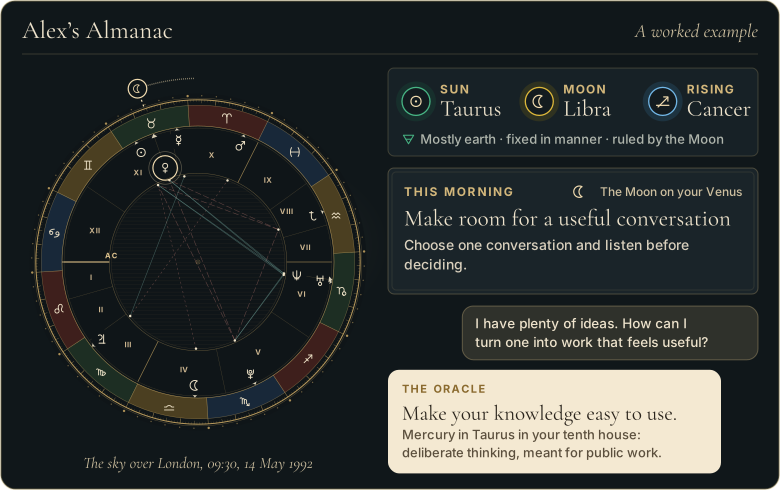
What does your own chart say about you?
Choose love, work or purpose for a personal insight and a useful next step. Your reading uses your own birth details.
Walk through Alex’s whole example first
 The Road of AgesSee the turning points of your whole life, from your birth date
Free first look
The Road of AgesSee the turning points of your whole life, from your birth date
Free first look
Prefer to explore first?
 The Road of AgesThe turning points of your whole life, from your own chart
Walk my road
The Road of AgesThe turning points of your whole life, from your own chart
Walk my road
Visual guide
Genesis 1:14 and the Meaning of Signs and Seasons
What the verse says
Genesis 1:14 sets the lights in the expanse to separate day from night and to serve as signs, as appointed times, and as markers of days and years. Othot is the ordinary Hebrew word for a mark or token, something that points beyond itself; it is used elsewhere of the rainbow and of the sabbath. Moadim means appointed times and names the festival calendar through the rest of the Pentateuch. Read plainly, the verse gives the sun, moon and stars a calendrical and significatory office: they mark when, and they mark that. It says no more, and every argument built on it has to supply the rest from elsewhere.
How it has been read
Jewish and Christian interpreters have read the verse across a wide range for two thousand years, and the range itself is the honest starting point. Many take it as establishing the calendar and nothing further, so that the lights are a clock and the appointed times are the festivals. Others, including patristic and medieval writers, allowed that the lights signify weather, season and the ordinary course of nature. A third reading, present in Christian astrological writing of the medieval and early modern period, extended signification to human affairs. These readings are not equally represented in the tradition, and anyone holding one should be able to say which it is and why.
What the verse does not settle
It does not describe a technique, name a zodiac, or authorise reading a person’s character or future from a chart. It also does not forbid the study of the sky, which is why quoting it as a prohibition proves as little as quoting it as a licence. The passages that bear directly on the question are elsewhere: Deuteronomy on divination, Isaiah and Daniel on those who consult the stars as an authority. Their concern is with treating the sky as a source of counsel in the place of God rather than with observing it. Whatever a reader concludes, the conclusion has to be argued rather than asserted from this one verse.
A test that outlives the argument
Scripture generally judges a practice by what it forms in a person. The question worth carrying is therefore not whether a verse can be made to permit something, but whether the practice produces humility, honesty, responsibility, patience and love of neighbour, or fear, pride, superstition and avoidance. That test can be applied this week by anybody, without settling a translation dispute first. It is also the test that has always separated attention to the sky as a created thing from dependence on it as an oracle, which is the distinction the difficult passages are actually about.
Concrete examples
| Example | What it means in practice |
|---|---|
| A verse quoted to end a conversation | Ask what it is being taken to establish, then read the next five verses aloud. The argument usually becomes more careful. |
| The calendrical reading | The least contested one: the lights mark days, years and appointed times, which is how the festivals were kept. |
| A practice that produces fear | Whatever the exegesis, that is the fruit test failing, and the tradition treats that result as decisive. |
Prayerful reflection
Let me hold the heavens as made rather than as mastering, and let me not use a verse to win an argument I have not honestly thought through.
Related Almanac guides
More from the journal
Sources and editorial method
Research and editorial references used for this page include:
- Astrodienst: Transits - Used for the basic definition of transits as current planetary passages over birth positions.
- Astrodienst: The four Elements - Used for the traditional grouping of zodiac signs by element.
This guide distinguishes traditional symbolism from calculated positions. Examples illustrate possible reflections, not predictions about a particular person.
From the reference page to your own chart
Every word here
is in your own chart.
- Your chart and numbers, read for you in about a minute
- Ask the Oracle anything about them
- Every personal tool and daily guidance
Free reading, no card needed. Optional membership: payment details required, 7 days free, then $12/month. Cancel before it renews and you pay nothing.
Common questions
Does Genesis 1:14 permit astrology?
It does not say. The verse gives the lights a role in marking signs, appointed times, days and years, and stops there. Both the permission and the prohibition have to be argued from other passages and from what a practice actually forms in a person.
What does the Hebrew word for signs mean?
Othot is the ordinary word for a mark or token, something that points beyond itself. It is used elsewhere of the rainbow and of the sabbath. It indicates; it does not by itself describe a method of interpretation.
What about the passages that condemn astrologers?
They are the serious part of the question. Isaiah and Daniel address consulting the stars as an authority in the place of God, and Deuteronomy addresses divination among the nations. Anyone who takes Genesis 1:14 seriously has to take those seriously too.