Aspects in Your Birth Chart, Explained
An aspect is an angle between two points in a chart, measured in degrees. Five of them do most of the work, and the tradition reads them as how two parts of a person get along rather than as good and bad news.
Direct answer
Short version
An aspect is the angular distance between two placements along the ecliptic. The conjunction is zero degrees, the sextile sixty, the square ninety, the trine one hundred and twenty, and the opposition one hundred and eighty. An aspect counts when the two points sit within a stated orb of that exact angle. Squares and oppositions are traditionally read as friction and sextiles and trines as ease, and neither is a verdict on a life.
What does your own chart say about you?
Choose love, work or purpose for a personal insight and a useful next step. Your reading uses your own birth details.
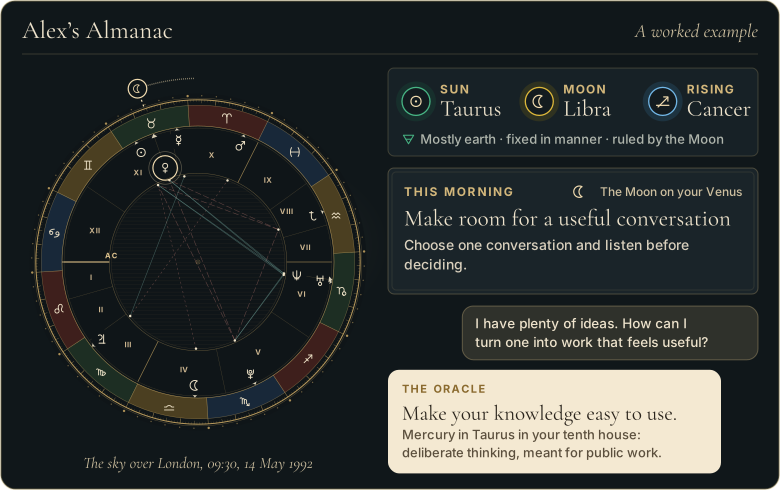
Walk through Alex’s whole example first
 The Road of AgesSee the turning points of your whole life, from your birth date
Free first look
The Road of AgesSee the turning points of your whole life, from your birth date
Free first look
Prefer to explore first?
 The Road of AgesThe turning points of your whole life, from your own chart
Walk my road
The Road of AgesThe turning points of your whole life, from your own chart
Walk my road
Visual guide
Aspects in Your Birth Chart, Explained
What an aspect measures
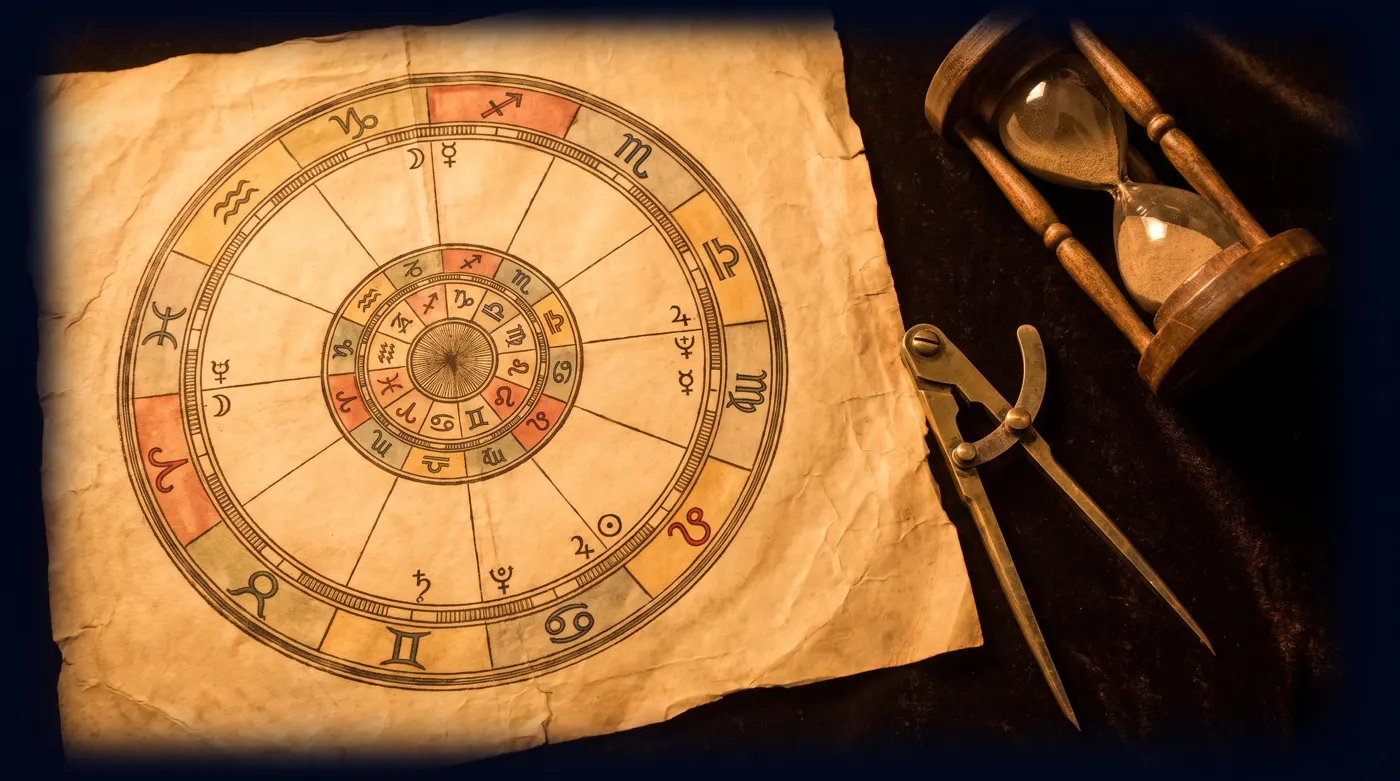
An aspect is geometry and nothing else: the number of degrees between two points as measured around the circle of the ecliptic. Because the circle is three hundred and sixty degrees, the angles that divide it evenly are the ones the tradition uses. Halving gives the opposition at one hundred and eighty, thirds give the trine at one hundred and twenty, quarters give the square at ninety, and sixths give the sextile at sixty. The conjunction, at zero, is two placements in the same part of the sky. That is the whole apparatus, and it is why the same five angles appear in traditions that otherwise disagree about almost everything.
The five that do most of the work
A conjunction fuses: two placements in one channel, hard to tell apart, and read according to what the two bodies are. An opposition puts two placements at either end of an axis and is read as awareness through contrast, often experienced through other people. A square sets two placements at right angles and is read as friction that has to be resolved by action. A trine is read as ease and flow, and a sextile as an opportunity that has to be taken up rather than one that arrives. Everything else in the aspect vocabulary is refinement on these.
Why an orb decides what counts
No two placements are ever at a perfect angle, so an aspect is a range rather than a point. The orb is the range you allow: within three degrees of exact, or six, or eight. That single choice decides how many aspects your chart appears to have, which means it decides how complicated your chart looks. Common practice allows a wider orb for the Sun and Moon and a narrower one for the outer planets, and tightens everything when reading transits. There is no correct number. There is only a stated number, kept consistently, so that two readings can be compared.
What a hard aspect is and is not
The older language of benefic and malefic still shapes how squares and oppositions are heard, and it misleads. A hard aspect describes two parts of a chart that do not naturally cooperate, and the traditional reading is that such a pairing demands effort and often produces skill. It is not a prediction of misfortune and it is not a flaw in the person. Charts full of easy aspects are not obviously better lives, and the practitioners who say so are usually the ones who have read a great many charts. What an aspect gives you is a description of an internal arrangement, not a forecast of what will happen to you.
Concrete examples
| Example | What it means in practice |
|---|---|
| Sun square Saturn within one degree | Tight, so it is read as a defining tension between effort and standard. Tightness is emphasis, and it is still not a forecast. |
| Venus trine Jupiter at seven degrees | Wide enough that many practitioners would leave it out. State your orb, and say when you have stretched it. |
| A chart with very few aspects | Uncommon but real, and it usually means the placements are spread evenly. The reading turns to signs, houses and rulers instead. |
Prayerful reflection
Let me not read friction in my chart as a fault in me, nor ease as a reason to coast.
Related Almanac guides
More from the journal
Sources and editorial method
Research and editorial references used for this page include:
- Astrodienst: Transits - Used for the basic definition of transits as current planetary passages over birth positions.
- Astrodienst: The four Elements - Used for the traditional grouping of zodiac signs by element.
This guide distinguishes traditional symbolism from calculated positions. Examples illustrate possible reflections, not predictions about a particular person.
From the reference page to your own chart
Every word here
is in your own chart.
- Your chart and numbers, read for you in about a minute
- Ask the Oracle anything about them
- Every personal tool and daily guidance
Free reading, no card needed. Optional membership: payment details required, 7 days free, then $12/month. Cancel before it renews and you pay nothing.
Common questions
How many aspects are there?
Five are used in almost every tradition: conjunction, sextile, square, trine and opposition. Many practitioners add minor angles such as the quincunx and the semisquare, which take tighter orbs and carry less weight.
Are square aspects bad?
No. They describe friction between two parts of a chart, and friction is where effort and skill usually come from. A chart of nothing but ease is not obviously a better life to live.
What orb should I use for natal aspects?
Common practice allows more for the Sun and Moon and less for the outer planets, often six to eight degrees for the luminaries and three to five for the rest. The discipline that matters is stating yours and keeping it.