
The Jupiter Return, and What a Twelve Year Cycle Marks
Jupiter comes back to its natal degree about every twelve years. The tradition reads the return as a widening rather than a windfall, and the difference between those two readings is most of what makes it useful.
Direct answer
Short version
Jupiter takes roughly eleven years and ten months to orbit the Sun, so it returns to its natal position at about twelve, twenty four, thirty six, forty eight, sixty and seventy two. The tradition associates it with scope, learning, generosity and confidence, and reads the return as a season for growth that still has to be chosen. It is not a promise of money, and reading it as one is how the cycle disappoints people.

What does your own chart say about you?
Choose love, work or purpose for a personal insight and a useful next step. Your reading uses your own birth details.
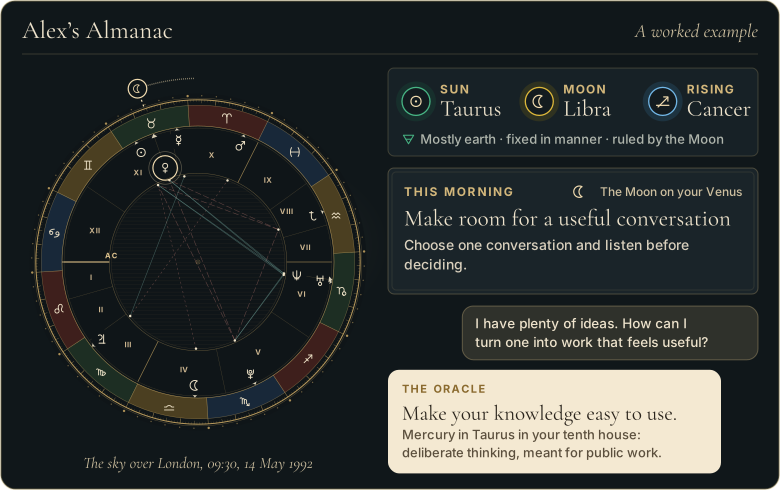
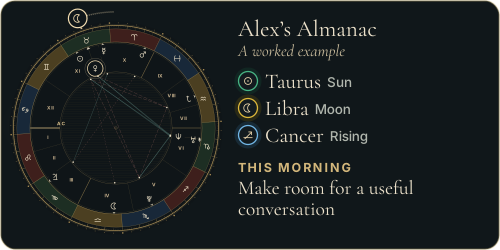
Walk through Alex’s whole example first
 The Road of AgesSee the turning points of your whole life, from your birth date
Free first look
The Road of AgesSee the turning points of your whole life, from your birth date
Free first look
Prefer to explore first?
 The Road of AgesThe turning points of your whole life, from your own chart
Walk my road
The Road of AgesThe turning points of your whole life, from your own chart
Walk my road
Visual guide
The Jupiter Return, and What a Twelve Year Cycle Marks
What a return actually is
A planetary return is the moment a transiting planet reaches the exact degree and minute it occupied at birth. For the Sun that happens once a year, which is a solar return; for the Moon it happens every month. Jupiter takes about eleven years and ten months, so the returns land near the ages of twelve, twenty four, thirty six and so on, drifting by months as the orbit does not divide evenly into years. Because Jupiter stations twice in most years, the return can be exact two or three times across several months rather than once, which is why practitioners speak of a return season rather than a return day.
Why Jupiter is read the way it is
Traditional astrology assigns Jupiter the significations of expansion, patronage, education, law, travel, generosity and faith, and calls it the greater benefic. Those associations are old and stable across several traditions, which is worth noting without treating it as proof. What they amount to in practice is a reading about scope: the sense that a field of life has become larger, that more is possible in it, and that the risk attached is overextension rather than scarcity. A return is read as that quality touching its own starting point again, which is why the tradition treats it as a natural place to begin something with room in it.
What a return does not deliver
It does not deliver money, an opportunity, or a change of circumstances, and no reputable practitioner should say otherwise. Expansion enlarges whatever is already present, which means a Jupiter return during a disciplined and prepared year and one during a chaotic year are not the same experience at all. The most common disappointment with this cycle comes from expecting the sky to supply something rather than to describe a season in which supplying it yourself might meet less resistance. Held that way, the reading is useful. Held the other way, it is a twelve year setup for a letdown.
Using a twelve year rhythm honestly
The practical value of a long cycle is perspective rather than prediction. Looking back at your previous Jupiter returns and asking what was actually happening then, in plain terms, will tell you more than any description of what the return is supposed to bring. Some people find a consistent theme; many find nothing legible, and that is a real result worth keeping. A cycle you only notice when it flatters you is not a cycle you are testing, and the honest version of this practice records the quiet returns as carefully as the memorable ones.
Concrete examples
| Example | What it means in practice |
|---|---|
| A first return at about twelve | Usually invisible as an event and legible only in hindsight: the year the world became larger than the household. |
| A return at thirty six with nothing obvious | The common case, and worth recording. The quiet ones are what keep the practice honest. |
| A return that coincides with an opportunity | Take the opportunity on its own merits. The sky did not underwrite it and cannot be blamed if it fails. |
Prayerful reflection
Let me use what widens rather than only enjoy it, and let me not wait twelve years for permission to begin.
Related Almanac guides
More from the journal
Sources and editorial method
Research and editorial references used for this page include:
- Astrodienst: Transits - Used for the basic definition of transits as current planetary passages over birth positions.
- Astrodienst: The four Elements - Used for the traditional grouping of zodiac signs by element.
This guide distinguishes traditional symbolism from calculated positions. Examples illustrate possible reflections, not predictions about a particular person.
From the reference page to your own chart
Every word here
is in your own chart.
- Your chart and numbers, read for you in about a minute
- Ask the Oracle anything about them
- Every personal tool and daily guidance
Free reading, no card needed. Optional membership: payment details required, 7 days free, then $12/month. Cancel before it renews and you pay nothing.
Common questions
How old am I at my Jupiter return?
Approximately twelve, twenty four, thirty six, forty eight, sixty and seventy two, though the exact dates drift by months because the orbit is not exactly twelve years long.
Is a Jupiter return lucky?
The tradition reads Jupiter as expansive rather than lucky, and expansion enlarges what is already there. A return in a prepared year and a return in a chaotic one are not the same experience.
How long does the return last?
Jupiter stays within a few degrees of its natal place for several months, and a station inside that orb can produce two or three exact passes across a year.