Reading a Chart for Someone Else, Carefully
Reading for another person is a different act from reading for yourself. What you say lands in a life you do not have to live in, and the practice that protects them protects you too.
Direct answer
Short version
Ask what they actually want to know before you look. Describe rather than predict, name your uncertainty out loud, and never say anything about health, death, pregnancy, or another person’s conduct. If they are in crisis, the right answer is not a chart. And a reading nobody asked for is not a gift.

What does your own chart say about you?
Choose love, work or purpose for a personal insight and a useful next step. Your reading uses your own birth details.
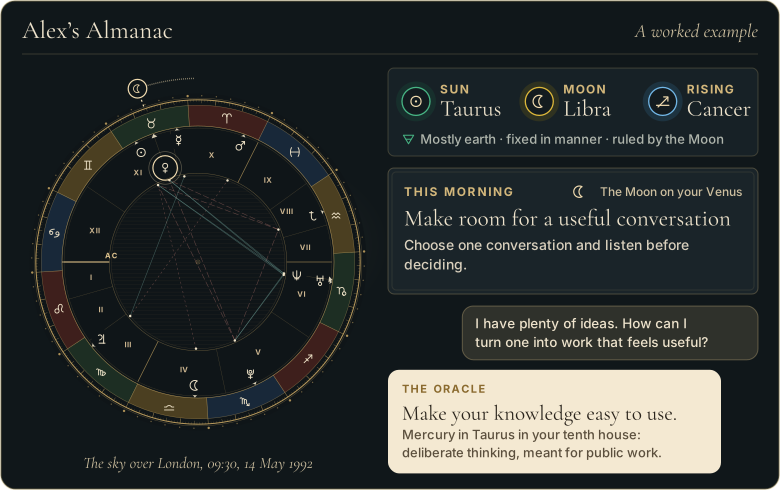
Walk through Alex’s whole example first
 The Road of AgesSee the turning points of your whole life, from your birth date
Free first look
The Road of AgesSee the turning points of your whole life, from your birth date
Free first look
Prefer to explore first?
 The Road of AgesThe turning points of your whole life, from your own chart
Walk my road
The Road of AgesThe turning points of your whole life, from your own chart
Walk my road
Visual guide
Reading a Chart for Someone Else, Carefully
Ask before you look
A reading given without a question becomes a performance, and a performance rewards the reader rather than the person in front of them. Asking first, in their own words, does three things: it tells you what they are carrying, it stops you answering something they never asked, and it makes the reading checkable afterwards. If the answer is "I do not know, just tell me what you see", that is worth noticing too. Somebody who wants to be described rather than helped is asking for something a chart cannot responsibly give.
What should never be said
Nothing about health, diagnosis or death, ever, whatever anybody thinks they see. Nothing about a pregnancy. Nothing that characterises a third party who is not present and cannot answer, which includes partners, parents and children whose charts have been handed to you along with the question. And nothing framed as certain about the future. These are not squeamishness. They are the boundaries a symbolic practice has to hold in order to stay a symbolic practice, and a reader who crosses them has stopped describing a chart and started making claims about a life.
Handling what you notice
You will sometimes see a hard configuration in a chart and feel the pull to name it dramatically. Resist it: name the theme plainly, say what it might ask for, and stop. If a person volunteers something painful and it seems to line up with what you were looking at, the useful move is to attend to what they said rather than to confirm it from the chart, which teaches them that the chart knew. It did not. And if you notice something you cannot say responsibly, you are allowed to keep it, which is a skill rather than a failure.
When to decline
Decline when the person is in crisis, when the question is medical, legal or financial, when they want the chart to make a decision for them, and when they are asking about somebody who has not consented. Declining well is short: say that a chart is not the right instrument for that, say what is, and stay in the conversation as a person. A reader who cannot say no is not offering a practice with limits, and a practice without limits is exactly the kind people are right to be wary of.
Concrete examples
| Example | What it means in practice |
|---|---|
| They ask what you see, with no question | Ask again, differently. A reading without a question tends to serve the reader. |
| They hand you a partner’s birth data | Read their side of it. The absent person did not agree to be described. |
| They ask about a diagnosis | Say plainly that a chart cannot answer that and that a doctor can. Then stay in the conversation. |
Prayerful reflection
Let me say less than I could and mean more of it, and let me not enjoy being the one who knows.
Related Almanac guides
More from the journal
Sources and editorial method
Research and editorial references used for this page include:
- Astrodienst: Transits - Used for the basic definition of transits as current planetary passages over birth positions.
- Astrodienst: The four Elements - Used for the traditional grouping of zodiac signs by element.
This guide distinguishes traditional symbolism from calculated positions. Examples illustrate possible reflections, not predictions about a particular person.
From the reference page to your own chart
Every word here
is in your own chart.
- Your chart and numbers, read for you in about a minute
- Ask the Oracle anything about them
- Every personal tool and daily guidance
Free reading, no card needed. Optional membership: payment details required, 7 days free, then $12/month. Cancel before it renews and you pay nothing.
Common questions
Can I read for a friend without training?
You can, and many people do. The boundaries in this article matter more than the technique: what you refuse to say protects your friend more than what you know allows you to say.
What if I see something worrying?
Name the theme plainly and stop, or keep it. A hard configuration is not an event, and dramatising one puts a thought in somebody’s head that you cannot take back out.
Should I charge for readings?
That is your decision and it does not change the boundaries. Being paid tends to add pressure to produce something impressive, which is the pressure this practice exists to resist.