The Part of Fortune, and Why It Changes by Day or Night
The Part of Fortune is a calculated point rather than a body. It is built from the Ascendant, Sun and Moon, its formula reverses between day and night births, and it moves a full circle every day.
Direct answer
Short version
For a day birth the Part of Fortune is the Ascendant plus the Moon minus the Sun. For a night birth the Sun and Moon change places in the formula. Because the Ascendant is part of it, the point moves about one degree every four minutes, so it needs an accurate birth time to be worth reading. The tradition reads it as where the body and circumstances find their ease.
What does your own chart say about you?
Choose love, work or purpose for a personal insight and a useful next step. Your reading uses your own birth details.
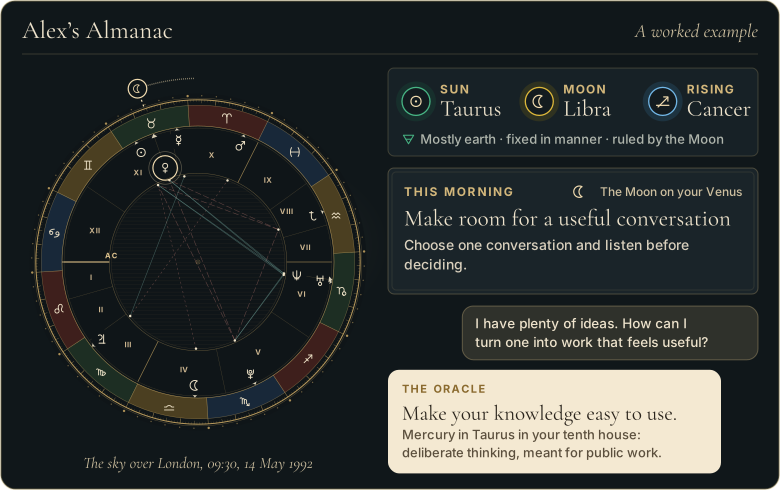
Walk through Alex’s whole example first
 The Road of AgesSee the turning points of your whole life, from your birth date
Free first look
The Road of AgesSee the turning points of your whole life, from your birth date
Free first look
Prefer to explore first?
 The Road of AgesThe turning points of your whole life, from your own chart
Walk my road
The Road of AgesThe turning points of your whole life, from your own chart
Walk my road
Visual guide
The Part of Fortune, and Why It Changes by Day or Night
What kind of thing it is
The Part of Fortune is one of the Arabic parts, also called lots, and it is arithmetic rather than astronomy. Nothing is there to observe: the point is derived by adding and subtracting three positions already in the chart. That does not make it meaningless, but it does change what kind of claim can be made about it. A planet is a body whose position can be checked against an ephemeris; a lot is a construction whose value depends entirely on the formula chosen. Traditions that use lots use dozens of them, and the Part of Fortune is simply the oldest and best attested.
Why the formula reverses at night
Traditional astrology divides charts by sect, into day charts where the Sun is above the horizon and night charts where it is below. Sect changes how several things are read, and for the lots it changes the arithmetic directly: the Sun and Moon exchange places in the formula. The reasoning is that the luminary in charge changes with sect, so the relationship the lot is meant to express has to be measured from the other one. The practical consequence is blunt. Two births an hour apart across sunrise can produce two Parts of Fortune in different signs and houses.
What the tradition reads in it
Hellenistic and medieval writers associate the Part of Fortune with the body, with livelihood, and with the circumstances a person finds themselves in rather than the choices they make. Later practice softened this toward ease, flow and a natural channel of good fortune. In either reading the house placement carries most of the weight: the Part of Fortune in the tenth is read through work and standing, in the fourth through home and family, in the sixth through daily work and health. It describes a channel rather than an amount, and no version of the tradition treats it as a promise of wealth.
Why the birth time decides everything here
The Ascendant sits inside the formula, so everything that is true of the Ascendant is true of this point. It moves about one degree every four minutes, a full circle in a day, and an hour of uncertainty puts it anywhere across fifteen degrees. That is enough to move it into another sign and frequently into another house, which is where its meaning is read. A Part of Fortune calculated from a remembered birth time is not information; it is a guess with decimal places. The honest options are to rectify the time, to read the point as provisional, or to leave it out and say so.
Concrete examples
| Example | What it means in practice |
|---|---|
| A day birth and a night birth an hour apart | Two different formulas and two different points. Sect is not a detail here; it is the calculation itself. |
| The Part of Fortune in the tenth house | Traditionally read as ease found through work and public standing. It describes a channel rather than an outcome. |
| A birth time known only to the hour | The point could be anywhere across fifteen degrees. Read it as provisional, or leave it out and say why. |
Prayerful reflection
Let me look for what actually sustains me rather than for what I have been told should.
Related Almanac guides
More from the journal
Sources and editorial method
Research and editorial references used for this page include:
- Astrodienst: Transits - Used for the basic definition of transits as current planetary passages over birth positions.
- Astrodienst: The four Elements - Used for the traditional grouping of zodiac signs by element.
This guide distinguishes traditional symbolism from calculated positions. Examples illustrate possible reflections, not predictions about a particular person.
From the reference page to your own chart
Every word here
is in your own chart.
- Your chart and numbers, read for you in about a minute
- Ask the Oracle anything about them
- Every personal tool and daily guidance
Free reading, no card needed. Optional membership: payment details required, 7 days free, then $12/month. Cancel before it renews and you pay nothing.
Common questions
Is the Part of Fortune a planet?
No. It is an arithmetic point derived from three positions, which is why it is called a lot or a part rather than a body. There is nothing at that degree to observe in the sky.
Why does the formula change for a night birth?
Because the traditional lots are built on sect, the division of charts into day and night. Exchanging the Sun and Moon keeps the relationship the lot expresses when the luminaries change roles.
Do modern astrologers use the reversal?
Practice is split. Many modern texts use the day formula for every chart while traditional practice reverses it. The two give different points, so a reading should say which convention it used.