
Astrological houses
Whole Sign Houses
Direct answer
Whole Sign Houses is a house system where the entire rising sign becomes the First House and each following sign becomes the next house.
Whole Sign Houses use one whole zodiac sign per house, beginning with the Ascendant sign.
$0 today, then $12/month after 7 days. Cancel anytime.
At a glance
- In astrology
- In Whole Sign Houses, the Midheaven degree can fall in the Ninth, Tenth, or Eleventh House rather than acting as the Tenth House cusp.
- Found in
- Houses
- Related
- Birth Chart, Zodiac, Transit
Whole Sign Houses use one whole zodiac sign per house, beginning with the Ascendant sign.
A structural orientation; exact placements depend on the chart or technique being discussed.
What does your own chart say about you?
Choose love, work or purpose. Your reading is written from your chart. Your reading uses your own birth details.
Walk through Alex’s whole example first


 The Road of AgesSee the turning points of your whole life, from your birth date
See your road's shape
Prefer to explore first?
 The Road of AgesThe turning points of your whole life, from your own chart
Walk my road
Free, by email
Your daily Almanac letter
One short letter at 7 each morning: the day’s theme read for your own chart, and one thing to do with it.
What sets Whole Sign Houses apart
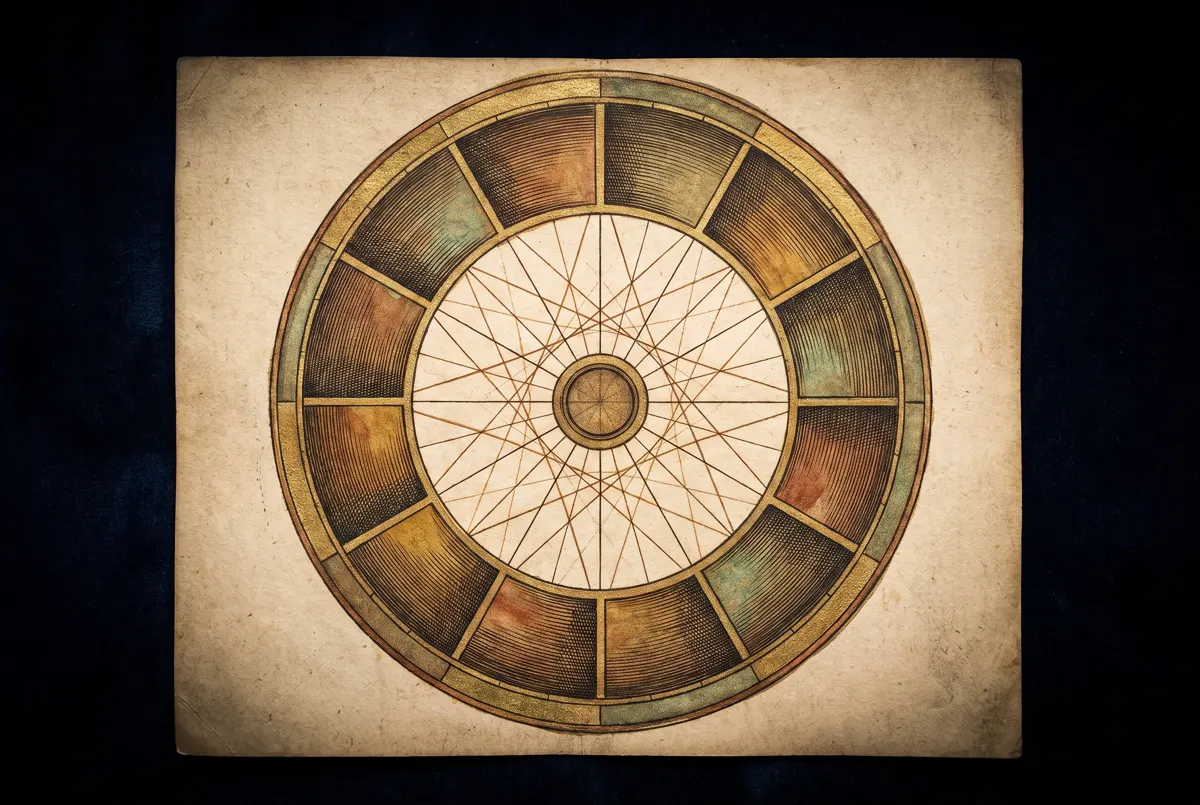
In whole sign houses the sign that holds the Ascendant is the first house in its entirety, and each next sign is the next house, so every house is exactly 30 degrees and starts at a sign boundary. The Ascendant degree can stand anywhere in the first house. It is the system found in the Hellenistic texts, such as the work of Vettius Valens, and it is still the house scheme of Indian astrology.
- House size: exactly 30 degrees, one sign each
- Cusps: all fall at 0 degrees of a sign
- First house: the whole rising sign, not only the degrees after the Ascendant
- Angles: the Midheaven falls in the 9th, 10th or 11th house, as the dictionary page explains
- Used in: Hellenistic texts such as Vettius Valens, and the Indian rashi chart
Often mistaken for something else: Equal houses are also 30 degrees but start at the Ascendant degree. Whole sign houses start at the sign boundary, so the Ascendant is not their first cusp.
A one-minute story
The Twelve Places
How the turning sky was cut into twelve places, and what each was read for.

The oldest house system
Whole sign houses are the original Hellenistic system. The entire sign that is rising becomes the first house, the next sign the second, and so on around the circle. A house is a whole sign, and the sign is the home of its ruler (Aries of Mars, Taurus of Venus). Only four points inside the chart carry extra weight: the Ascendant, the Midheaven, the Descendant and the Imum Coeli, the angles.
Reading a topic from a whole sign means the topic belongs to the sign, whatever degree the Midheaven falls in. Career is read from the tenth sign even if the Midheaven degree is in the ninth or eleventh sign. Benjamin Dykes calls these houses "places" in his translations of the medieval texts.
What the ancient sources call the houses
Different authors name the whole-sign places differently, and they do not always agree:
- Dorotheus (first century): the second house is the place of property, the eighth is the sign of death, the third is where the Moon rejoices, the fifth is the house of the child, the sixth and twelfth are the worst of the worst.
- Firmicus Maternus (fourth century): the eight places are life, hope or money, brothers, parents, children, health, spouse and death. The angles are the horoscope, the descendant, the midheaven and the imum caelum.
- Firmicus names the second place inferna porta, the infernal gate, and the eighth epicatafora. He groups the second, sixth, eighth and twelfth as places that do not see the Ascendant.
The ranking of the places in Dorotheus is its own surprise: best are the first, then the tenth, eleventh, fifth, seventh, fourth, and only seventh best is the ninth.
Why the word "house" is ambiguous in old books
Medieval Latin used the word domus for a sign as the home of a planet, and also for a house in the later quadrant sense. The word locus or place is ambiguous too, and Arabic numerals hide the choice. Dykes reads "10th" as the quadrant house, "10th domicile" as the whole sign and the spelled-out "tenth" as probably the whole sign.
His historical account is that the quadrant systems of Alchabitius, Porphyry, Placidus and Regiomontanus grew out of subdividing the angles. At first those divisions measured strength, not topics, and later they took over the topics too. By Bonatti's time the shift was well advanced and scholars still argue about when and why. Dykes's chronology is one account, and others differ in the details.
Whole sign against quadrant houses
The practical difference is in where the lines fall. In whole sign houses every cusp is zero degrees of a sign and the houses are exactly thirty degrees each, so there are no intercepted signs, and the system works at any latitude. In quadrant systems the houses are unequal, which means a planet five degrees before a cusp can be read as in the next house, and at high latitudes the system can fail.
The old systems agree on the angles even where the houses differ. If you want to see the effect on your own chart, compare the planets' houses in both, and notice that the Ascendant sign itself is the first house in one and only the opening degrees of the first house in the other.
The story behind Whole Sign Houses
Whole Sign Houses are widely associated with early Hellenistic astrology and have returned strongly in modern traditional practice.
The spiritual meaning of Whole Sign Houses
Spiritually, Whole Sign Houses ask what each sign governs as a complete room in the life.
Why Whole Sign Houses matters
Whole Sign Houses matter because they give a clean sign-based structure and often clarify topics quickly.
Whole Sign Houses in practice: an example
If Libra rises, all of Libra is the First House, Scorpio is the Second House, and Sagittarius is the Third House.
Where readings of Whole Sign Houses go wrong
It is a mistake to assume Whole Sign is less precise because it is simple. It is a different logic, not a shortcut.
Sources and editorial method
This entry summarizes the tradition in the Almanac's own words; where no source is listed, it is an editorial summary rather than a primary text, and symbolic readings are named as the tradition's, not as fact.
- Source
- The Great Almanac Dictionary
- Category
- Houses
- Last updated
- 2026-09-26
Read your Whole Sign chart
Whole Sign Houses in a book is one thing; Whole Sign Houses in your own birth chart is your life. The Oracle casts your real chart and tells you what it means for your love, your work, and your year ahead, in conversation. It opens with the 7-day Seeker trial.
Speak with the OracleHow Whole Sign Houses lives in your own chart across your year, in love, in work, in timing, is written in the Cosmic Codex: the whole year, once. Open the Cosmic Codex
Related terms
More in Houses
- Campanus Houses
- Empty House
- Horizon Axis
- House Topic
- Meridian Axis
- Planet in the Fourth House
- Planet in the Third House
- Succedent Houses
From the reference page to your own chart
Every word here
is in your own chart.
- A personal reading about love, work or purpose, written from your chart
- A practical next step to consider
- It opens with 7 days free, with the AI Oracle and daily guidance
$0 today, then $12/month after 7 days. Cancel anytime.
Common questions
What are Whole Sign Houses?
Whole Sign Houses is a house system where the entire rising sign becomes the First House and each following sign becomes the next house.
Where do Whole Sign Houses come from?
Whole Sign Houses are widely associated with early Hellenistic astrology and have returned strongly in modern traditional practice.
What do Whole Sign Houses mean in astrology?
In Whole Sign Houses, the Midheaven degree can fall in the Ninth, Tenth, or Eleventh House rather than acting as the Tenth House cusp.
What do Whole Sign Houses look like in a birth chart?
If Libra rises, all of Libra is the First House, Scorpio is the Second House, and Sagittarius is the Third House.
What do Whole Sign Houses mean spiritually?
Spiritually, Whole Sign Houses ask what each sign governs as a complete room in the life.
Free, by email
The Almanac, in your inbox at 7
One short letter at 7 each morning: the day’s theme read for your own chart, and one thing to do with it.


