Traditional astrology
House Almuten
Direct answer
Calculate the exact cusp longitude, list its domicile, exaltation, triplicity, term, and face rulers, award the method’s declared points, and total by planet. The highest score is the house almuten; ties and sect-dependent triplicity rules must be shown rather than hidden.
The almuten of a house is the planet receiving the highest total of essential-dignity points at that house’s cusp degree under a specified traditional scoring system. It may be the domicile ruler, but it need not be.
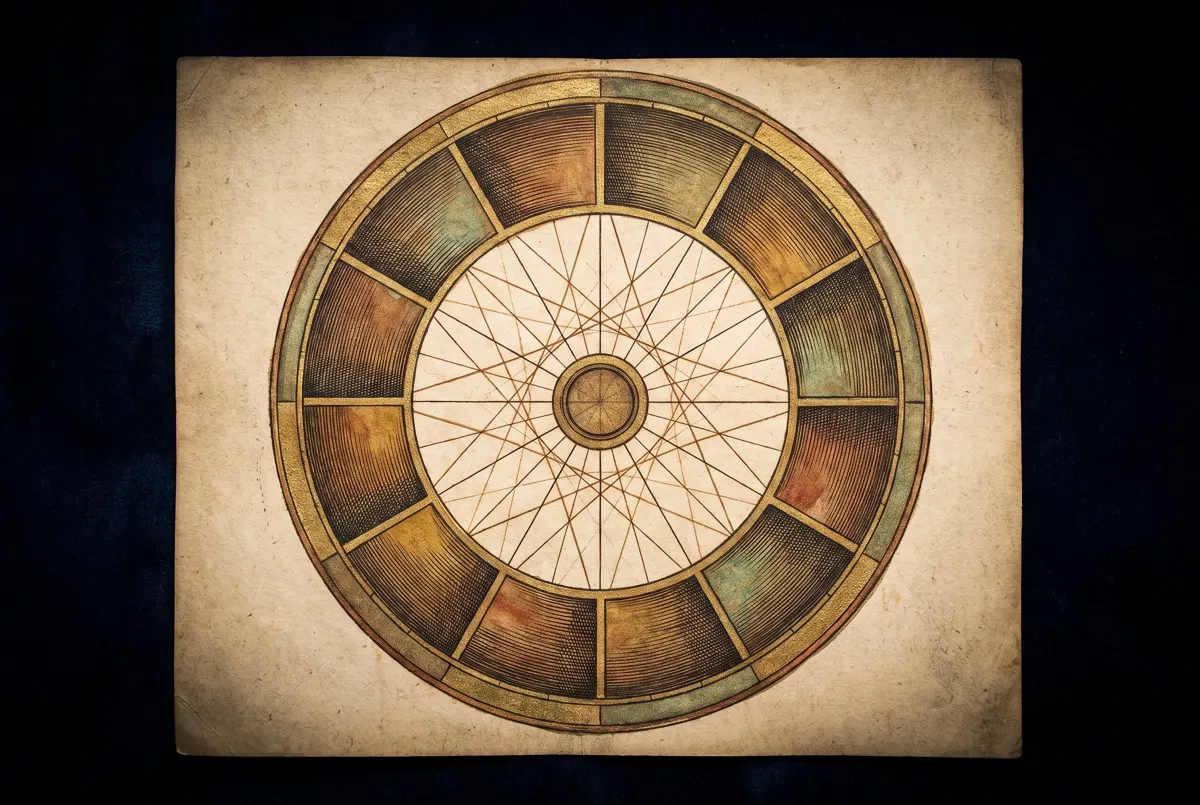
House Almuten means the planet with the strongest essential claim over a house or house cusp.
A structural orientation; exact placements depend on the chart or technique being discussed.Quick facts
| Dignity | Common score in a widely used scheme |
|---|---|
| Domicile | 5 points |
| Exaltation | 4 points |
| Triplicity | 3 points, with ruler choice depending on sect and table. |
| Term or bound | 2 points |
| Face or decan | 1 point |
The Instruments
Ten readings, worked out from your own birth chart
An instrument is a reading this house works out for you. Give your birth date, time and place once, and each one reads today’s real sky against the chart you were born under. Eight are personal; two are calendars anyone can open. A free account opens one instrument a day. The plans open every instrument, every day.
- Natal Chart Every planet, house and aspect in your chart
- Active Transits Where the planets are now, read against your chart
- Daily Counsel What to pursue today, and what to leave alone
- Personal Timing Your best days to decide, weeks ahead
- Fellowship Your chart and another, read side by side
- Theme of the Day The one thing today is asking of you
- Sacred Numbers Your life path, your cycles, your name in numbers
- Aeolian Harmonics Classical music chosen to match your chart
- Mercury Retrograde Every Mercury retrograde this year, with its dates Open to all
- Void-of-Course Moon When the Moon is between signs, hour by hour Open to all






Why the almuten can differ from the house lord
A house lord follows one rule: the domicile ruler of the cusp sign. An almuten compares several layers of dignity at the exact degree. Suppose a cusp falls in a place where one planet rules the sign but another holds exaltation, triplicity, and term. The second planet may accumulate more points and become almuten. This does not erase the domicile lord. Traditional judgment can consider both, with the ruler supplying baseline governance and the almuten indicating a planet with especially strong testimony at that degree.
A transparent scoring procedure
Record the cusp to degree and minute and select a table set: exaltation degrees or signs, Dorothean or Ptolemaic triplicity rulers, Egyptian or Ptolemaic terms, and a decan scheme. Determine whether the chart is diurnal or nocturnal when triplicity rulership depends on sect. Place every ruler and point award in a table, then sum by planet. Some authors include participating triplicity rulers or special qualifications; others do not. A result is reproducible only when these choices and the handling of ties are explicit.
How to judge the winning planet
After identifying the almuten, evaluate whether it can act: sign dignity or debility, house, angularity, sect status, combustion, retrogradation, speed, aspects, and reception all matter. Winning a points table does not automatically make a planet benefic, dominant, or successful. For a second-house almuten, its condition may describe stewardship of resources or the quality of support available to financial topics, but concrete wealth judgment still requires the house lord, occupants, relevant lots, and the broader chart rather than one score.
Cusp systems, ties, and terminology
Whole-sign practice may use the sign’s degree corresponding to the Ascendant for derived cusps, while quadrant systems supply distinct cuspal degrees; authors disagree. A birth-time change can therefore alter the dignity rulers. If planets tie, some methods prefer the one with additional accidental strength, stronger reception, or priority by dignity, while others report co-almutens. “Almuten figuris” or chart almuten is a separate multi-point calculation and should not be confused with a house almuten. The technique is traditional astrological judgment, not a scientifically validated measure. Preserve the worksheet because the visible score is part of the interpretation, not disposable arithmetic.
Sources and editorial method
Research and editorial references used for this page include:
- Astrodienst Astrowiki: Almuten - Overview of almuten scoring and related traditional terminology.
- Skyscript: Essential dignities - Traditional reference tables and explanation of domicile, exaltation, triplicity, term, and face.
These references support the factual, historical, textual, or interpretive claims on this page. Interpretive traditions are identified as such, and factual claims are kept separate from symbolic claims.
Related reading
Clarify your house map
House Almuten in a book is one thing; House Almuten in your own birth chart is your life. The Oracle casts your real chart and tells you what it means for your love, your work, and your year ahead, in conversation, free.
Speak with the OracleHow House Almuten lives in your own chart across your year, in love, in work, in timing, is written in the Cosmic Codex: the whole year, once. Open the Cosmic Codex
More in Houses
- House Topic
- Ninth House
- Planet in the Fourth House
- Planet in the Twelfth House
- Succedent Houses
- Angular Axis
- Cusp Ruler
- Empty Houses
Common questions
Is the house almuten always the sign ruler?
No. The sign ruler receives the largest single dignity score, but another planet can win by combining exaltation, triplicity, term, and face points.
Which dignity table should I use?
Use the tables belonging to the historical method you are following and name them. Switching tables after seeing the result undermines reproducibility.
What if two planets tie?
Report the tie first. If the chosen author provides a tiebreaker based on dignity or accidental strength, apply and cite that rule consistently.