Direct answer
Short version
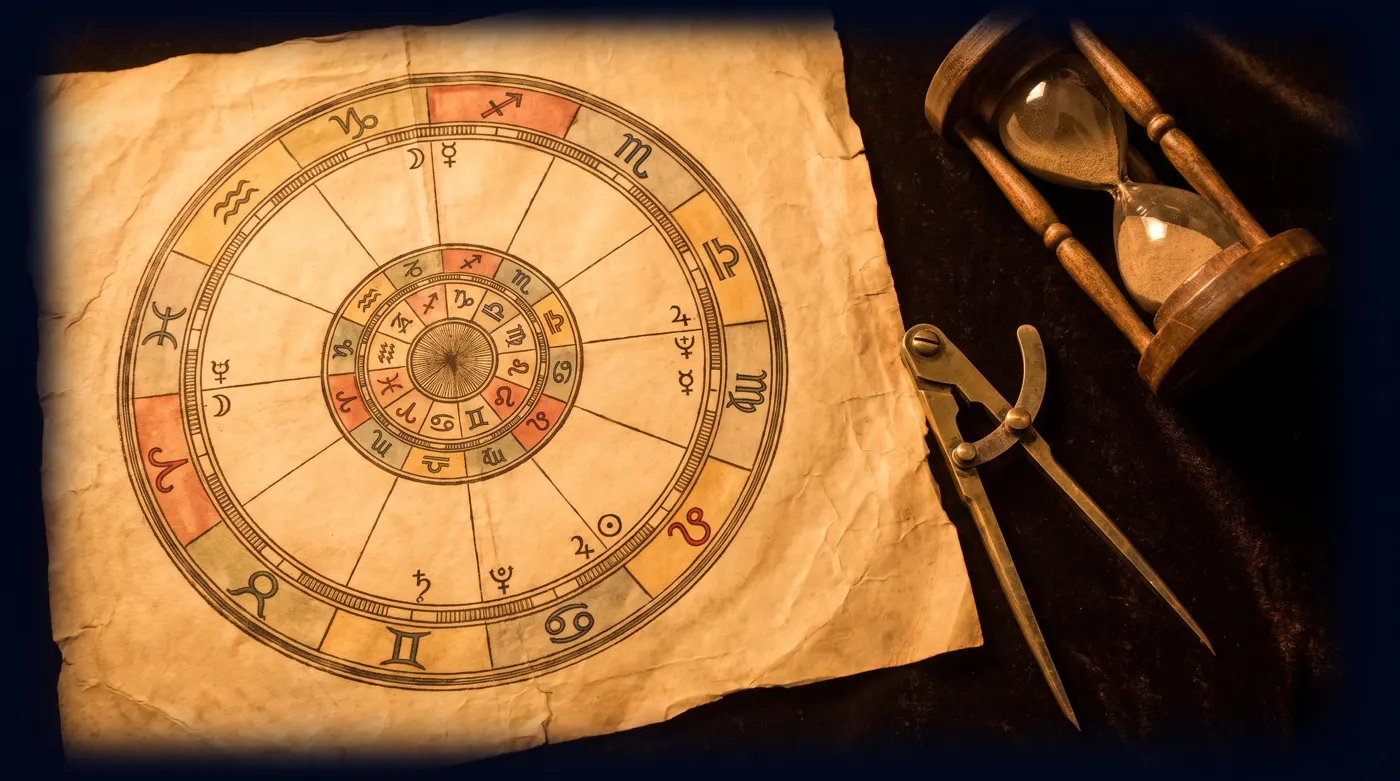
The Moon’s orbit is tilted about five degrees to the plane of Earth’s orbit, so it crosses that plane twice each month. Those two crossing points are the nodes, and they are where eclipses happen. In a birth chart they sit exactly opposite each other, and the tradition reads the North Node as the direction that does not come naturally and the South Node as the ground you already know.
What does your own chart say about you?
Choose love, work or purpose. Your reading is written from your chart. Your reading uses your own birth details.
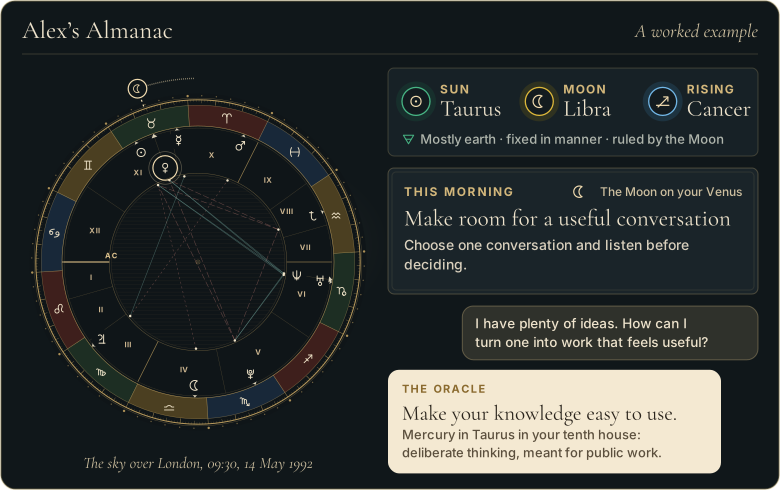
Walk through Alex’s whole example first
 The Road of AgesSee the turning points of your whole life, from your birth date
See your road's shape
The Road of AgesSee the turning points of your whole life, from your birth date
See your road's shape
Prefer to explore first?
 The Road of AgesThe turning points of your whole life, from your own chart
Walk my road
The Road of AgesThe turning points of your whole life, from your own chart
Walk my road
Free, by email
Your daily Almanac letter
One short letter at 7 each morning: the day’s theme read for your own chart, and one thing to do with it.
Visual guide
The North Node and South Node, Explained Plainly
What is actually there
Nothing physical. The nodes are geometric intersections, which is why they are drawn as a pair of symbols rather than a planet, and why they move backwards through the zodiac at a steady rate of about nineteen degrees a year, completing a cycle in roughly eighteen and a half years. Eclipses occur when a new or full Moon happens near one, which is the concrete fact underneath the symbolism.
The reading, stated carefully
The tradition treats the South Node as an inheritance: a set of abilities so familiar that you reach for them automatically, including when they are not what the situation needs. The North Node is the opposite point and is read as the growth direction, which by definition does not feel natural. Whether you accept that framing or not, the axis is at least a real geometric feature and not an invention.
The mistake almost everyone makes
Reading the South Node as a fault to be discarded. It is not. It is the thing you are good at, and abandoning competence in order to be more spiritually advanced is a bad trade that nobody actually completes. The useful reading is that the South Node is your resource and the North Node is where it is needed.
The nodal return
The nodes come back to their birth position roughly every eighteen and a half years, around nineteen, thirty seven, fifty six and seventy four. Those years often coincide with a change of direction, and the eclipses of that period fall on your own axis. It is a reasonable moment to ask whether you are still using your competence on something worth it.
Concrete examples
| Example | What it means in practice |
|---|---|
| South Node in the tenth, North in the fourth | Fluent in standing and achievement, asked to build something private that nobody applauds. |
| A nodal return at nineteen | Rarely dramatic and often the year a direction quietly gets chosen. |
| An eclipse on the axis | The tradition reads it as a marker. It is also, plainly, an eclipse, and both things can be said without inflating either. |
Prayerful reflection
Let me carry what I am good at toward the thing I am avoiding, rather than despising my own gifts for being easy.
Related Almanac guides
More from the journal
Sources and editorial method
Research and editorial references used for this page include:
- Astrodienst: Transits - Used for the basic definition of transits as current planetary passages over birth positions.
- Astrodienst: The four Elements - Used for the traditional grouping of zodiac signs by element.
This guide distinguishes traditional symbolism from calculated positions. Examples illustrate possible reflections, not predictions about a particular person.
From the reference page to your own chart
Every word here
is in your own chart.
- A personal reading about love, work or purpose, written from your chart
- A practical next step to consider
- It opens with 7 days free, with the AI Oracle and daily guidance
$0 today, then $12/month after 7 days. Cancel anytime.
Common questions
Are the nodes planets?
No. They are the two points where the Moon’s orbit crosses the ecliptic, which is why eclipses happen near them.
What is the difference between the true and mean node?
The true node is the actual instantaneous crossing point, which wobbles; the mean node is its smoothed average. They differ by a degree or so and most charts use one or the other consistently.
Should I work on my North Node?
Treat it as a direction rather than an instruction. Nothing in a chart obliges you to anything, and a growth direction pursued as a duty stops being growth.
Free, by email
The Almanac, in your inbox at 7
One short letter at 7 each morning: the day’s theme read for your own chart, and one thing to do with it.