
Direct answer
Short version
Mars conjunct natal Venus occurs when transiting Mars reaches Venus’s exact natal degree. It can sharpen chemistry, appetite, creativity, competition, and spending impulses; it does not establish mutual interest, justify pressure, or guarantee a relationship event.

Understand your own relationship patterns.
Explore what you need in love and a next step for your situation. Your reading uses your own birth details.
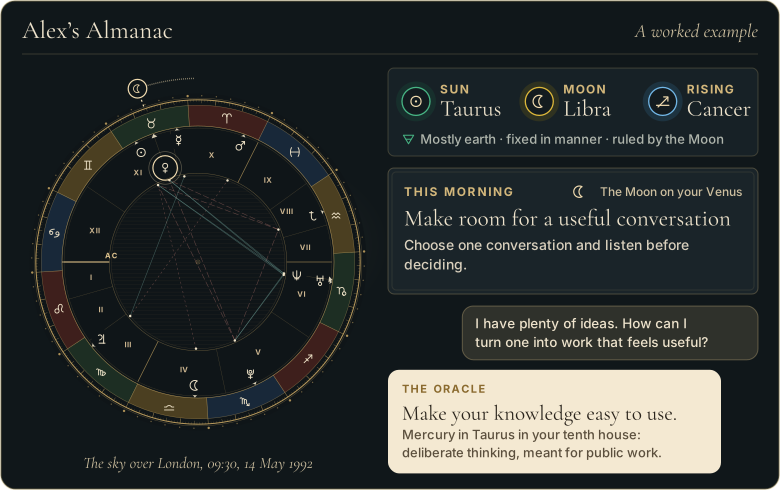
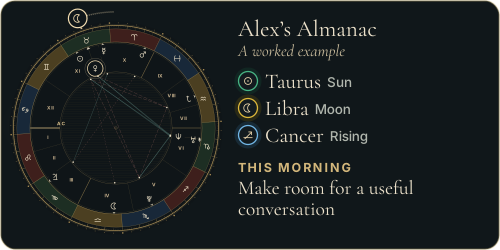
Walk through Alex’s whole example first
 The Road of AgesSee the turning points of your whole life, from your birth date
See your road's shape
The Road of AgesSee the turning points of your whole life, from your birth date
See your road's shape
Prefer to explore first?
 The Road of AgesThe turning points of your whole life, from your own chart
Walk my road
The Road of AgesThe turning points of your whole life, from your own chart
Walk my road
Free, by email
Your daily Almanac letter
One short letter at 7 each morning: the day’s theme read for your own chart, and one thing to do with it.
Quick facts
| Question | Reference answer |
|---|---|
| Geometry | 0 degrees; calculate it from exact zodiacal longitudes rather than sign labels alone. |
| Natal factor | Venus: natal Venus describes attraction, affection, reciprocity, pleasure, taste, money choices, social ease, and what a person treats as worth preserving. |
| Likely pace | Mars takes roughly two years to circle the zodiac, so the conjunction recurs on that broad rhythm. The strongest ordinary window is usually one to two weeks, while a Mars retrograde can extend or repeat the contact over a much longer period. |
| Best use | A reflective timing lens tested against circumstances, choices, and the rest of the chart. |
| Not evidence of | A guaranteed event, diagnosis, soulmate, moral judgment, or instruction to surrender consent and practical judgment. |
A one-minute story
The Wandering Stars
How the moving planets were watched, named and found, and what a transit is.

What Mars Conjunct Natal Venus actually means
A conjunction places the moving body at the same zodiacal longitude as the natal factor. Astrologers read it as concentration and merging: the transit does not replace the natal promise, but it puts sustained pressure and attention on that function. In this case, the moving factor is Mars, while the receiving natal factor is Venus: natal Venus describes attraction, affection, reciprocity, pleasure, taste, money choices, social ease, and what a person treats as worth preserving. That distinction matters because a transit describes a temporary relationship to a permanent birth-chart position; it does not rewrite the entire natal chart.
Begin with measured positions. Record the longitude of transiting Mars, the longitude of natal Venus, the exact angular distance, whether the transit is applying or separating, and any retrograde return. A sign-only match can be many degrees from exact. Most readers benefit from starting with a tight orb near one degree, then widening cautiously while noting the method used.
Constructive expression and pressure points
The constructive expression is value translated into action. A person may initiate a date, make art, negotiate directly, advocate for fair compensation, improve a space, or admit a desire that passive politeness had concealed.
The shadow is appetite without proportion: impulsive pursuit, jealousy, competitive seduction, conflict over taste, or spending for immediate gratification. Mars can make Venusian preference feel urgent even when no urgent decision exists.
In a Mars conjunction natal Venus reading, neither expression is a prediction. The symbolism can appear internally as a change in attention, relationally through another person, or externally through circumstances. Natal house, sign, rulerships, existing aspects, concurrent transits, age, culture, and actual biography determine which expression is plausible.
Relationships, work, and material decisions
Chemistry may become easier to express, but consent must remain explicit and freely given. In established partnerships the transit can revive play or expose differences in pace and desire. Neither intensity nor mutual attraction removes the need for care and communication.
For creative and financial matters, the transit favors making, pitching, editing, bargaining, or taking one visible step. Before buying or committing, ask whether the action serves a durable value or merely discharges temporary energy.
If Mars conjunction natal Venus accompanies a consequential choice, separate symbolic reflection from due diligence. Relationship questions require consent and observed conduct. Financial questions require figures, documents, and risk limits. Health, legal, and safety questions belong with qualified professionals. Astrology can organize questions; it cannot supply missing evidence.
Orb, exact dates, and duration
Mars takes roughly two years to circle the zodiac, so the conjunction recurs on that broad rhythm. The strongest ordinary window is usually one to two weeks, while a Mars retrograde can extend or repeat the contact over a much longer period.
For Mars conjunction natal Venus, use an ephemeris to list every exact pass in chronological order. The first pass may introduce a theme, a retrograde pass may reopen or revise it, and a final direct pass may coincide with integration, but that three-stage sequence is an interpretive convention rather than a rule. Note real events without forcing them to fit the story. Faster contacts from the Moon, Sun, Mercury, Venus, or Mars may briefly activate the background transit.
Worked chart example
Suppose natal Venus is at 5 degrees Leo in the tenth house and Mars reaches it. A public creative proposal, attraction at work, or compensation conversation may become difficult to ignore. The tenth house raises reputational consequences, so clarity and professional boundaries matter as much as courage.
A responsible interpretation of Mars conjunction natal Venus would show the degree and house first, then name two or three possible manifestations and one practical observation period. It would not claim to know which event must occur. If the birth time is uncertain, house-based claims and angles may be unreliable even when the planetary degree itself is usable.
A practical way to work with the transit
- Confirm the natal Venus degree and the time zone used for the birth chart.
- Calculate each exact Mars contact and mark whether it is applying, exact, separating, or returning by retrograde motion.
- Read the natal house and the houses ruled by the natal factor before assigning a life topic.
- Compare the symbolism with events and choices already present; do not invent a crisis to make the transit seem important.
- Choose one reversible experiment, conversation, boundary, record-keeping practice, or creative action suited to the actual situation.
- Review what happened after the exact pass and revise the interpretation when the evidence does not support it.
Astrological transit meanings belong to an interpretive tradition and are not scientifically validated causal claims. Precision in calculation does not turn symbolic interpretation into certainty.
Questions worth asking
- What value is asking for a concrete action?
- Can I express desire directly while leaving the other person fully free?
- Will this purchase or commitment still fit when the urgency passes?
Sources and editorial method
Research and editorial references used for this page include:
- Astrodienst Astrowiki: Transit - Defines a transit as a moving body aspecting a natal factor and discusses exactness, recurrence, and practical orb choices.
- Astrodienst: Swiss Ephemeris - Documents the high-precision planetary and lunar ephemeris used to calculate exact longitudes and aspect times.
- NASA Science: Mars Facts - Astronomical background on Mars and the orbital motion behind its recurring natal contacts.
Astronomical timing claims are grounded in ephemeris and space-science references. Interpretive meanings are identified as astrological tradition, presented as possibilities, and bounded against deterministic claims.
Related reading
From the transit to your own chart
The sky moves.
See where it lands in yours.
- A personal reading about love, work or purpose, written from your chart
- A practical next step to consider
- It opens with 7 days free, with the AI Oracle and daily guidance
$0 today, then $12/month after 7 days. Cancel anytime.
Common questions
What does Mars Conjunct Natal Venus mean?
Mars conjunct natal Venus occurs when transiting Mars reaches Venus’s exact natal degree. It can sharpen chemistry, appetite, creativity, competition, and spending impulses; it does not establish mutual interest, justify pressure, or guarantee a relationship event.
How long does Mars Conjunct Natal Venus last?
Mars takes roughly two years to circle the zodiac, so the conjunction recurs on that broad rhythm. The strongest ordinary window is usually one to two weeks, while a Mars retrograde can extend or repeat the contact over a much longer period. Exact duration depends on the orb chosen and the number of retrograde passes, so publish the actual dates rather than a universal promise.
What orb should I use for Mars Conjunct Natal Venus?
Start close to exact, around one degree, and state the orb explicitly. A wider orb can be used for observation, especially with slow bodies, but it should not be presented as an exact contact.
Does Mars Conjunct Natal Venus guarantee an event?
No. A transit is symbolic timing language. It cannot guarantee romance, separation, money, healing, crisis, or any other event, and it never overrides evidence, consent, or professional advice.
Related transits
Free, by email
The Almanac, in your inbox at 7
One short letter at 7 each morning: the day’s theme read for your own chart, and one thing to do with it.
