
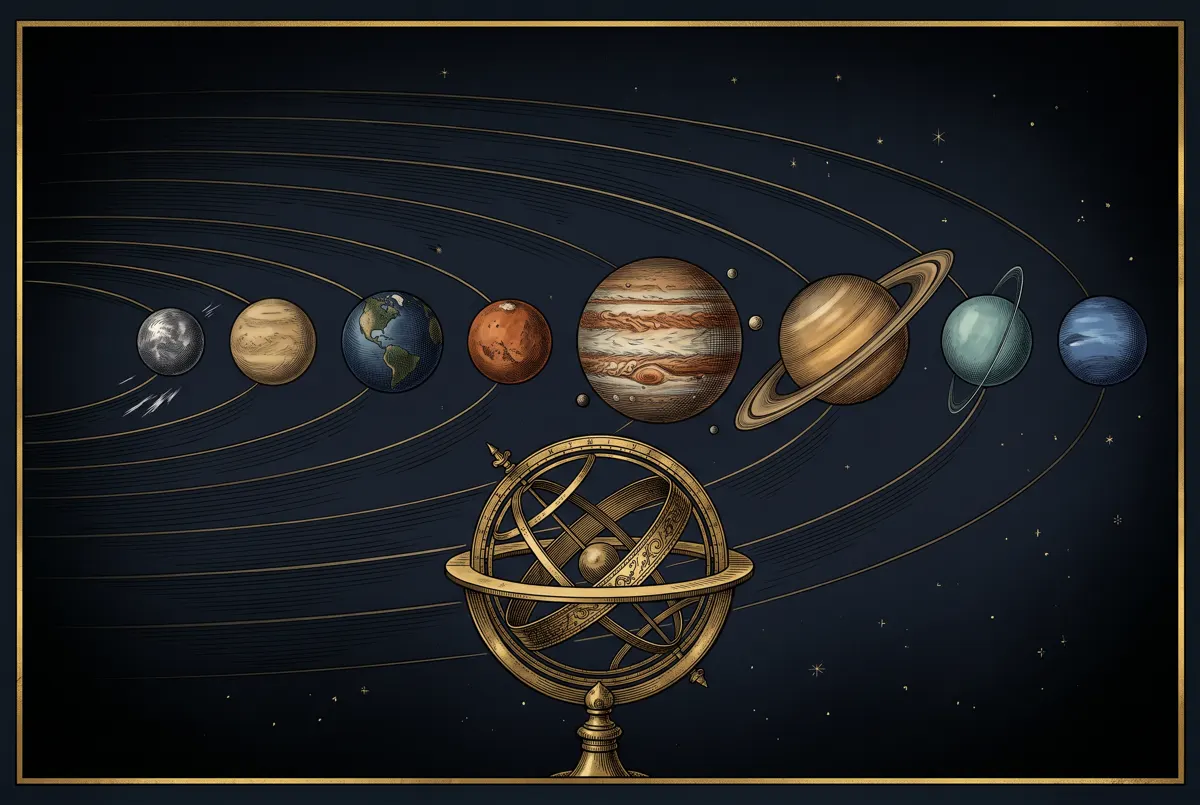
Planetary motion
Station Retrograde
Direct answer
The planet does not reverse its physical orbit. Retrograde motion is an apparent change produced by the moving vantage points of Earth and the other body. An exact station time depends on the coordinate system and ephemeris, while the broader “station period” depends on a chosen speed threshold.
A station retrograde is the calculated moment when a planet’s apparent geocentric motion in longitude changes from direct to retrograde. Around the station, its daily change becomes extremely small, so it seems nearly fixed against the zodiac.
$0 today, then $12/month after 7 days. Cancel anytime.
Quick facts
| Term | Precise meaning |
|---|---|
| Direct motion | Geocentric ecliptic longitude is increasing over time. |
| Station retrograde | Longitudinal speed reaches zero and changes from positive to negative. |
| Retrograde motion | Geocentric ecliptic longitude decreases for a period. |
| Station direct | Speed reaches zero again and changes from negative to positive. |
Station Retrograde marks the turn from forward motion into review.
The orbit map distinguishes physical bodies, calculated points, and symbolic cycles where possible.
What does your own chart say about you?
Choose love, work or purpose. Your reading is written from your chart. Your reading uses your own birth details.
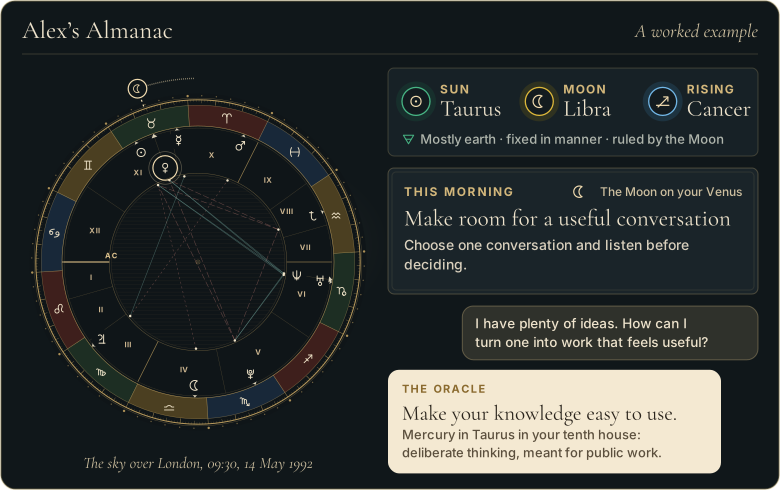
Walk through Alex’s whole example first
 The Road of AgesSee the turning points of your whole life, from your birth date
See your road's shape
The Road of AgesSee the turning points of your whole life, from your birth date
See your road's shape
Prefer to explore first?
 The Road of AgesThe turning points of your whole life, from your own chart
Walk my road
The Road of AgesThe turning points of your whole life, from your own chart
Walk my road
Free, by email
Your daily Almanac letter
One short letter at 7 each morning: the day’s theme read for your own chart, and one thing to do with it.
The astronomy behind a retrograde station
Planets normally drift eastward relative to the background stars when viewed from Earth, but their apparent paths periodically form loops or reversals. For an outer planet, Earth’s faster orbit changes the line of sight as Earth overtakes it. The planet then appears to move westward for a time, much as a slower vehicle can seem to slide backward when observed from a passing vehicle. Inner planets show retrograde near their inferior conjunctions through a different geometry of the same relative-motion principle.
A station is the turning point in the chosen apparent coordinate. In a longitude ephemeris, the instantaneous rate of geocentric ecliptic longitude becomes zero before changing sign. The body still travels continuously along its orbit; “stationary” and “backward” describe its projected position as seen from Earth. A telescope view across several nights reveals the slowing and reversal, not a physical halt in space.
A one-minute story
The Wandering Stars
How the moving planets were watched, named and found, and what a transit is.

Exact station time versus station period
An ephemeris may publish an exact station to the minute, found by solving for the time at which longitudinal speed crosses zero. Results can differ slightly if calculations use true versus apparent position, a different reference frame, light-time corrections, or another numerical ephemeris. Those small differences matter for reproducing a timestamp but rarely change the ordinary observation that the planet is moving exceptionally slowly around that date.
Astrologers also speak of a planet being “stationary” for hours or days on either side. That is not a second astronomical event; it is an interpretive window set by a speed threshold. Mercury’s visible change accelerates relatively quickly, whereas Pluto can remain near one longitude for much longer. A careful calendar distinguishes the exact reversal from the wider slow-motion interval and states whether dates are in UTC or a local time zone.
How astrologers interpret a station retrograde
In astrology, a station is often treated as an intensification because the planet concentrates near one degree and may make an aspect repeatedly. A station on a natal planet is therefore read through the transiting planet, the natal point, the aspect, houses, and exact dates. “Mercury stations retrograde” alone does not specify which life area is involved for an individual, and a collective station is not a guarantee that communications or devices will fail.
The familiar language of review, return, revision, or inwardness is symbolic. It can offer a planning prompt, but it should not replace the actual evidence relevant to a decision. When a slow planet stations three times across an aspect because of direct-retrograde-direct passes, astrologers may treat the sequence as an unfolding process. Record each exact pass rather than blending an entire season into one undifferentiated influence.
How to verify a listed station
Check the body, date, time standard, zodiac, and reference center. Most astrological station tables are geocentric and tropical, while an astronomical service may return right ascension, declination, or vectors unless ecliptic longitude is requested. Sample positions before and after the listed time: longitude should increase, flatten, and then decrease for a retrograde station. Take care at the 359-to-0-degree boundary, where naive subtraction can falsely report a reversal.
High-quality ephemerides such as JPL Horizons expose their assumptions and output settings. Astrology software may use another respected numerical source and round displayed longitudes, so a planet can look motionless for several printed rows. Verify with unrounded speed before declaring the station erroneous. The astronomical event is calculable; any personal meaning belongs to an interpretive framework rather than the mechanics themselves.
What sets Station Retrograde apart
This is the first station, the instant the planet's longitude stops increasing and begins to decrease. It opens the loop, so the degree where it happens becomes the upper end of the retrograde arc and the mark that the post-shadow later returns to. From here the planet gains speed backward, reaches its fastest retrograde motion near the middle of the loop, and slows toward the second station.
- Also called: first station, or the station to retrograde
- What turns: longitude changes from increasing to decreasing
- Arc opened: the degrees the planet will cover backward, from this point to the second station
- Midpoint of the loop: opposition to the Sun for Mars, Jupiter and Saturn, inferior conjunction for Mercury and Venus
- Abu Ma'shar: counts the first station among the eight properties of a superior planet's cycle (Abbreviation II.17 to 21)
Often mistaken for something else: Station retrograde is a single moment. Mercury Retrograde and the others name the weeks or months that follow it, until the second station.
The first station
The first station is the point where a planet appears to stop before it begins to move backward. Abu Ma'shar reads it as dissolution. Retrograde motion itself he reads as disobedience, turning back and discord, and Dorotheus says retrograde brings difficulty.
In al-Qabisi's account of the superior planets, the stretch from the first station to opposition is eastern retrograde, and from opposition to the second station western retrograde.
What retrograde weakens
Ptolemy lists retrograde with occidental and slow as the signs of a weak planet, and oriental, swift and direct as the signs of a strong one. Al-Qabisi splits the retrograde stretch of a superior planet into two halves, eastern retrograde from the first station to opposition and western retrograde from opposition to the second station.
Sources and editorial method
Research and editorial references used for this page include:
- NASA Night Sky Network: Mars retrograde motion - Illustrated explanation of apparent retrograde motion from Earth’s moving viewpoint.
- NASA JPL: Horizons system manual - Technical reference for generating positions, coordinate quantities, and ephemerides.
These references support the factual, historical, textual, or interpretive claims on this page. Interpretive traditions are identified as such, and factual claims are kept separate from symbolic claims.
Related reading
Pause before the review begins
Station Retrograde in a book is one thing; Station Retrograde in your own birth chart is your life. The Oracle casts your real chart and tells you what it means for your love, your work, and your year ahead, in conversation. It opens with the 7-day Seeker trial.
Speak with the OracleThe Cosmic Codex reads a whole year of transits against your own chart, Station Retrograde included where it touches your love, your work, your timing. Open the Cosmic Codex
More in Transits & Cycles
- Transit Peak
- Waning Moon
- Combustion
- Ingress Chart
- Lunar Trigger
- Nodal Axis
- Planetary Station
- Return Chart
From the reference page to your own chart
Every word here
is in your own chart.
- A personal reading about love, work or purpose, written from your chart
- A practical next step to consider
- It opens with 7 days free, with the AI Oracle and daily guidance
$0 today, then $12/month after 7 days. Cancel anytime.
Common questions
Does a planet stop in space at a station?
No. Its orbit continues. The apparent geocentric longitude briefly stops changing direction because Earth, the planet, and the line of sight are moving relative to one another.
Why do station times differ between calendars?
Time zones, rounding, ephemeris choices, and the definition of apparent position can shift a published timestamp. Compare all settings before deciding that one is wrong.
Is a planet retrograde for the whole station day?
The exact change of direction occurs at one calculated moment. “Station day” or “station period” is a broader convention describing unusually slow apparent motion.
Free, by email
The Almanac, in your inbox at 7
One short letter at 7 each morning: the day’s theme read for your own chart, and one thing to do with it.
