
Timing and cycles
Planetary Station
Direct answer
Planetary Station is the period when a planet appears to pause before changing from direct to retrograde motion or from retrograde to direct motion.
A Planetary Station is the apparent pause before a planet changes direction.
$0 today, then $12/month after 7 days. Cancel anytime.
At a glance
- In astrology
- A station is based on apparent speed: the planet seems to slow, stop, and then change direction in zodiacal longitude.
- Found in
- Transits & Cycles
- Related
- Birth Chart, Zodiac, Transit
A Planetary Station is the apparent pause before a planet changes direction.
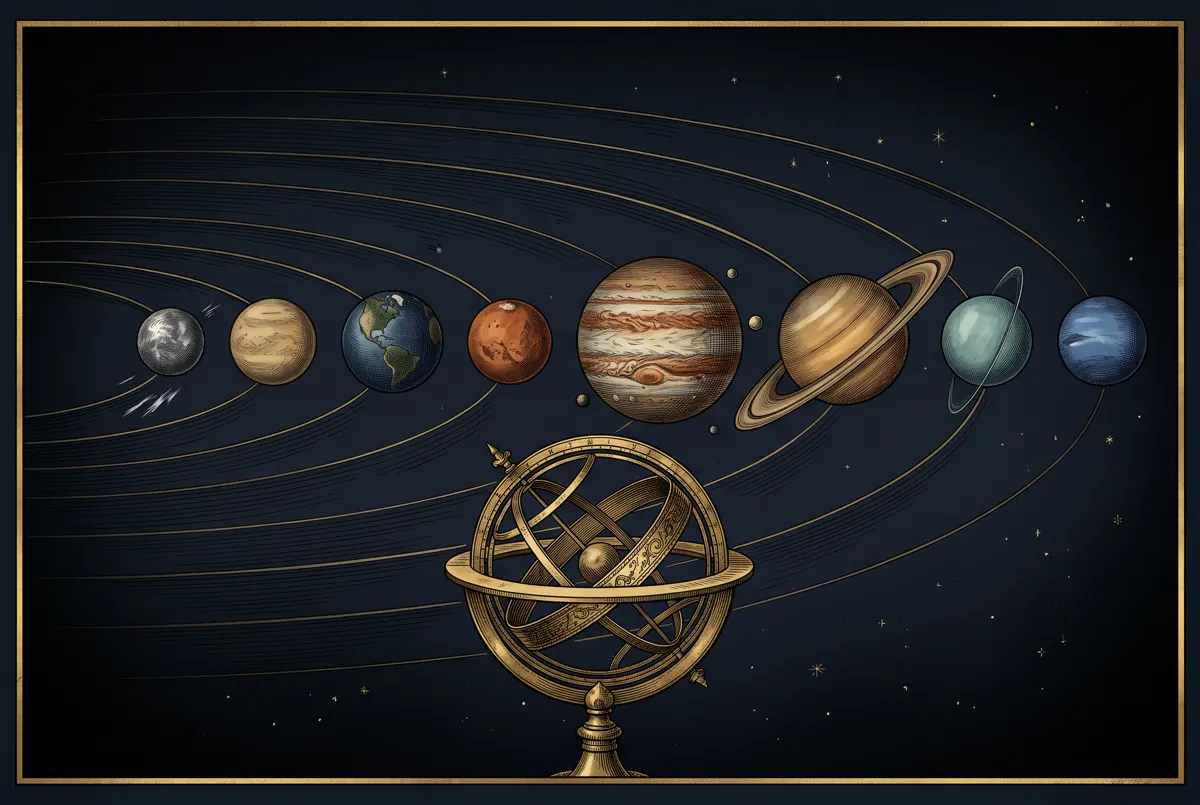
The orbit map distinguishes physical bodies, calculated points, and symbolic cycles where possible.
What does your own chart say about you?
Choose love, work or purpose. Your reading is written from your chart. Your reading uses your own birth details.
Walk through Alex’s whole example first


 The Road of AgesSee the turning points of your whole life, from your birth date
See your road's shape
Prefer to explore first?
 The Road of AgesThe turning points of your whole life, from your own chart
Walk my road
Free, by email
Your daily Almanac letter
One short letter at 7 each morning: the day’s theme read for your own chart, and one thing to do with it.
What sets Planetary Station apart
A station is a point in time when the planet's speed in zodiacal longitude falls to zero, so it neither gains nor loses degrees from one day to the next. It is a stop in longitude only: the planet still turns with the sky each day and may still shift in latitude. Each retrograde loop holds exactly two stations, one at each end, and Ptolemy's Almagest (Book XII) treats both as part of the one theory of retrogradation.
- Speed at a station: zero in longitude, shown as 0 degrees 0 minutes a day in an ephemeris
- Per retrograde loop: two stations: first (to retrograde) and second (to direct)
- Mercury: usually three retrograde loops a year, so six stations
- Ptolemy, Tetrabiblos I.8: divides a planet's cycle by first emergence, first station, opposition, second station, occultation
- Abu Ma'shar: reads the first station as dissolution and the second as hope renewed
Often mistaken for something else: A station is the stop. Retrograde is the whole backward stretch between two stations, and direct motion is the forward stretch outside it.
A one-minute story
The Wandering Stars
How the moving planets were watched, named and found, and what a transit is.

Stations in the traditional sources
A station is the moment a planet appears to stop before turning. Abu Ma'shar gives each station a meaning: the first station, when a planet is about to go retrograde, means dissolution, and the second, when it is about to go direct, means hope renewed. Retrograde motion between them means disobedience, turning back and discord.
Ptolemy ties the stations to the planet's phases, and al-Qabisi to its ages: a planet from emergence to its first station is moist, in childhood; from the station to opposition hot, in youth; from opposition to the second station dry, in completed age; and from the second station to its disappearance cold, in senility.
Strength and motion
Ptolemy says a planet is strong when it is oriental, swift and direct, and weak when it is occidental, slow and retrograde. Abu Ma'shar calls a superior planet moving faster than its average increasing in course. Dorotheus says retrograde brings difficulty.
Abu Ma'shar also lists mean daily motions: the Moon about 13 degrees 10 minutes, the Sun and Mercury and Venus about 59 minutes, Mars 31 minutes, Jupiter 5 minutes and Saturn 2 minutes (the text is partly damaged).
The story behind Planetary Station
Traditional astrologers watched stations closely because they marked visible changes in planetary motion and strength.
The spiritual meaning of Planetary Station
Spiritually, Planetary Station asks what is pausing because the direction is about to change.
Why Planetary Station matters
Planetary Station matters because a stationary planet can feel concentrated, loud, delayed, or unusually important in timing work.
How to read Planetary Station
stations to identify turning points, peak emphasis, stalled processes, and moments applies when a planetary theme hangs in the air.
Planetary Station in practice: an example
Mercury stationing direct on a natal Moon may bring a communication or emotional decision to a turning point.
Where readings of Planetary Station go wrong
It is a mistake to read the station without checking the planet, house, aspects, and whether it contacts the natal chart.
Sources and editorial method
This entry summarizes the tradition in the Almanac's own words; where no source is listed, it is an editorial summary rather than a primary text, and symbolic readings are named as the tradition's, not as fact.
- Source
- The Great Almanac Dictionary
- Category
- Transits & Cycles
- Last updated
- 2026-09-26
Notice your turning points
Planetary Station in a book is one thing; Planetary Station in your own birth chart is your life. The Oracle casts your real chart and tells you what it means for your love, your work, and your year ahead, in conversation. It opens with the 7-day Seeker trial.
Speak with the OracleThe Cosmic Codex reads a whole year of transits against your own chart, Planetary Station included where it touches your love, your work, your timing. Open the Cosmic Codex
Related terms
More in Transits & Cycles
- Retrograde Shadow
- Station Retrograde
- Transit Peak
- Waning Moon
- Combustion
- Ingress Chart
- Lunar Trigger
- Nodal Axis
From the reference page to your own chart
Every word here
is in your own chart.
- A personal reading about love, work or purpose, written from your chart
- A practical next step to consider
- It opens with 7 days free, with the AI Oracle and daily guidance
$0 today, then $12/month after 7 days. Cancel anytime.
Common questions
What is Planetary Station?
Planetary Station is the period when a planet appears to pause before changing from direct to retrograde motion or from retrograde to direct motion.
Where does Planetary Station come from?
Traditional astrologers watched stations closely because they marked visible changes in planetary motion and strength.
What does Planetary Station mean in astrology?
A station is based on apparent speed: the planet seems to slow, stop, and then change direction in zodiacal longitude.
What does Planetary Station look like in a birth chart?
Mercury stationing direct on a natal Moon may bring a communication or emotional decision to a turning point.
What does Planetary Station mean spiritually?
Spiritually, Planetary Station asks what is pausing because the direction is about to change.
Free, by email
The Almanac, in your inbox at 7
One short letter at 7 each morning: the day’s theme read for your own chart, and one thing to do with it.


