Retrograde Planets in a Birth Chart
Roughly a fifth of all planetary placements are retrograde at any moment, so a retrograde planet in a chart is ordinary. The tradition reads it as inward rather than broken.
$0 today, then $12/month after 7 days. Cancel anytime.
Direct answer
Short version
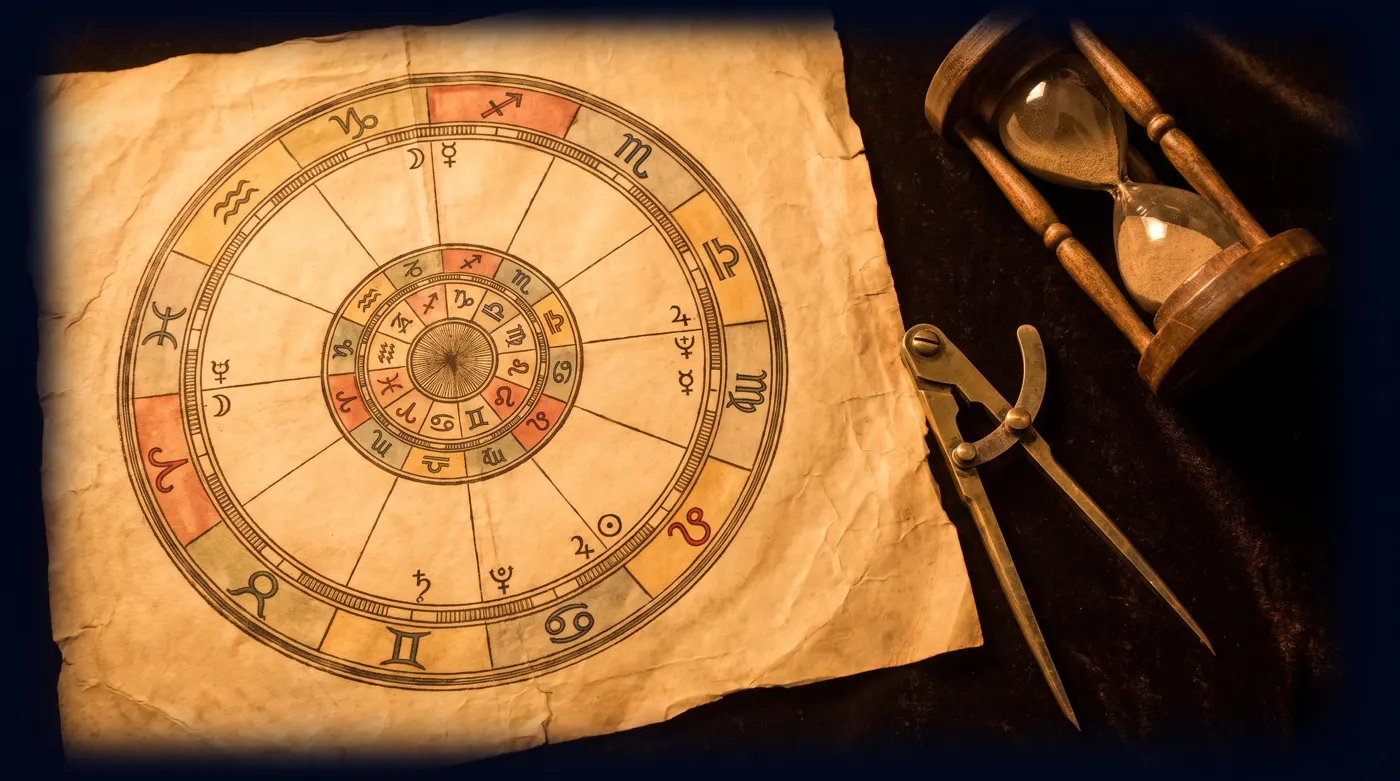
A natal retrograde means that from Earth the planet appeared to be moving backwards on the day you were born. It is an apparent motion caused by the relative speeds of two orbits. Traditionally it is read as a function that runs inward first, is slower to express outwardly, and is often reconsidered before it is acted on. It is common, and it is not a fault.

What does your own chart say about you?
Choose love, work or purpose. Your reading is written from your chart. Your reading uses your own birth details.
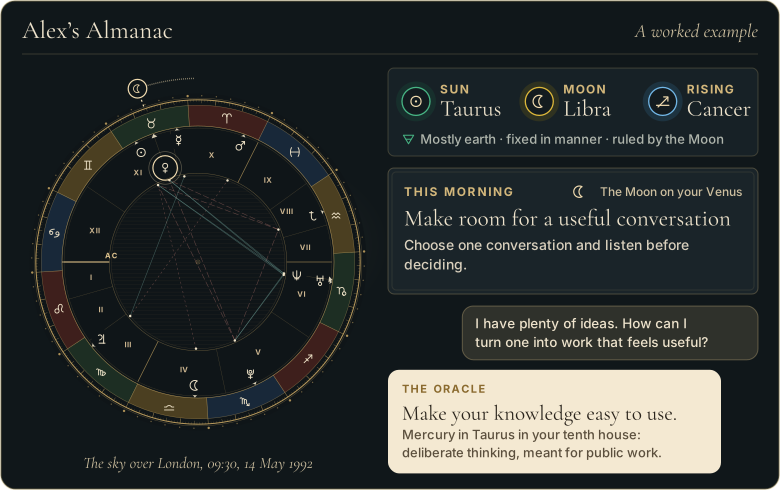
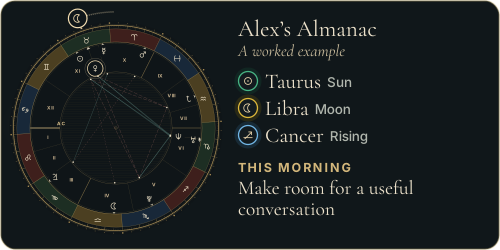
Walk through Alex’s whole example first
 The Road of AgesSee the turning points of your whole life, from your birth date
See your road's shape
The Road of AgesSee the turning points of your whole life, from your birth date
See your road's shape
Prefer to explore first?
 The Road of AgesThe turning points of your whole life, from your own chart
Walk my road
The Road of AgesThe turning points of your whole life, from your own chart
Walk my road
Free, by email
Your daily Almanac letter
One short letter at 7 each morning: the day’s theme read for your own chart, and one thing to do with it.
Visual guide
Retrograde Planets in a Birth Chart
Why it happens
Earth and the other planets orbit at different speeds, so their apparent paths against the stars sometimes appear to reverse when one overtakes another. Nothing in the solar system changes direction. Mercury and Venus retrograde because Earth passes them or they pass Earth; the outer planets appear retrograde for a large part of every year, which is why Jupiter through Pluto are marked so often.
How common it really is
Pluto, Neptune and Uranus are retrograde for something like forty per cent of the year. Saturn and Jupiter are not far behind. Mercury for about eighteen per cent, Venus for about seven, Mars for about nine. A chart with three or four retrograde planets is unremarkable, which is worth knowing before reading a description that treats it as rare and significant.
The traditional reading
The function is described as internalised: a retrograde Mercury thinks it through before saying it and may prefer writing to speaking; a retrograde Venus is slower to show affection than to feel it; a retrograde Mars pushes inwardly and can be uncomfortable with open confrontation. Held lightly these are useful descriptions. Held tightly they become an excuse.
What it is not
It is not a weakened planet, a karmic penalty, or a sign that the function is broken. Any reading that treats a placement occurring in a large share of the population as a personal wound is doing astrology badly. The reasonable claim is about style and direction, and that is where it should be left.
Concrete examples
| Example | What it means in practice |
|---|---|
| Retrograde Mercury at birth | Often described as thinking before speaking. Perfectly compatible with being articulate. |
| Three or four retrogrades | Common, especially with the outer planets. Not a diagnosis. |
| No retrogrades at all | Also unremarkable, and not a sign of anything in particular. |
Prayerful reflection
Let me not turn an ordinary thing into a wound, and let me give my slower faculties the time they were always going to need.
Related Almanac guides
More from the journal
Sources and editorial method
Research and editorial references used for this page include:
- Astrodienst: Transits - Used for the basic definition of transits as current planetary passages over birth positions.
- Astrodienst: The four Elements - Used for the traditional grouping of zodiac signs by element.
This guide distinguishes traditional symbolism from calculated positions. Examples illustrate possible reflections, not predictions about a particular person.
From the reference page to your own chart
Every word here
is in your own chart.
- A personal reading about love, work or purpose, written from your chart
- A practical next step to consider
- It opens with 7 days free, with the AI Oracle and daily guidance
$0 today, then $12/month after 7 days. Cancel anytime.
Common questions
Is a natal retrograde bad?
No. It is common, and the tradition reads it as an inward direction rather than a defect.
Can the Sun or Moon be retrograde?
No. Neither ever appears to move backwards from Earth.
Does a retrograde planet ever "go direct" in my chart?
The natal position is fixed. Progressed charts do show stations, which is a separate technique with its own assumptions.
Free, by email
The Almanac, in your inbox at 7
One short letter at 7 each morning: the day’s theme read for your own chart, and one thing to do with it.