Eclipse SeasonsWhat They Mark and What They Do Not
Eclipses are New and Full Moons that fall near the lunar nodes. They come in seasons of two or three, roughly twice a year, and they read better as punctuation in a longer sentence than as events that decide anything.
Direct answer
Short version
An eclipse is a New or Full Moon close enough to a lunar node for the three bodies to line up. That alignment is possible for about thirty five days at a time, twice a year, which produces two or three eclipses in each season. Astronomically they are ordinary and predictable for centuries. Traditionally they are read as emphasis: the same lunation, underlined.
The Instruments
Ten readings, worked out from your own birth chart
An instrument is a reading this house works out for you. Give your birth date, time and place once, and each one reads today’s real sky against the chart you were born under. Eight are personal; two are calendars anyone can open. A free account opens one instrument a day. The plans open every instrument, every day.
- Natal Chart Every planet, house and aspect in your chart
- Active Transits Where the planets are now, read against your chart
- Daily Counsel What to pursue today, and what to leave alone
- Personal Timing Your best days to decide, weeks ahead
- Fellowship Your chart and another, read side by side
- Theme of the Day The one thing today is asking of you
- Sacred Numbers Your life path, your cycles, your name in numbers
- Aeolian Harmonics Classical music chosen to match your chart
- Mercury Retrograde Every Mercury retrograde this year, with its dates Open to all
- Void-of-Course Moon When the Moon is between signs, hour by hour Open to all
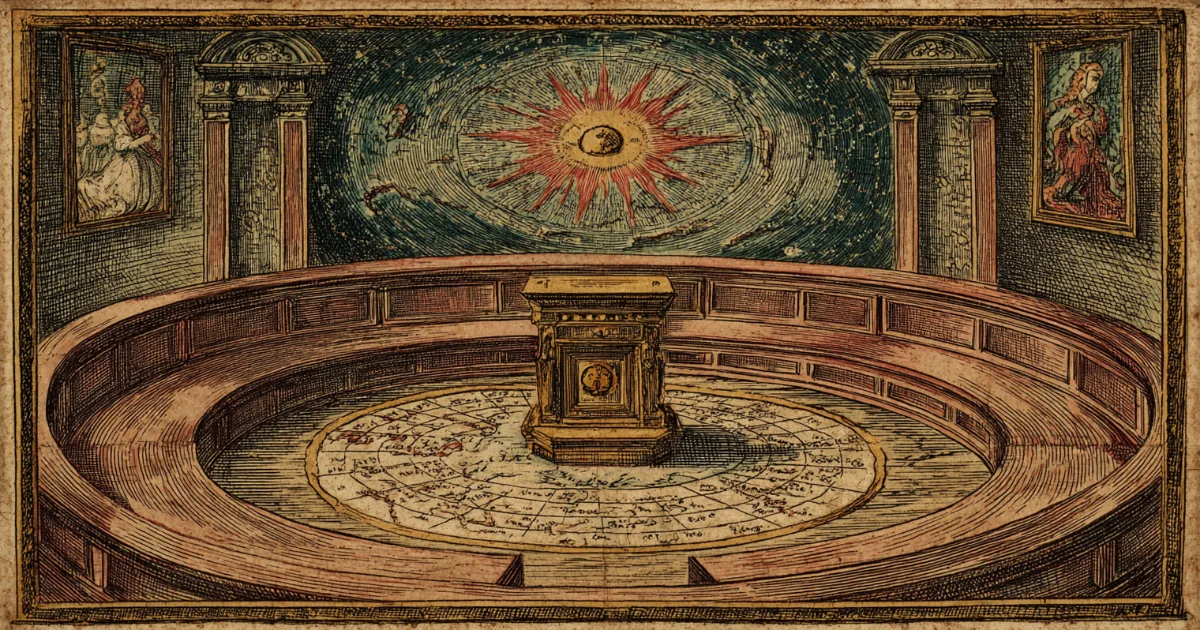
Visual guide
Eclipse Seasons: What They Mark and What They Do Not
Why they arrive in seasons
The Moon’s orbit is tilted about five degrees to the plane of Earth’s orbit, so at most New and Full Moons the three bodies miss their alignment and no shadow falls. Twice a year the line where the two planes cross points at the Sun, and for roughly thirty five days any New or Full Moon happens close enough to that line to eclipse. Those windows are what an eclipse season is. They drift backwards through the calendar by about three weeks a year, which is why the seasons move and why the same signs are involved for about eighteen months at a time.
What the tradition reads in them
Eclipses have been recorded as significant for as long as records exist, usually as marks in public life rather than private mood. Modern practice tends to read them as emphatic lunations: a New Moon eclipse as a beginning that arrives with more weight than usual, a Full Moon eclipse as a culmination that is harder to look away from. Because they repeat along the nodal axis, the same two houses of a chart are involved across a season of about eighteen months, and practitioners read that as one long subject rather than a series of shocks.
What an eclipse cannot do
It cannot cause an event, and it does not select a person. The shadow falls on a track across the Earth that was calculable long before anybody living was born, and it falls the same way whatever is happening in your life. An eclipse that touches no degree in your chart is a beautiful thing to watch and nothing more. Reading dread into one is a choice, and it is a choice that costs something: fear of a date is a poor guide to a decision, and it tends to arrive precisely when a clear head would be more useful.
Holding a season without dread
Give an eclipse season a wider frame and a slower hand. Notice what is raised, write it down, and let a week pass before you decide anything you cannot undo. If nothing is raised, that is the ordinary case and worth recording too. The practice that makes eclipse seasons useful is the same one that makes any timing practice useful: keep a short record, read it back after the season, and let the record rather than the anticipation tell you what these windows do in your life.
Concrete examples
| Example | What it means in practice |
|---|---|
| An eclipse lands on nothing in your chart | The common case. Watch it for its own sake and carry on with the week. |
| An eclipse falls near your Ascendant | Read it as emphasis on how you meet the world, and give the following weeks room rather than forcing a decision on the day. |
| Two eclipses two weeks apart | One subject in two halves. What the first uncovers, the second usually asks you to answer. |
Prayerful reflection
Let me not read every shadow as a warning, and let me use what is uncovered for repair rather than for fear.
Related Almanac guides
More from the journal
Sources and editorial method
Research and editorial references used for this page include:
- Google Search Central: Creating helpful, reliable, people-first content - Used as the editorial standard for direct answers, useful depth, and reader-first structure.
- Astrodienst: Transits - Used for the basic definition of transits as current planetary passages over birth positions.
- Astrodienst: The four Elements - Used for the traditional grouping of zodiac signs by element.
This static article is written for crawlable, reader-first depth: a direct answer, visual framework, examples, internal next steps, and clear limits around prediction or fatalism.
Put this insight to work
Use this article as the map, then open the matching tool when you want the idea applied to your own chart and timing.
See active transitsCommon questions
How many eclipses happen in a year?
Between four and seven, arriving in two or three seasons. Most are partial, and any single one is visible from only part of the Earth.
Is an eclipse dangerous?
Not in itself. A solar eclipse requires proper eye protection to observe, which is a physical caution rather than a symbolic one. The tradition treats eclipses as emphatic rather than harmful.
Should I make no decisions during an eclipse?
That is stricter than the tradition asks and stricter than life allows. The usual counsel is to prefer response over initiative for a few days, and not to decide anything important while startled.