
Jacob wrestles until dawn
On his way home to face Esau, Jacob was left alone by the ford of the Jabbok, and there wrestled a man with him until the breaking of the day. He came away limping, with a new name: Israel.
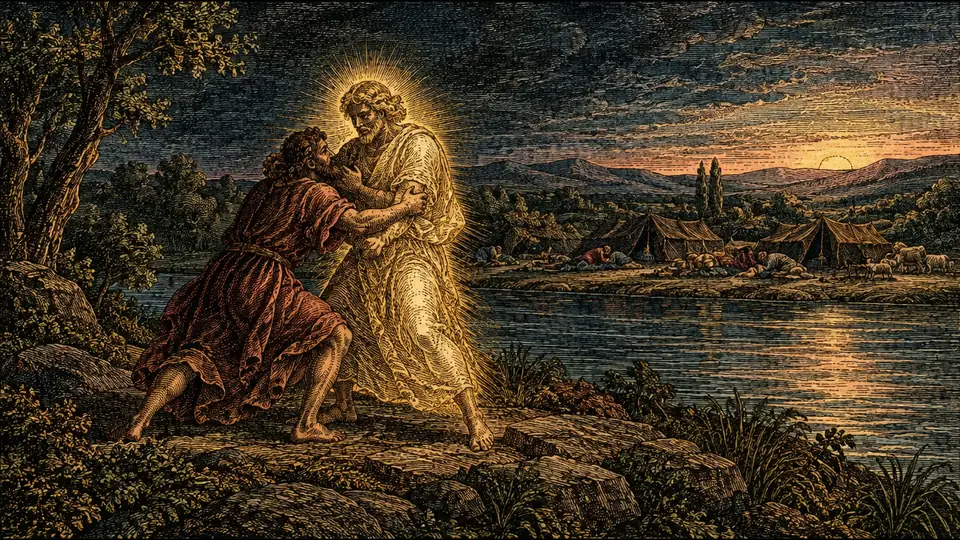
Press play: the paintings change with the story and the words come as the narrator reads them. The whole story is written out below.
Now playing: Jacob wrestles until dawn
The whole story
Genesis calls the stranger a man; the prophet Hosea says Jacob “had power over the angel, and prevailed” (Hosea 12:4); Jacob himself says he has seen God face to face. When the stranger could not prevail, he touched the hollow of Jacob’s thigh and put it out of joint, and still Jacob would not let him go without a blessing.
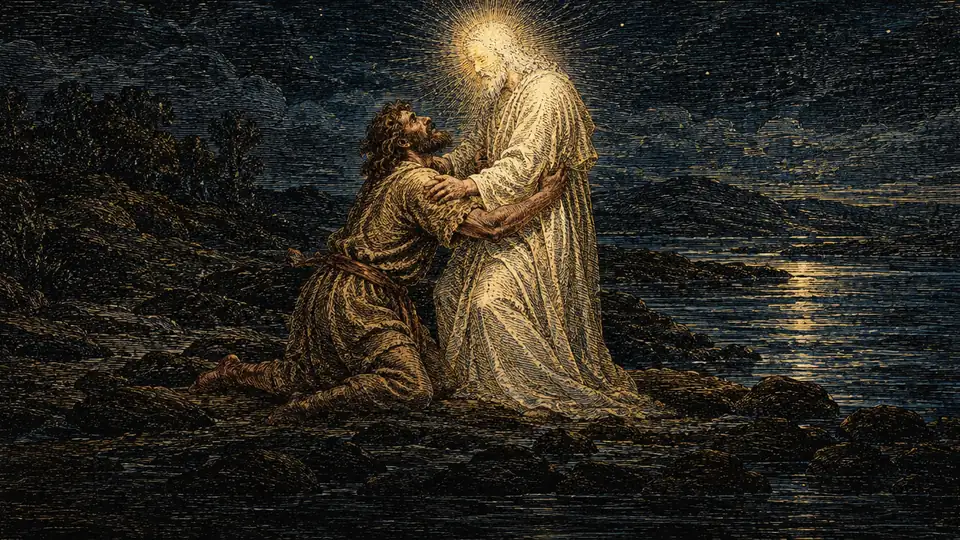
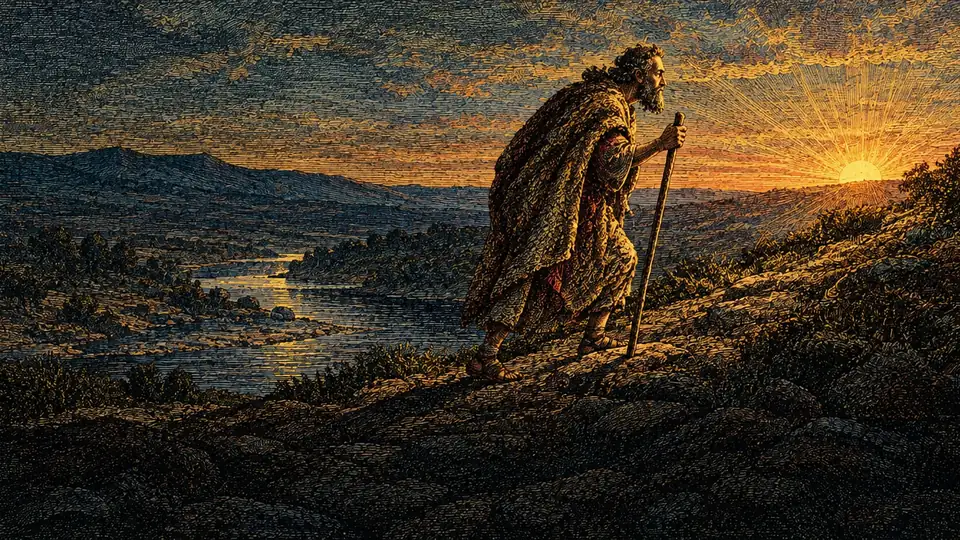
Asked his name, Jacob gave it, and was given another: “Thy name shall be called no more Jacob, but Israel: for as a prince hast thou power with God and with men, and hast prevailed” (Genesis 32:28). Jacob asked the stranger’s name in return and was not told. “And as he passed over Penuel the sun rose upon him, and he halted upon his thigh” (Genesis 32:31).
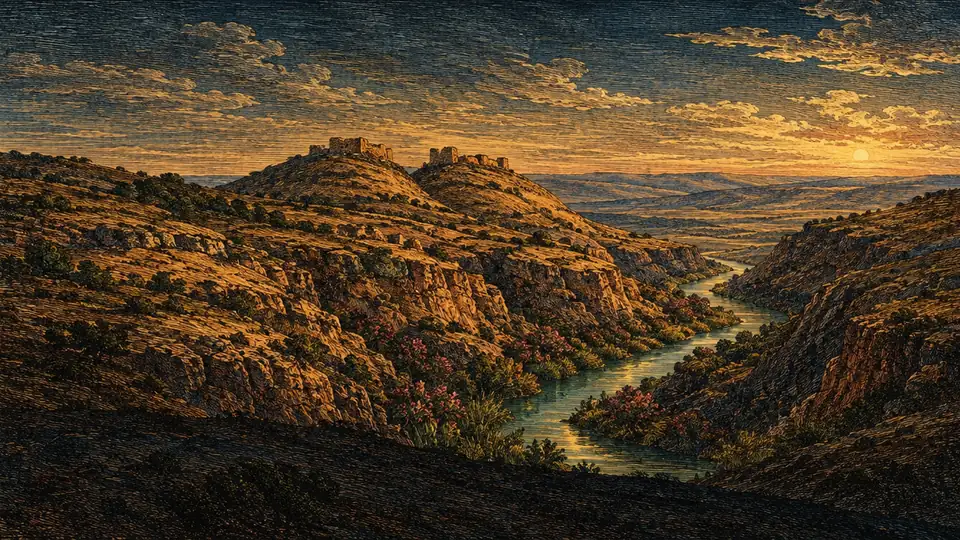
The Jabbok, now the Zarqa river, cuts a deep gorge through the hills of Gilead down to the Jordan. Most place Penuel at Tulul adh-Dhahab, twin hills on its banks where a later king of Israel built a stronghold. Genesis adds that the children of Israel do not eat the sinew of the thigh, in memory of that night.
And Jacob called the name of the place Peniel: for I have seen God face to face, and my life is preserved.
Genesis 32:30, KJV
Where it happened
Peniel by the Jabbok, Tulul adh-Dhahab, by the Zarqa river, Jordan (site likely).
Most place Penuel at Tulul adh-Dhahab, twin hills by the Jabbok, now the Zarqa river, in Jordan.
Every story stands at its place on the Worldwide Watch map: the Bible’s world, on the map.
More from the fathers
Genesis 12 to 50
Sources and editorial method
Research and editorial references used for this page include:
- The King James Bible, as published by bible-api.com
- The Book of Enoch, translated by R. H. Charles (1917), Project Gutenberg
Every story is told from the King James Bible, and from the Book of Enoch in R. H. Charles’s translation (1917) where a story names it. Every quotation was checked word for word against those texts. Where a place is not known, the page says so. The paintings and the narration were made for the house.

