
Fire on Sodom
God rained brimstone and fire on Sodom and Gomorrah, the cities of the plain. Lot escaped; his wife looked back and became a pillar of salt.
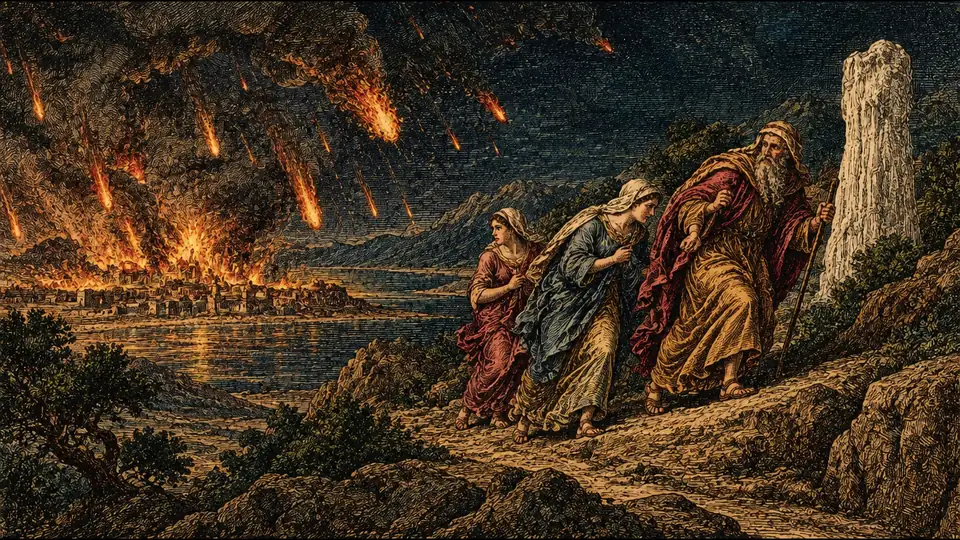
Press play: the paintings change with the story and the words come as the narrator reads them. The whole story is written out below.
Now playing: Fire on Sodom
The whole story
Lot had chosen the well-watered plain of the Jordan and pitched his tent toward Sodom. When the men of the city surrounded his house, the two angels he had taken in struck them with blindness, and at dawn they hurried his family out, telling them not to look behind them nor to stay anywhere in the plain.
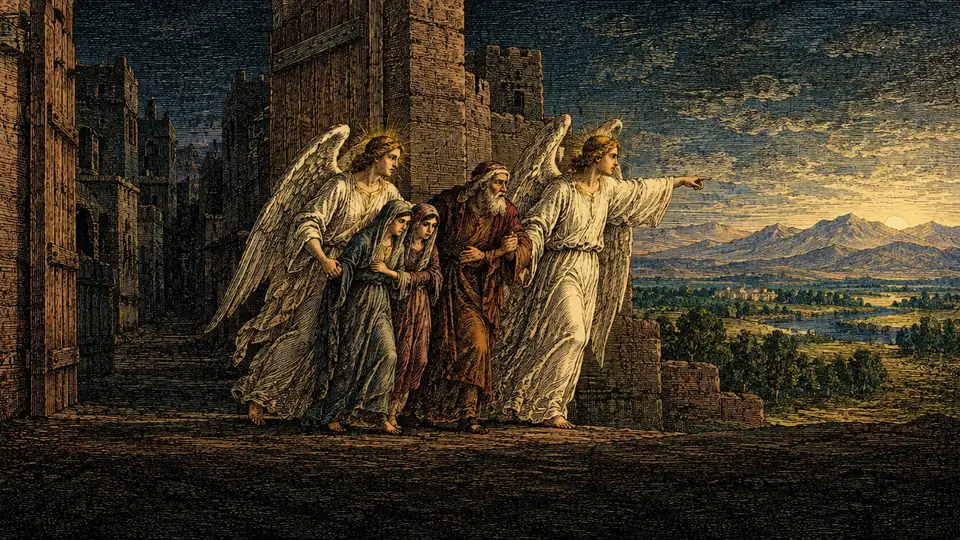
Abraham had pleaded with God for the city, asking whether he would destroy the righteous with the wicked, and God agreed to spare it for ten righteous men; they were not found. Early in the morning Abraham looked toward Sodom and Gomorrah, “and, lo, the smoke of the country went up as the smoke of a furnace” (Genesis 19:28).
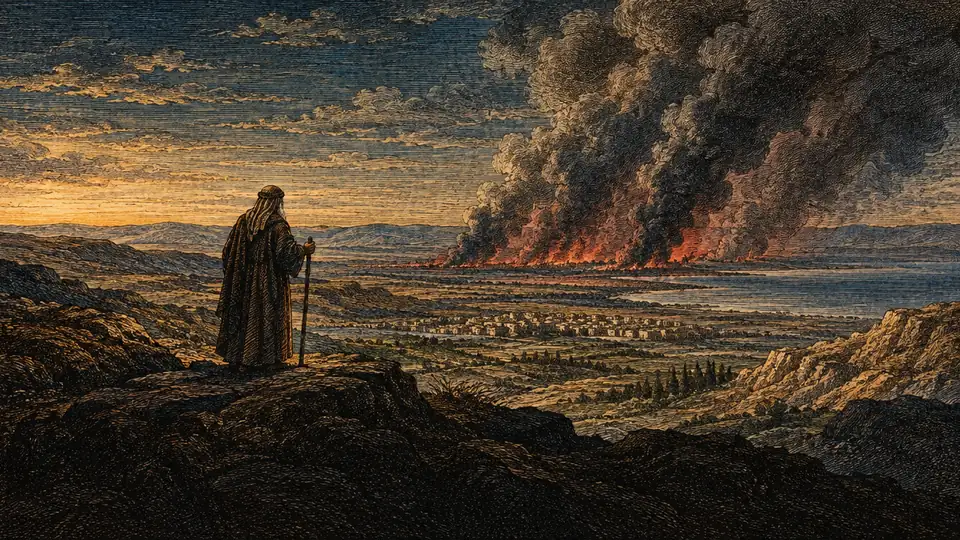
Where the cities of the plain stood is still argued. An old view looks to the shallow south end of the Dead Sea, near the salt ridge of Mount Sodom, where pillars of salt still stand; another to the north, where Tall el-Hammam shows signs of a sudden destruction in the Bronze Age, though how and when is debated. Jesus said, “Remember Lot’s wife” (Luke 17:32).
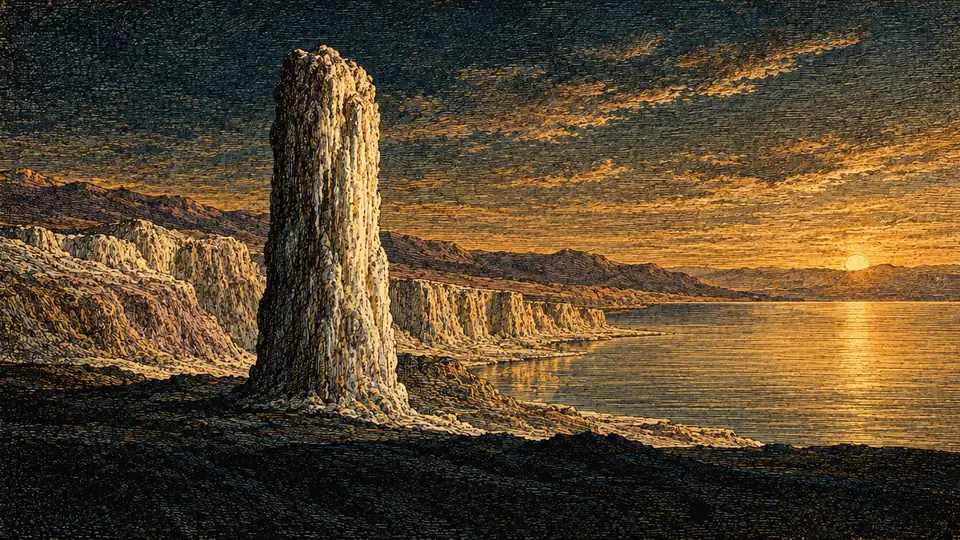
Then the LORD rained upon Sodom and upon Gomorrah brimstone and fire from the LORD out of heaven;
Genesis 19:24, KJV
Where it happened
Sodom, The Dead Sea (site unknown).
One old view looks to the south end of the Dead Sea, where the mark stands; others look north of it, to Tall el-Hammam.
Every story stands at its place on the Worldwide Watch map: the Bible’s world, on the map.
More from the fathers
Genesis 12 to 50
Sources and editorial method
Research and editorial references used for this page include:
- The King James Bible, as published by bible-api.com
- The Book of Enoch, translated by R. H. Charles (1917), Project Gutenberg
Every story is told from the King James Bible, and from the Book of Enoch in R. H. Charles’s translation (1917) where a story names it. Every quotation was checked word for word against those texts. Where a place is not known, the page says so. The paintings and the narration were made for the house.

