
My name is Legion
Across the lake, in the country of the Gadarenes, a man possessed lived among the tombs, so strong that no chain could hold him. Jesus asked his name, and he answered, Legion, for we are many.
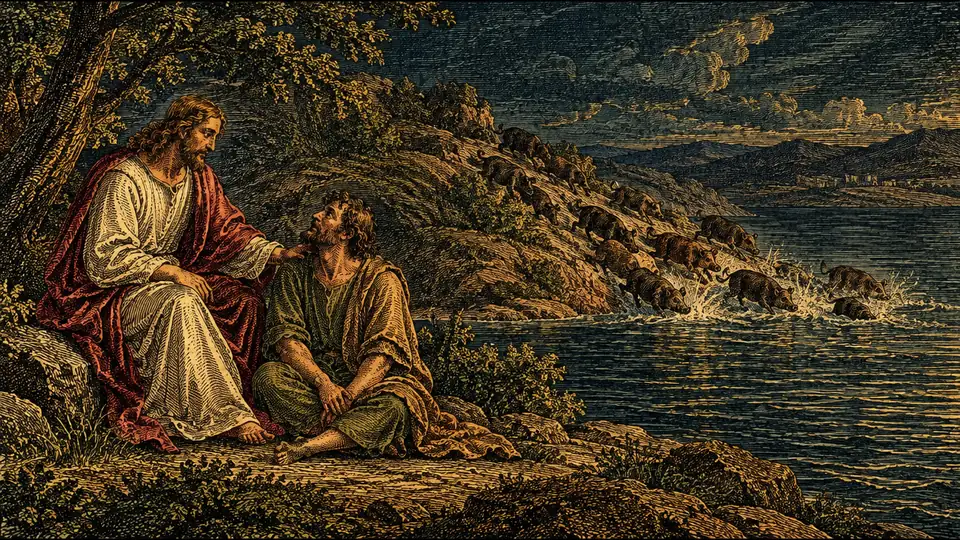
Press play: the paintings change with the story and the words come as the narrator reads them. The whole story is written out below.
Now playing: My name is Legion
The whole story
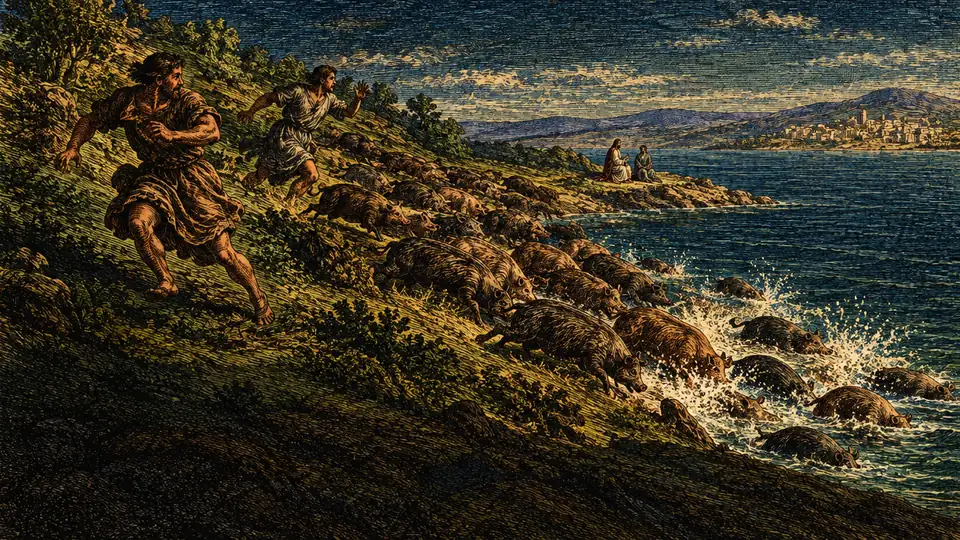
The spirits begged not to be sent away out of the country, and asked to enter a great herd of swine feeding on the mountain. About two thousand rushed down a steep place into the sea and were drowned. The herdsmen fled to the city, and the people came and found the man “sitting, and clothed, and in his right mind” (Mark 5:15).
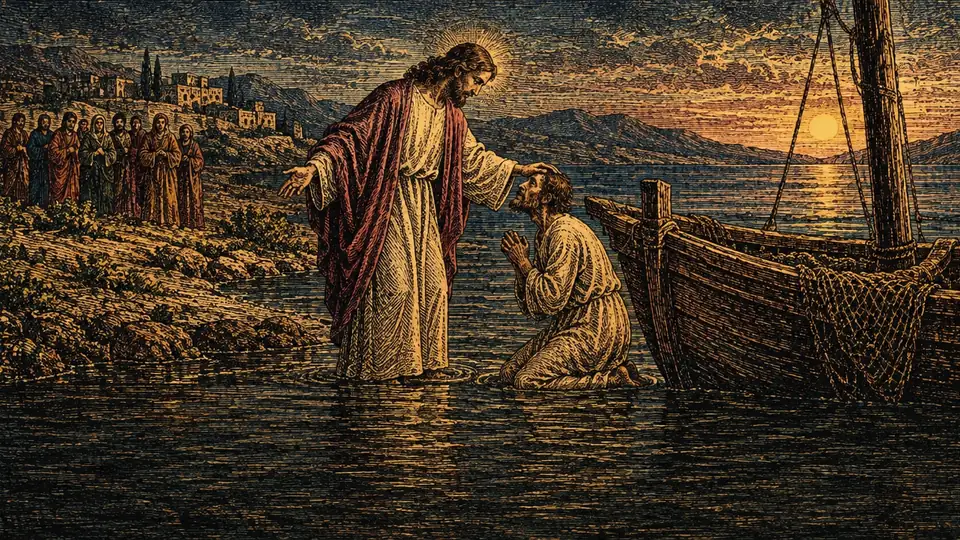
Instead of rejoicing, the townspeople asked Jesus to leave. The healed man wanted to go with him, but Jesus sent him home: “Go home to thy friends, and tell them how great things the Lord hath done for thee” (Mark 5:19). He told it through the Decapolis, the ten Greek cities beyond the Jordan.
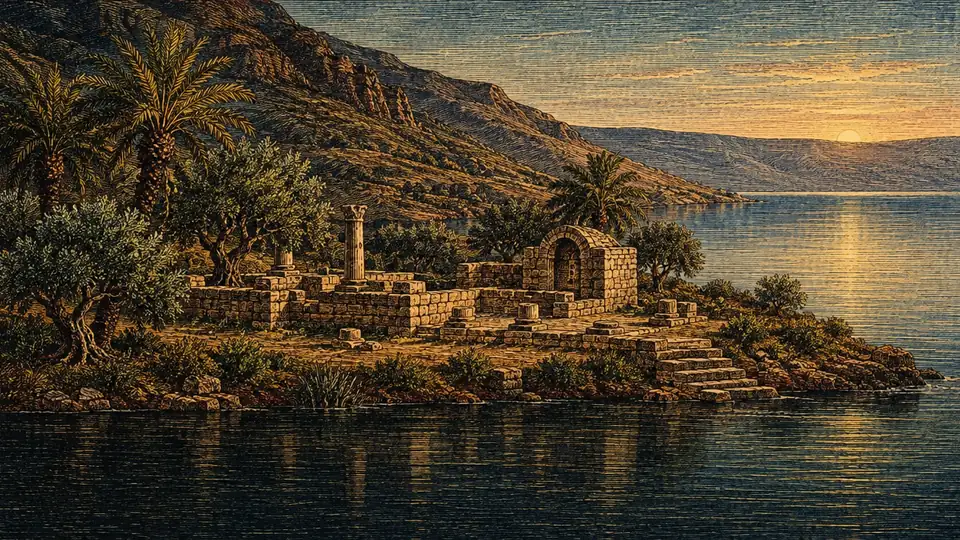
The Gospels name the place differently: Mark and Luke say the Gadarenes, Matthew the Gergesenes, and Matthew tells of two men. Gadara lay miles from the shore, so many favor Kursi on the eastern bank, where a monastery and chapel of the fifth century were found in 1970 while a road was being built, near a steep slope that comes down close to the water.
And he asked him, What is thy name? And he answered, saying, My name is Legion: for we are many.
Mark 5:9, KJV
Where it happened
The country of the Gadarenes, Kursi, on the eastern shore of the Sea of Galilee (site by tradition).
The Gospels name the country of the Gadarenes or of the Gergesenes. A monastery of the fifth century at Kursi, below a steep slope on the eastern shore, marks the place by tradition.
Every story stands at its place on the Worldwide Watch map: the Bible’s world, on the map.
More from the Gospels
Matthew to John
Sources and editorial method
Research and editorial references used for this page include:
- The King James Bible, as published by bible-api.com
- The Book of Enoch, translated by R. H. Charles (1917), Project Gutenberg
Every story is told from the King James Bible, and from the Book of Enoch in R. H. Charles’s translation (1917) where a story names it. Every quotation was checked word for word against those texts. Where a place is not known, the page says so. The paintings and the narration were made for the house.

