
Golgotha
Jesus carried his cross out to Golgotha, the place of a skull, and was crucified there between two others.
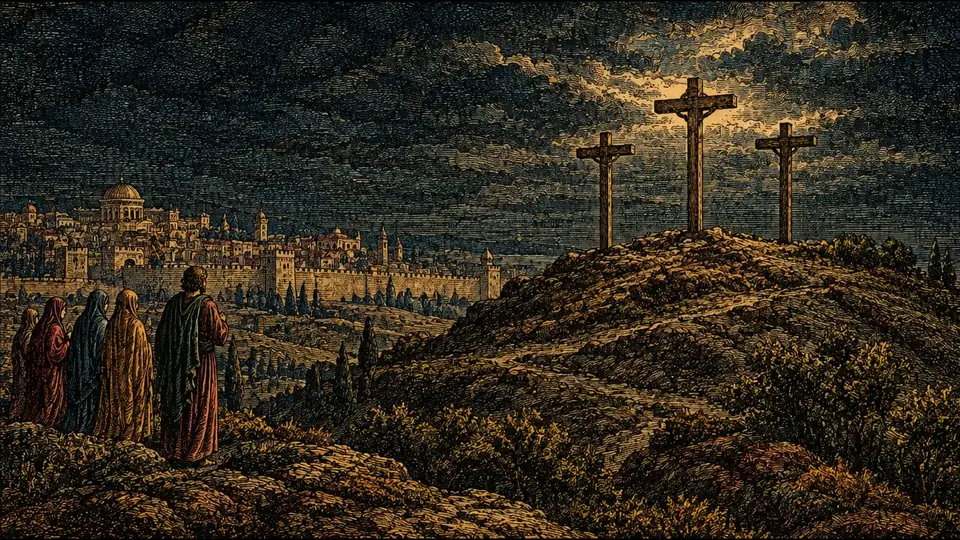
Press play: the paintings change with the story and the words come as the narrator reads them. The whole story is written out below.
Now playing: Golgotha
The whole story
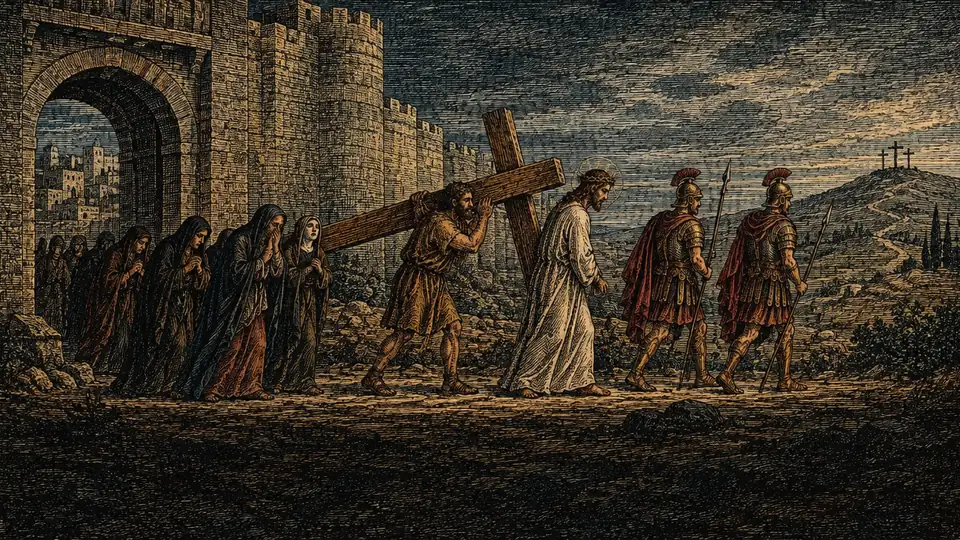
After the last supper, Jesus prayed in Gethsemane, was betrayed by Judas and taken. He stood before the high priest and the council, and before Pilate, who found no fault in him but gave him up to be crucified when the crowd cried out. He went out bearing his cross, and Simon of Cyrene was made to carry it to the place called Golgotha.
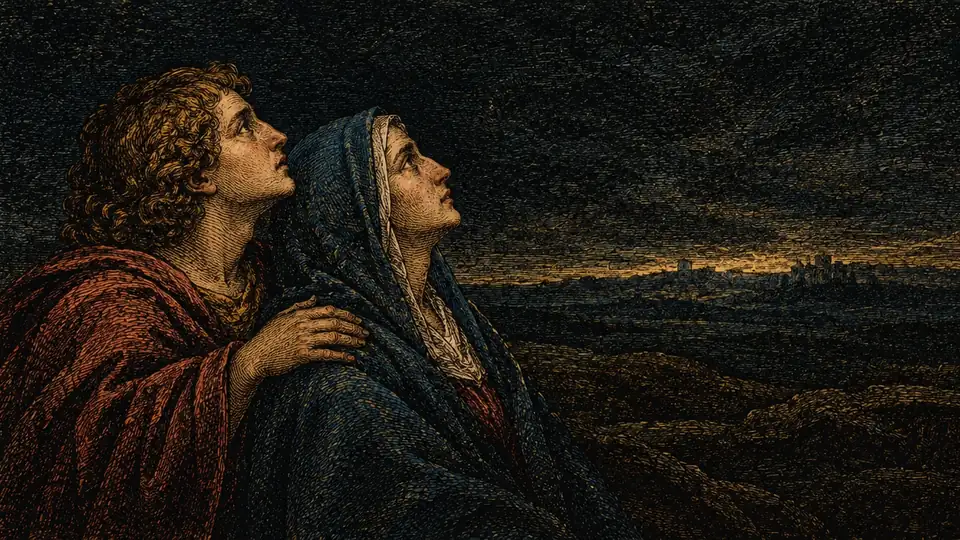
Over his head was written in Hebrew, Greek and Latin, JESUS OF NAZARETH THE KING OF THE JEWS. He prayed, “Father, forgive them; for they know not what they do” (Luke 23:34), promised the thief beside him paradise, and gave his mother into the care of John. From the sixth hour there was darkness over all the land until the ninth, and then he cried with a loud voice and gave up the ghost.
The veil of the temple was rent in twain from the top to the bottom, and the centurion said, Truly this was the Son of God. Joseph of Arimathaea laid the body in his own new tomb. Since the fourth century, the Church of the Holy Sepulchre has marked both Golgotha and the tomb, within one great building in the old city.
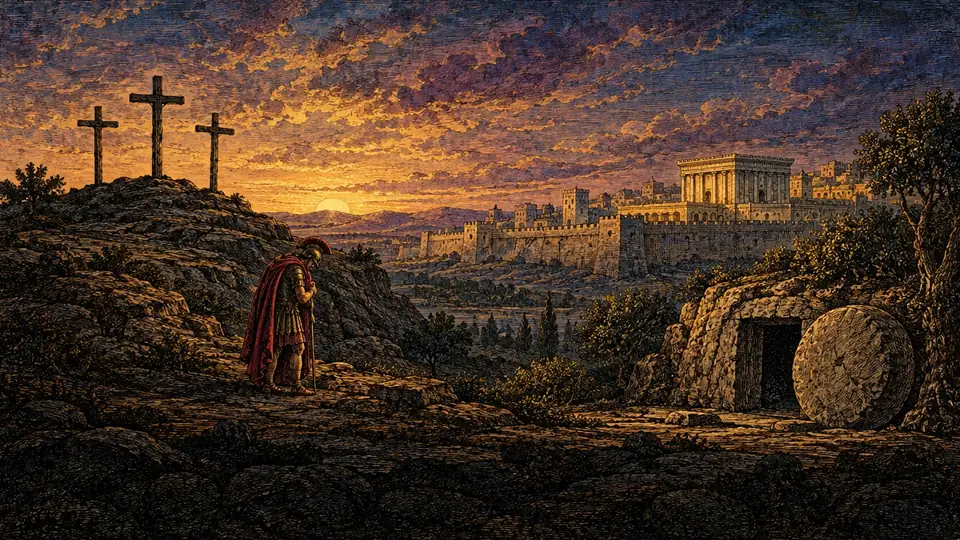
When Jesus therefore had received the vinegar, he said, It is finished: and he bowed his head, and gave up the ghost.
John 19:30, KJV
Where it happened
Jerusalem (site by tradition).
The Church of the Holy Sepulchre stands where tradition has placed Golgotha and the tomb since the fourth century; the Garden Tomb, north of the old city, is another view.
Every story stands at its place on the Worldwide Watch map: the Bible’s world, on the map.
More from the Gospels
Matthew to John
Sources and editorial method
Research and editorial references used for this page include:
- The King James Bible, as published by bible-api.com
- The Book of Enoch, translated by R. H. Charles (1917), Project Gutenberg
Every story is told from the King James Bible, and from the Book of Enoch in R. H. Charles’s translation (1917) where a story names it. Every quotation was checked word for word against those texts. Where a place is not known, the page says so. The paintings and the narration were made for the house.

