
Out of Egypt
Warned in a dream, Joseph took the young child and his mother by night into Egypt, and stayed there until Herod died. The Gospel does not say where in Egypt.
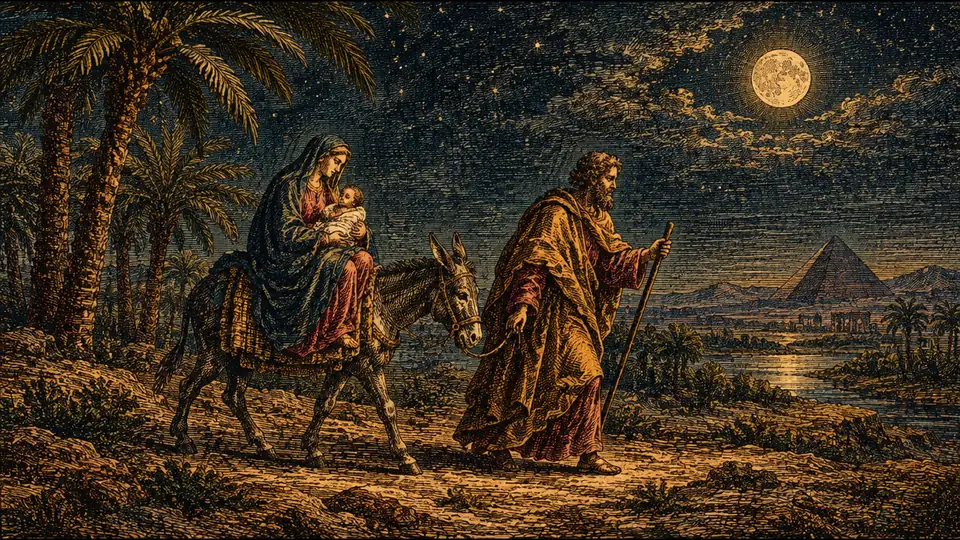
Press play: the paintings change with the story and the words come as the narrator reads them. The whole story is written out below.
Now playing: Out of Egypt
The whole story
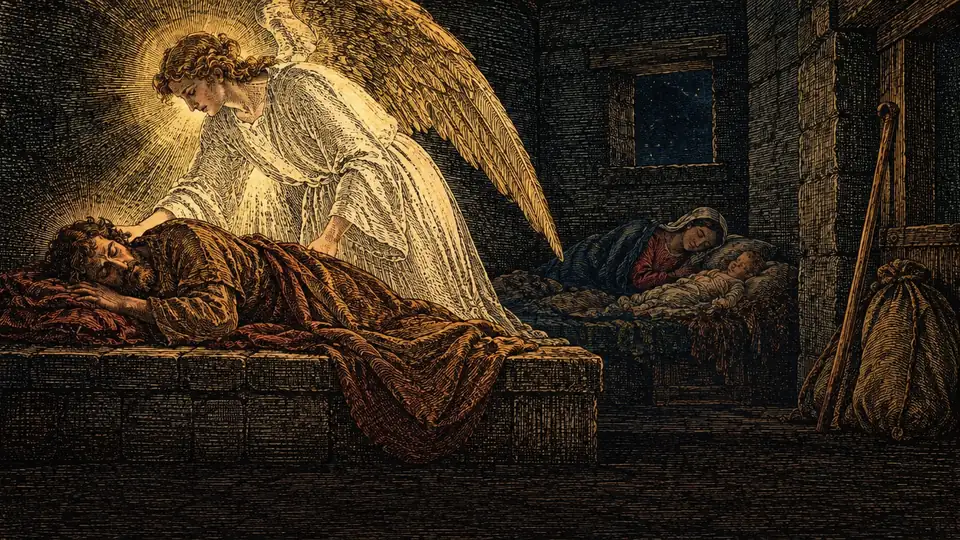
When the wise men had gone, the angel of the Lord appeared to Joseph in a dream: “Arise, and take the young child and his mother, and flee into Egypt” (Matthew 2:13), for Herod would seek the young child to destroy him. Joseph rose and took them by night and departed. Herod, mocked by the wise men, sent and slew all the children of Bethlehem two years old and under.
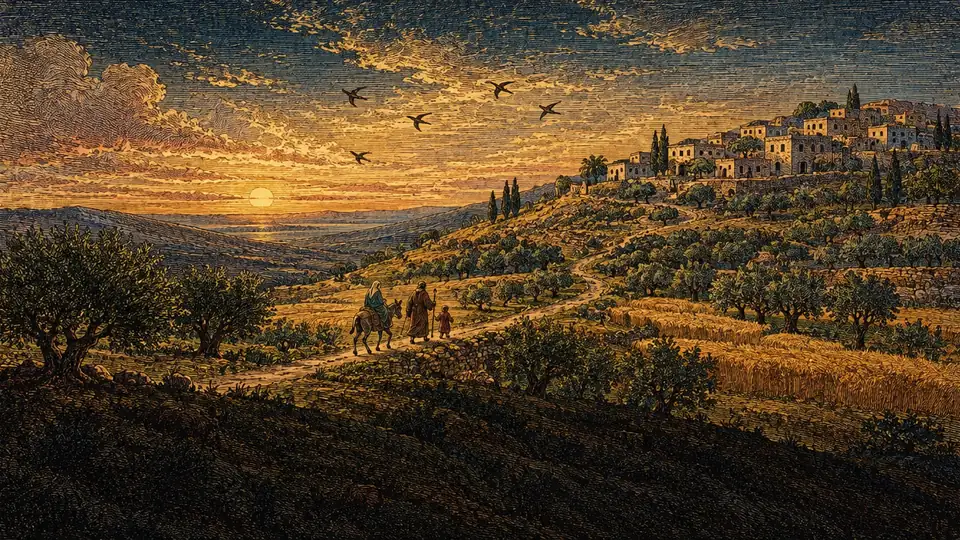
They stayed in Egypt until the death of Herod. Then Joseph, hearing that Herod’s son Archelaus reigned in Judaea, was afraid to go there, and being warned of God in a dream, turned aside into the parts of Galilee and came to Nazareth.
Egypt had large Jewish communities then, especially in Alexandria, so a family could find its own people there. The Coptic Church remembers the Holy Family’s journey at many places, from the Sinai road to Old Cairo, where the Church of Saint Sergius stands over a cave where they are said to have rested, and south to the monastery of al-Muharraq.
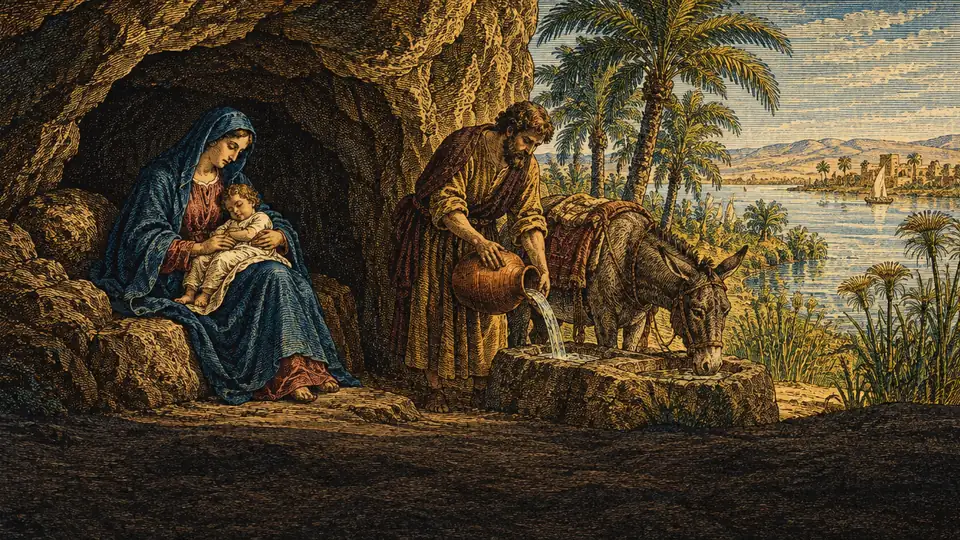
And was there until the death of Herod: that it might be fulfilled which was spoken of the Lord by the prophet, saying, Out of Egypt have I called my son.
Matthew 2:15, KJV
Where it happened
Egypt: the land of Goshen, The eastern Nile delta (site likely).
Goshen lay in the eastern Nile delta; most place it along the Wadi Tumilat, where the mark stands.
Every story stands at its place on the Worldwide Watch map: the Bible’s world, on the map.
More from the Gospels
Matthew to John
Sources and editorial method
Research and editorial references used for this page include:
- The King James Bible, as published by bible-api.com
- The Book of Enoch, translated by R. H. Charles (1917), Project Gutenberg
Every story is told from the King James Bible, and from the Book of Enoch in R. H. Charles’s translation (1917) where a story names it. Every quotation was checked word for word against those texts. Where a place is not known, the page says so. The paintings and the narration were made for the house.

