
Treasures in Heaven
A new house, a new car, a fuller account: none of it is evil, and none of it lasts. Jesus told of a rich man who built bigger barns and died that night. Here is how to hold money and things with an open hand.
Read without fear: "God hath not given us the spirit of fear" (2 Timothy 1:7).
On this page 6 parts · 4 min
For where your treasure is, there will your heart be also.
Matthew 6:21, KJV
The man who built bigger barns
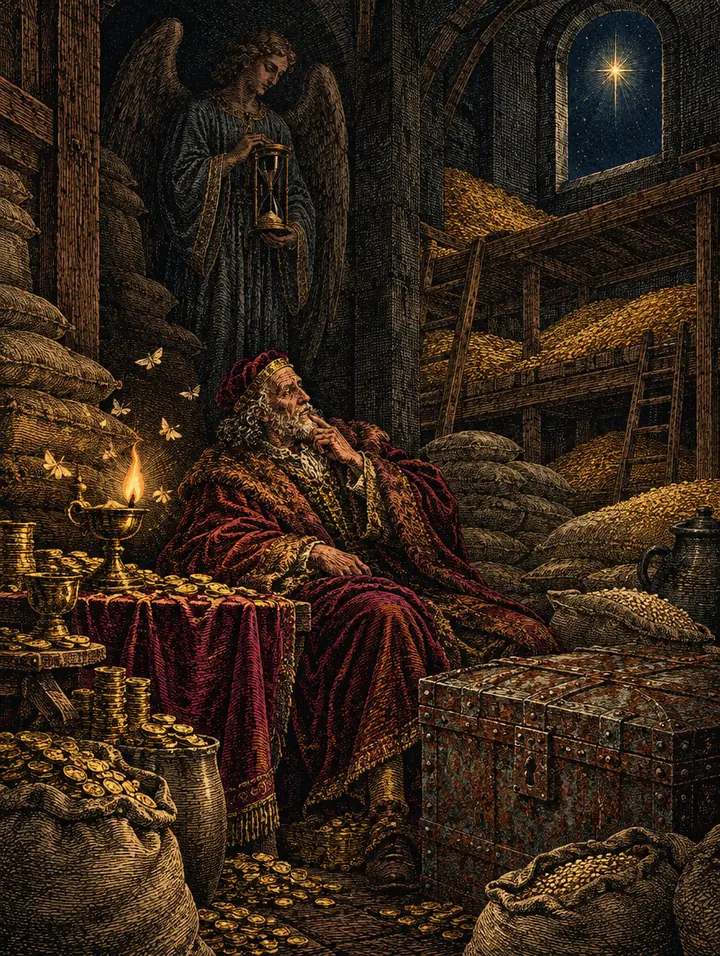
Jesus told of a farmer whose land "brought forth plentifully". He had no room for it all, so he decided, "I will pull down my barns, and build greater". Then he spoke to his own soul: "thou hast much goods laid up for many years; take thine ease, eat, drink, and be merry. But God said unto him, Thou fool, this night thy soul shall be required of thee: then whose shall those things be, which thou hast provided?" (Luke 12:16-20).
Nothing in the story says he stole, cheated or broke a law. His failure was quieter: he thought his life was in his barns. Jesus had just said, "a man's life consisteth not in the abundance of the things which he possesseth" (Luke 12:15), and he ended, "So is he that layeth up treasure for himself, and is not rich toward God" (Luke 12:21).
Where moth and rust corrupt
"Lay not up for yourselves treasures upon earth, where moth and rust doth corrupt, and where thieves break through and steal: But lay up for yourselves treasures in heaven" (Matthew 6:19-20). In Jesus' day wealth was kept in cloth, metal and coin, and moths, rust and burglars took it. Today it is kept in accounts and markets, and inflation, crashes and fraud take it. The principle has not changed: what is stored on earth can be lost on earth.
Paul told Timothy to charge the rich "that they be not highminded, nor trust in uncertain riches, but in the living God, who giveth us richly all things to enjoy" (1 Timothy 6:17). Notice the last words. Money is not evil, and enjoying God's gifts is no sin. "The love of money is the root of all evil" (1 Timothy 6:10), not money itself.
Opening the members’ pages…
Members read on
Read the rest of Treasures in Heaven
Your 7 free days open every page of Faith Over Fear, and the whole Almanac with them.
Still to read on this page About 2 min
- When the banks shake
- Holding things with an open hand
- Your birth details, about a minute
- Your 7 free days begin
- Back here, every page open
$0 today, then $12/month after 7 days. Cancel anytime.
Already a member? Log in
When the banks shake
Few fears spread faster than a rumour that the banks are failing. Sometimes the fear is real: banks have failed, and savers have queued at their doors. More often a frightening post turns out to be an outage or a scam. Either way, the believer's first step is the same: "What time I am afraid, I will trust in thee" (Psalm 56:3). Then take sensible steps with a clear head.
Know how your savings are protected. In the United States, deposits are insured by the FDIC up to $250,000 per depositor, per insured bank, for each account ownership category, and the FDIC says no depositor has lost a penny of insured funds since it began in 1934. In the European Union, deposits are guaranteed up to €100,000 per depositor per bank. Other countries have schemes of their own, and your bank can tell you which one covers you.
When an app shows a balance that is wrong or missing, call the number printed on your card or on the bank's own website, never one sent in a message, and never give a code or password to someone who calls you about it. Scammers use every banking scare.
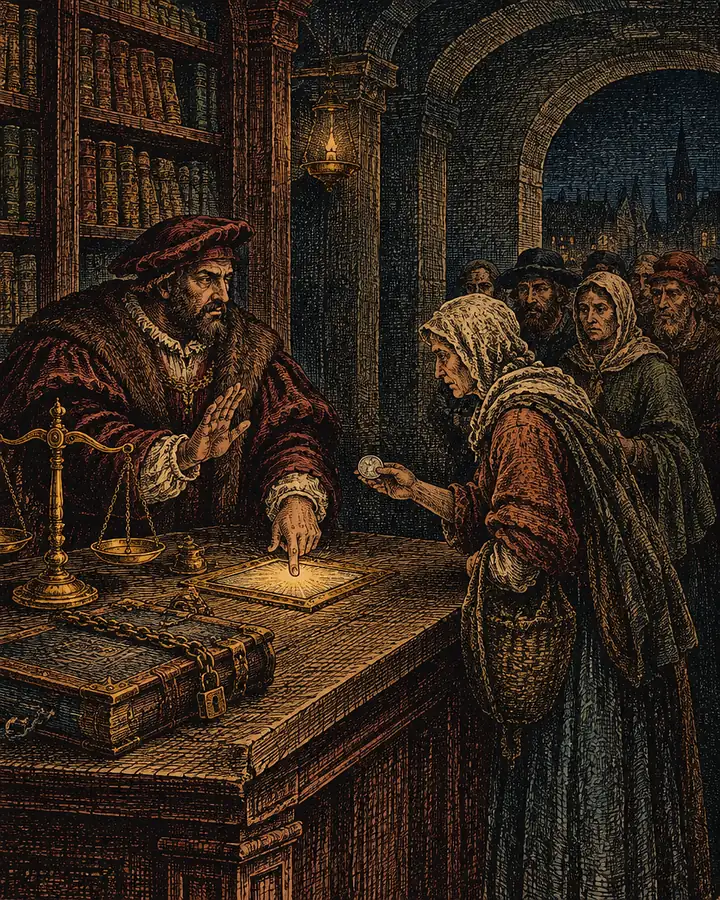
And that no man might buy or sell, save he that had the markRevelation 13:17
Go deeper: a calm financial plan: a budget, an emergency fund, cash at home and more than one bank.
Holding things with an open hand
Enjoy without worshipping
A house, a car and a good meal are gifts God gives "richly… to enjoy" (1 Timothy 6:17). Thank him for them, and hold them loosely.
Learn contentment
"Godliness with contentment is great gain. For we brought nothing into this world, and it is certain we can carry nothing out" (1 Timothy 6:6-7).
Give first
The poor widow gave two small coins, "all her living", and Jesus said she gave more than all the rich (Mark 12:42-44). Giving first loosens money's grip on the heart.
Step off the treadmill
Advertising tells us every hour that we lack something. Unsubscribe, unfollow and shop with a list. "Be content with such things as ye have: for he hath said, I will never leave thee, nor forsake thee" (Hebrews 13:5).
Remember your youth
"Childhood and youth are vanity" (Ecclesiastes 11:10), the Preacher says: fleeting, a breath. What impresses at twenty rarely matters at sixty. Spend your strength on what lasts.
Count what lasts
"For what shall it profit a man, if he shall gain the whole world, and lose his own soul?" (Mark 8:36). People, faithfulness and love are the treasures that go with us.
Common questions
What does "lay not up treasures on earth" mean?
In Matthew 6:19-21 Jesus warns against making earthly wealth our security and our goal, because it can be lost, and "where your treasure is, there will your heart be also". He calls his followers to invest in what lasts: love of God and neighbour, generosity and faithfulness, which he calls treasure in heaven.
Is it wrong for a Christian to be rich?
No. Abraham, Job and Joseph of Arimathea were wealthy. Scripture warns about trusting riches, loving money and neglecting the poor (1 Timothy 6:9-10, 17-19), and calls the rich to "be rich in good works, ready to distribute" (1 Timothy 6:18).
What should Christians do if banks fail?
Stay calm and trust God first (Psalm 56:3), then act sensibly: know your deposit insurance, keep some cash and an emergency fund, use more than one bank, and beware of scams that feed on banking scares. Share with those in need, as the first church did (Acts 2:44-45).
Who was the rich fool in the Bible?
He is the man in Jesus' parable in Luke 12:16-21 who built bigger barns for his harvest and planned to take his ease for many years, but died that night. Jesus called him a fool because he laid up treasure for himself and was "not rich toward God".
Sources and editorial method
Research and editorial references used for this page include:
- BibleGateway: Luke 12:13-21 (KJV) - Quoted on this page in the King James Version.
- BibleGateway: Matthew 6:19-21 (KJV) - Quoted on this page in the King James Version.
- BibleGateway: 1 Timothy 6:6-19 (KJV) - Quoted on this page in the King James Version.
- BibleGateway: Mark 12:41-44 (KJV) - Quoted on this page in the King James Version.
- BibleGateway: Hebrews 13:5 (KJV) - Quoted on this page in the King James Version.
- BibleGateway: Ecclesiastes 11:10 (KJV) - Quoted on this page in the King James Version.
- BibleGateway: Mark 8:36 (KJV) - Quoted on this page in the King James Version.
- BibleGateway: Psalm 56:3 (KJV) - Quoted on this page in the King James Version.
- BibleGateway: Acts 2:44-45 (KJV) - Quoted on this page in the King James Version.
- FDIC: Deposit Insurance - The $250,000 coverage, and the FDIC's record since 1934.
- EUR-Lex: Directive 2014/49/EU on deposit guarantee schemes - The €100,000 guarantee in the European Union.
Scripture is quoted from the King James Version. The few present-day facts were checked in November 2026. These pages teach from Scripture: they set no date, name no living person as a sign, call no disaster a verdict on its victims, and blame no people for the world's troubles. The paintings are illustrations made for The Great Almanac with AI image tools, in the house's engraved style.

