
The Lord Provides
Scripture is full of hungry seasons, and in every one God fed his people in a way no one expected: bread on the ground at dawn, ravens at a brook, a stranger at the tent door. Here is how he provides, and what he asks of those he feeds.
Read without fear: "God hath not given us the spirit of fear" (2 Timothy 1:7).
On this page 6 parts · 4 min
And Abraham called the name of that place Jehovahjireh: as it is said to this day, In the mount of the LORD it shall be seen.
Genesis 22:14, KJV
Bread from heaven, enough for the day
Israel had been free for barely a month when the food ran short in the wilderness, and the people wished aloud that they had died in Egypt beside the flesh pots (Exodus 16:3). God answered their fear with bread: "Behold, I will rain bread from heaven for you; and the people shall go out and gather a certain rate every day, that I may prove them" (Exodus 16:4).
The manna came with a lesson. "He that gathered much had nothing over, and he that gathered little had no lack" (Exodus 16:18). Some kept it overnight against the command, and "it bred worms, and stank" (Exodus 16:20). God was teaching a nation to trust him one day at a time. Moses said later that the manna was given "that he might make thee know that man doth not live by bread only, but by every word that proceedeth out of the mouth of the LORD" (Deuteronomy 8:3), and Jesus answered the tempter with those words when he was hungry in the wilderness himself (Matthew 4:4).
Ravens at the brook, oil in the jar
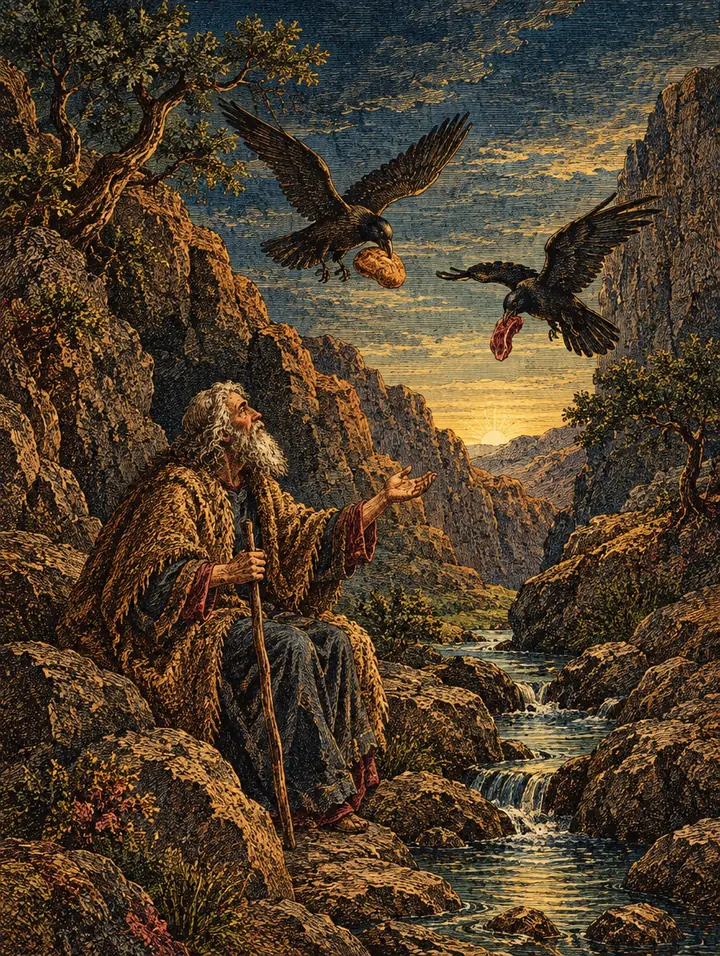
In a drought, God told Elijah to hide by the brook Cherith: "I have commanded the ravens to feed thee there." And "the ravens brought him bread and flesh in the morning, and bread and flesh in the evening" (1 Kings 17:4-6). When the brook dried up, God sent him to a widow in Zarephath who had only a handful of meal and a little oil. She fed the prophet first, and "the barrel of meal wasted not, neither did the cruse of oil fail" (1 Kings 17:16).
Later, worn out and afraid for his life, Elijah lay down under a juniper tree and asked to die. An angel woke him with a cake baked on the coals and a jar of water, and then came again: "Arise and eat; because the journey is too great for thee" (1 Kings 19:5-7). God did not scold his frightened prophet. He fed him and let him sleep.
Opening the members’ pages…
Members read on
Read the rest of The Lord Provides
Your 7 free days open every page of Faith Over Fear, and the whole Almanac with them.
Still to read on this page About 2 min
- Strangers, angels and bread on the water
- Laughing at famine: Job 5:22
- Your birth details, about a minute
- Your 7 free days begin
- Back here, every page open
$0 today, then $12/month after 7 days. Cancel anytime.
Already a member? Log in
Strangers, angels and bread on the water
"Be not forgetful to entertain strangers: for thereby some have entertained angels unawares" (Hebrews 13:2). The letter remembers Abraham, who ran from his tent in the heat of the day to wash the feet of three travellers and feed them, and learned only afterwards who they were (Genesis 18:1-10).
Many believers can tell of a meal paid for by a stranger, a bag of groceries left on a step, help that came from someone they never saw again. Whether the helper was an angel or a neighbour moved by God, the provision came from the same hand. And the giving runs both ways: "Cast thy bread upon the waters: for thou shalt find it after many days" (Ecclesiastes 11:1). Those who give in lean times are often the ones who are given to.
Jesus put it more strongly still: whoever feeds the hungry, welcomes the stranger or visits the sick does it to him (Matthew 25:35-40).
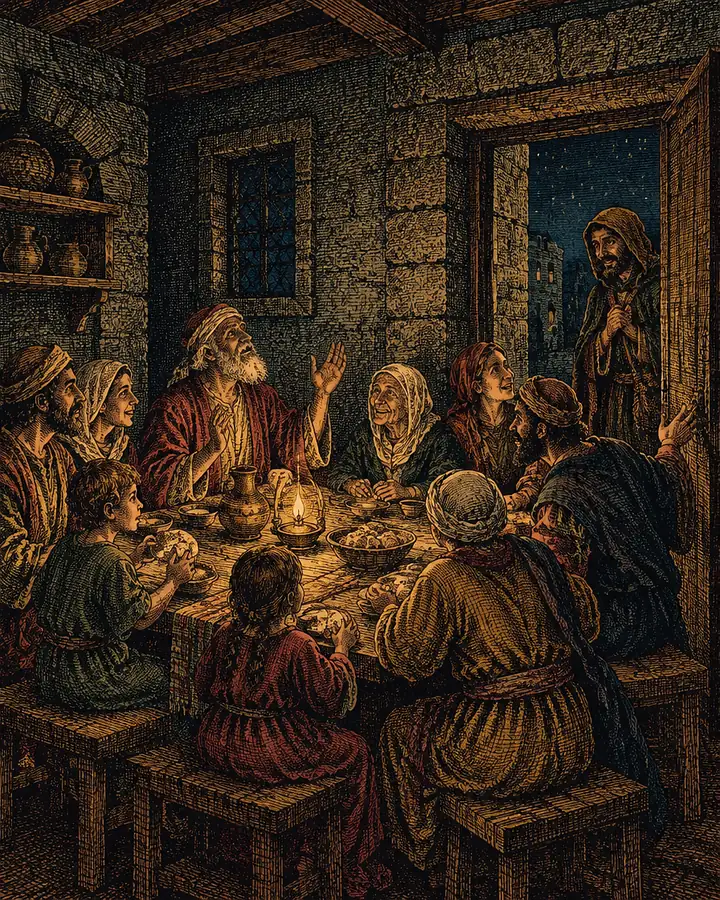
breaking bread from house to house, did eat their meat with gladness and singleness of heartActs 2:46
Laughing at famine: Job 5:22
Many readers look for the verse that says the righteous laugh in famine. It is Job 5:22: "At destruction and famine thou shalt laugh: neither shalt thou be afraid of the beasts of the earth." Two verses earlier the same speech says, "In famine he shall redeem thee from death: and in war from the power of the sword" (Job 5:20).
It comes with a caution worth knowing. These words are spoken by Eliphaz, one of Job's three friends, and at the end of the book God says to him, "ye have not spoken of me the thing that is right, as my servant Job hath" (Job 42:7). Eliphaz said true things about God's care, but he used them to tell a suffering man that suffering proves sin. So the verse is a comfort, not a guarantee, and never a weapon against someone who is hungry.
The Psalms say it without the caution: the eye of the LORD is upon those who fear him, "to keep them alive in famine" (Psalm 33:19), and "in the days of famine they shall be satisfied" (Psalm 37:19).
Common questions
Where does the Bible say "God will provide"?
In Genesis 22:8 Abraham tells Isaac, "God will provide himself a lamb", and in Genesis 22:14 he names the mountain Jehovahjireh, a name that means the LORD sees to it, or provides. Paul writes in Philippians 4:19, "my God shall supply all your need according to his riches in glory by Christ Jesus."
What is the verse about laughing at famine?
Job 5:22: "At destruction and famine thou shalt laugh: neither shalt thou be afraid of the beasts of the earth." It is spoken by Job's friend Eliphaz, whom God later corrects (Job 42:7), so it is best read as a comfort about God's care rather than a promise that the faithful never go hungry.
What does it mean to entertain angels unawares?
Hebrews 13:2 tells believers to show hospitality to strangers, "for thereby some have entertained angels unawares", remembering Abraham's three visitors in Genesis 18. The point is to welcome and feed strangers generously, because God may be at work in the meeting.
What does "cast thy bread upon the waters" mean?
Ecclesiastes 11:1 encourages generous, even risky giving: "Cast thy bread upon the waters: for thou shalt find it after many days." Give freely, without knowing where the return comes from; God remembers what is given in faith.
Does God promise that believers never go hungry?
Not in those words. Paul himself knew how "to be hungry" and "to suffer need" (Philippians 4:12). What God promises is his presence and care: "I will never leave thee, nor forsake thee" (Hebrews 13:5), and Scripture shows him providing again and again, often through his people.
Sources and editorial method
Research and editorial references used for this page include:
- BibleGateway: Genesis 22:8-14 (KJV) - Quoted on this page in the King James Version.
- BibleGateway: Exodus 16 (KJV) - Quoted on this page in the King James Version.
- BibleGateway: Deuteronomy 8:3 (KJV) - Quoted on this page in the King James Version.
- BibleGateway: Matthew 4:4 (KJV) - Quoted on this page in the King James Version.
- BibleGateway: 1 Kings 17:1-16 (KJV) - Quoted on this page in the King James Version.
- BibleGateway: 1 Kings 19:4-8 (KJV) - Quoted on this page in the King James Version.
- BibleGateway: Hebrews 13:2 (KJV) - Quoted on this page in the King James Version.
- BibleGateway: Genesis 18:1-10 (KJV) - Quoted on this page in the King James Version.
- BibleGateway: Ecclesiastes 11:1 (KJV) - Quoted on this page in the King James Version.
- BibleGateway: Matthew 25:35-40 (KJV) - Quoted on this page in the King James Version.
- BibleGateway: Job 5:20-22 (KJV) - Quoted on this page in the King James Version.
- BibleGateway: Job 42:7 (KJV) - Quoted on this page in the King James Version.
- BibleGateway: Psalm 33:18-19 (KJV) - Quoted on this page in the King James Version.
- BibleGateway: Psalm 37:19 (KJV) - Quoted on this page in the King James Version.
- BibleGateway: Philippians 4:12-19 (KJV) - Quoted on this page in the King James Version.
- BibleGateway: Hebrews 13:5 (KJV) - Quoted on this page in the King James Version.
Scripture is quoted from the King James Version. The few present-day facts were checked in November 2026. These pages teach from Scripture: they set no date, name no living person as a sign, call no disaster a verdict on its victims, and blame no people for the world's troubles. The paintings are illustrations made for The Great Almanac with AI image tools, in the house's engraved style.

