
Matthew 24 Explained
Two days before the cross, on the Mount of Olives, the disciples asked Jesus three questions: when the temple would fall, what would signal his coming, and when the age would end. Matthew 24 is his answer, the fullest outline of the last days he ever gave. Here it is, in his order.
No dates set: "of that day and hour knoweth no man" (Matthew 24:36).
On this page 6 parts · 6 min
Heaven and earth shall pass away, but my words shall not pass away.
Matthew 24:35, KJV
Three questions on the Mount of Olives
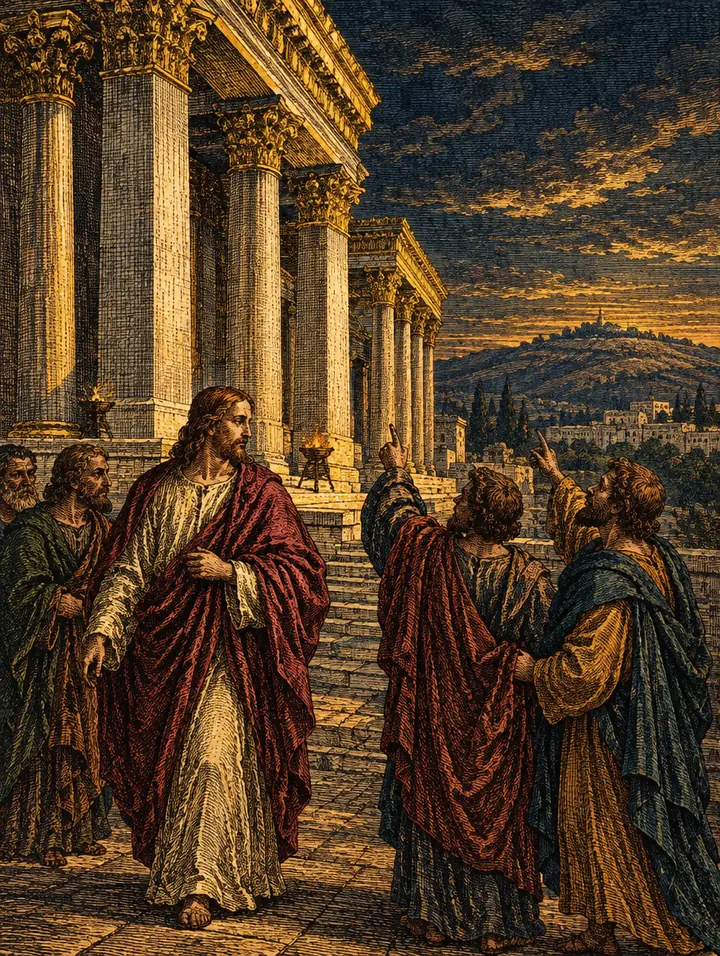
As they left the temple, the disciples pointed out its great buildings, and Jesus said, "There shall not be left here one stone upon another, that shall not be thrown down" (Matthew 24:2). Later, on the Mount of Olives, they came to him privately: "Tell us, when shall these things be? and what shall be the sign of thy coming, and of the end of the world?" (Matthew 24:3). Mark 13 and Luke 21 record the same discourse.
The first question was answered within a generation: in AD 70 the Roman legions burned the temple, and its stones were thrown down. The other two reach to the end of the age. Much of the discourse holds both at once, the way a mountain range seen from far off shows near peaks and far peaks together. That is why believers read it in more than one way, and why the timeline on this site sets out the major views.
The beginning of sorrows (verses 4 to 14)
Deception first
"Take heed that no man deceive you. For many shall come in my name, saying, I am Christ; and shall deceive many" (Matthew 24:4-5). Jesus put deception before every other sign.
Wars and rumours of wars
"See that ye be not troubled: for all these things must come to pass, but the end is not yet" (Matthew 24:6).
Famines, pestilences, earthquakes
"Nation shall rise against nation, and kingdom against kingdom: and there shall be famines, and pestilences, and earthquakes, in divers places" (Matthew 24:7).
Birth pains
"All these are the beginning of sorrows" (Matthew 24:8). The Greek word means labour pains: trouble that comes closer together and grows stronger before the birth.
Persecution and offence
"Then shall they deliver you up to be afflicted, and shall kill you: and ye shall be hated of all nations for my name's sake. And then shall many be offended" (Matthew 24:9-10).
False prophets and cold love
"And many false prophets shall rise, and shall deceive many. And because iniquity shall abound, the love of many shall wax cold" (Matthew 24:11-12).
Endurance
"But he that shall endure unto the end, the same shall be saved" (Matthew 24:13).
The gospel to all nations
"And this gospel of the kingdom shall be preached in all the world for a witness unto all nations; and then shall the end come" (Matthew 24:14).
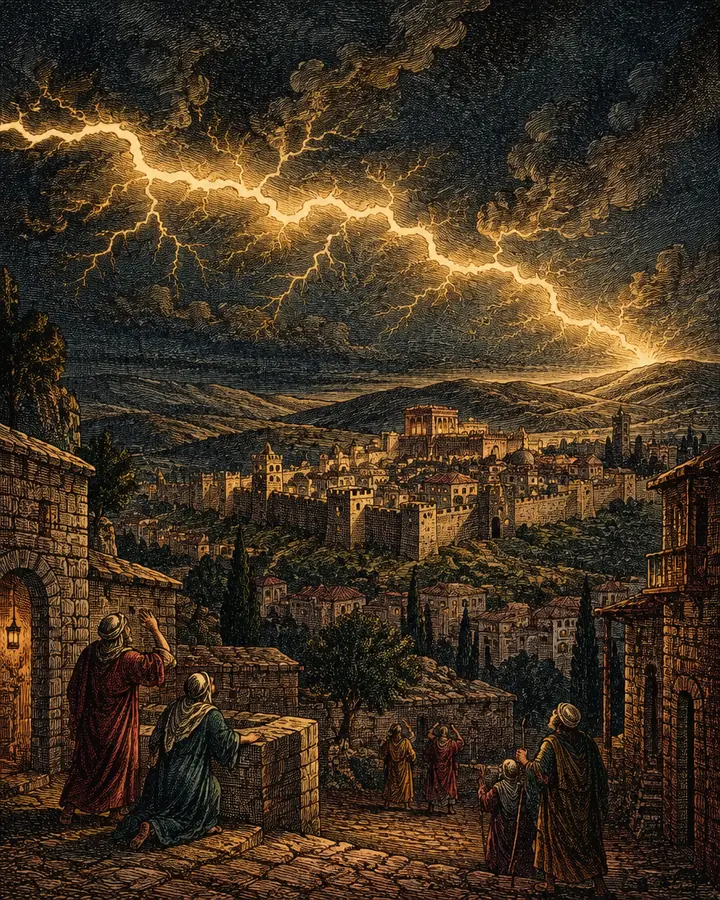
For as the lightning cometh out of the east, and shineth even unto the west; so shall also the coming of the Son of man beMatthew 24:27
Go deeper: the signs, and what we see now, the prophetic timeline.
Opening the members’ pages…
Members read on
Read the rest of Matthew 24 Explained
Your 7 free days open every page of End Times Preparation, and the whole Almanac with them.
Still to read on this page About 2 min
- The abomination of desolation
- The great tribulation
- Lightning from east to west
- His coming after the tribulation
- The parable of the fig tree
- The call to watch
- Your birth details, about a minute
- Your 7 free days begin
- Back here, every page open
$0 today, then $12/month after 7 days. Cancel anytime.
Already a member? Log in
The abomination and the great tribulation (verses 15 to 28)
"When ye therefore shall see the abomination of desolation, spoken of by Daniel the prophet, stand in the holy place, (whoso readeth, let him understand:) Then let them which be in Judaea flee into the mountains" (Matthew 24:15-16). Daniel had foretold a desecration of the holy place (Daniel 9:27; 11:31; 12:11). In 167 BC the Seleucid king Antiochus IV set up an altar to Zeus in the temple; in AD 70 Rome destroyed it; and Paul looked ahead to a final "man of sin" who "sitteth in the temple of God, shewing himself that he is God" (2 Thessalonians 2:4).
"For then shall be great tribulation, such as was not since the beginning of the world to this time, no, nor ever shall be. And except those days should be shortened, there should no flesh be saved: but for the elect's sake those days shall be shortened" (Matthew 24:21-22). The timeline on this site reads the great tribulation as begun, with its height, the man of sin in the holy place, still to come.
"Wherefore if they shall say unto you, Behold, he is in the desert; go not forth: behold, he is in the secret chambers; believe it not. For as the lightning cometh out of the east, and shineth even unto the west; so shall also the coming of the Son of man be" (Matthew 24:26-27). No one needs to be told where Christ is when he comes. A secret return is a false Christ's claim.
His coming, the fig tree, and the call to watch (verses 29 to 51)
"Immediately after the tribulation of those days shall the sun be darkened, and the moon shall not give her light, and the stars shall fall from heaven… and they shall see the Son of man coming in the clouds of heaven with power and great glory. And he shall send his angels with a great sound of a trumpet, and they shall gather together his elect from the four winds" (Matthew 24:29-31). In Jesus' order, the gathering of his people comes after the tribulation.
"Now learn a parable of the fig tree; When his branch is yet tender, and putteth forth leaves, ye know that summer is nigh: So likewise ye, when ye shall see all these things, know that it is near, even at the doors" (Matthew 24:32-33). Then the line every date-setter forgets: "But of that day and hour knoweth no man, no, not the angels of heaven, but my Father only" (Matthew 24:36).
Jesus ends with pictures of readiness: the days of Noah, two women at the mill, the thief in the night, and the servant found faithful: "Blessed is that servant, whom his lord when he cometh shall find so doing" (Matthew 24:46). The point of the whole discourse is not a calendar. It is a household found ready.
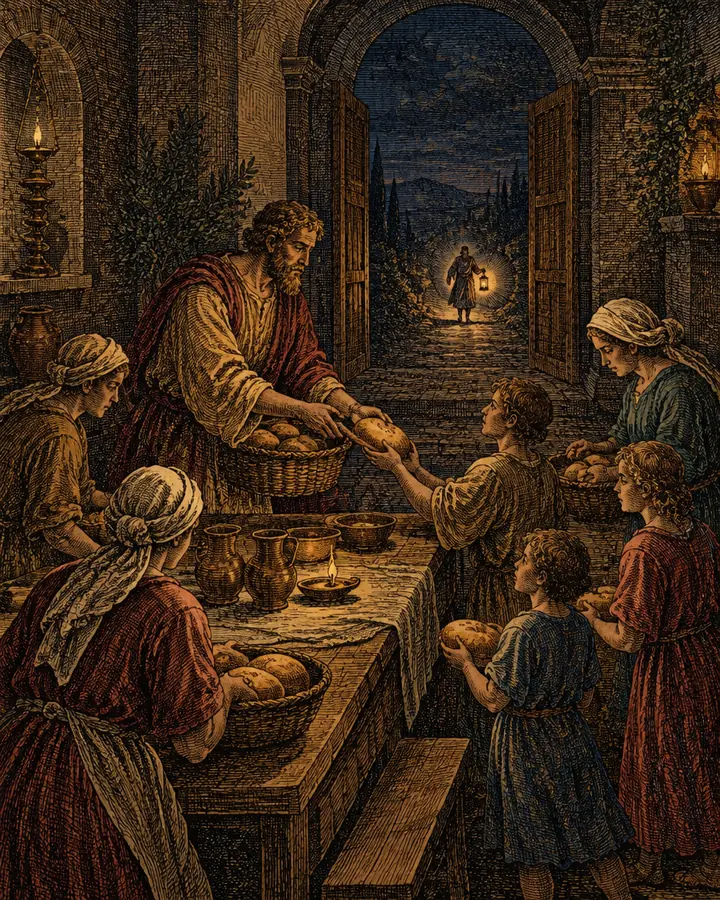
Blessed is that servant, whom his lord when he cometh shall find so doingMatthew 24:46
Go deeper: the gathering of his elect, spiritual preparation.
Common questions
What is Matthew 24 about?
Matthew 24 is Jesus' answer to his disciples' questions about the fall of the temple, the sign of his coming and the end of the age, given on the Mount of Olives two days before the crucifixion. It lists the signs (deception, wars, famines, earthquakes, persecution), the abomination of desolation and the great tribulation, his visible return, and a call to watch.
What does "this generation shall not pass" mean in Matthew 24:34?
Readers differ. Some take "this generation" as the people alive in Jesus' day, who saw the temple fall in AD 70. Others read it as the generation that sees the final signs begin, or as the Jewish people as a whole. Every reading agrees with verse 36: no one knows the day or the hour.
What is the abomination of desolation?
A desecration of the holy place foretold by Daniel (Daniel 9:27; 11:31; 12:11). It was foreshadowed when Antiochus IV set up an altar to Zeus in the temple in 167 BC, and Jesus spoke of a fulfilment still to come (Matthew 24:15). Paul describes a final "man of sin" seated in the temple of God (2 Thessalonians 2:4).
Does Matthew 24 teach a rapture before the tribulation?
In Matthew 24 the gathering of the elect comes "immediately after the tribulation of those days" (Matthew 24:29-31), the order the Almanac's timeline follows. Christians who hold a pre-tribulation rapture read this gathering differently, as our page on the rapture sets out.
Has Matthew 24 already been fulfilled?
In part. The temple fell in AD 70 just as Jesus said. Preterist readers place most of the chapter in that generation; most Christians see a fuller fulfilment still ahead, above all his visible return "in the clouds of heaven with power and great glory".
Sources and editorial method
Research and editorial references used for this page include:
- BibleGateway: Matthew 24 (KJV) - Quoted on this page in the King James Version.
- BibleGateway: Mark 13 (KJV) - Quoted on this page in the King James Version.
- BibleGateway: Luke 21 (KJV) - Quoted on this page in the King James Version.
- BibleGateway: Daniel 9:27 (KJV) - Quoted on this page in the King James Version.
- BibleGateway: Daniel 11:31 (KJV) - Quoted on this page in the King James Version.
- BibleGateway: Daniel 12:11 (KJV) - Quoted on this page in the King James Version.
- BibleGateway: 2 Thessalonians 2:3-4 (KJV) - Quoted on this page in the King James Version.
- Wikipedia: Antiochus IV Epiphanes - The desecration of the temple in 167 BC.
Scripture is quoted from the King James Version. Present-day facts were checked against current reporting in October 2026; where events are still unfolding, the page says what was known then. We describe how believers read the signs and never set a date. The paintings are illustrations made for The Great Almanac with AI image tools, in the house's engraved style.

