
What Pluto opposite natal Moon means

Pluto opposite natal Moon is about emotional intensity, family shadows, attachment, grief, and hidden need. Transiting Pluto, carrying depth, power and transformation, stands directly across the chart from your natal Moon, the seat of feelings, home and the body’s rhythms.
An opposition is half the circle, 180 degrees. Signs in opposition share their pace and their elements answer each other, fire with air and earth with water, so the tension works like a seesaw: it asks for balance, and it often arrives through another person.

What does your own chart say about you?
Choose love, work or purpose. Your reading is written from your chart. Your reading uses your own birth details.
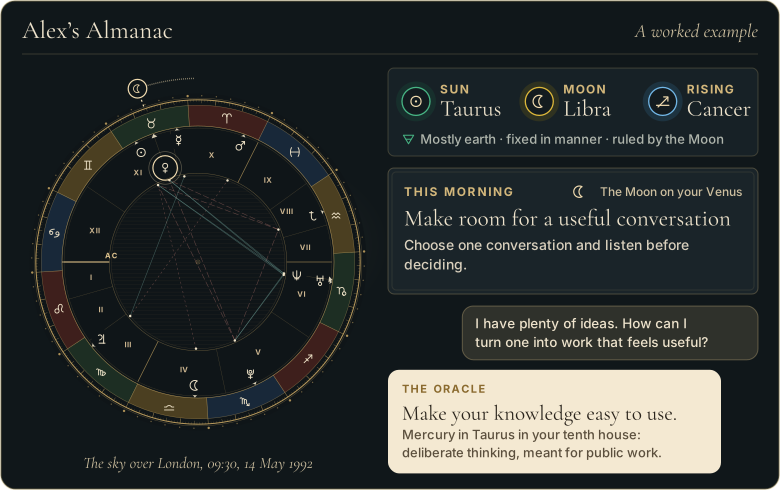
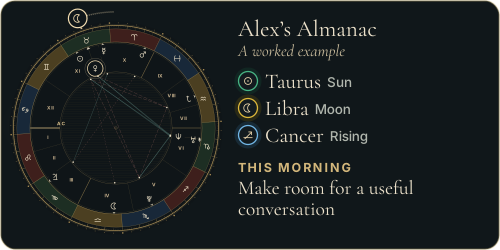
Walk through Alex’s whole example first
 The Road of AgesSee the turning points of your whole life, from your birth date
See your road's shape
The Road of AgesSee the turning points of your whole life, from your birth date
See your road's shape
Prefer to explore first?
 The Road of AgesThe turning points of your whole life, from your own chart
Walk my road
The Road of AgesThe turning points of your whole life, from your own chart
Walk my road
Free, by email
Your daily Almanac letter
One short letter at 7 each morning: the day’s theme read for your own chart, and one thing to do with it.
Pluto opposite natal Moon at a glance
| Layer | What to know |
|---|---|
| Moving planet | Pluto: depth, power and transformation |
| Contact | Opposition to natal Moon, the opposite degree, 180 away |
| Themes | emotional intensity, family shadows, attachment, grief, and hidden need |
| How long | About two years or more, in three passes |
| How often | Once in every 248 years |
A one-minute story
The Wandering Stars
How the moving planets were watched, named and found, and what a transit is.

How long does Pluto opposite natal Moon last?
Months for each pass, usually in three passes spread over about two years, sometimes longer: Pluto moves so slowly that its yearly retrograde carries it back across the same degree.
How often: Once in every circuit Pluto makes of the zodiac, which takes about 248 years. A lifetime holds at most one or two of Pluto’s hard aspects to any natal point, and many people never meet a given one.
Is Pluto opposite natal Moon good or bad?
Challenging and revealing: an opposition sets Pluto across the chart from your Moon, so the tension usually arrives through other people and asks for balance.
How Pluto opposite natal Moon shows up in real life
With Pluto it tends to arrive as a crisis, a power struggle or a change that cannot be undone. Where it lands is the territory of your natal Moon:
- home and family
- moods, sleep and appetite
- a mother, a caregiver or the people who feel like home
- whatever makes you feel safe
It can come as an outer event, an inner pressure, a repeating conversation or a change in the body, and it is loudest when it is applying and exact, quieter as it separates, and louder again if a retrograde brings it back.
Timing, orb and chart context
Most astrologers feel a transit from about a degree before exact to a degree after for the fast planets, and allow two or three degrees for the slow ones. It builds as it approaches, peaks at the exact hit, and fades as it separates.
- Speed: Long-season outer-planet timing. The contact usually matters most when it is close, repeated, angular, or tied to a major natal pattern.
- Where it lands: Check the natal Moon house, the transiting Pluto house, and whether the same theme repeats through other current contacts.
- The usual misreading: Reading one transit alone. It weighs more when it is close, repeats, touches an angle or the chart ruler, or echoes another transit at the same time.
How to work with Pluto opposite natal Moon
Let the buried feeling speak without letting it rule. Seek support where the pattern is bigger than today.
How to know if Pluto opposite natal Moon is active for you
Find the degree of your natal Moon in your birth chart and watch for transiting Pluto to reach the opposite degree, 180 away. Within about a degree it is at its strongest.
The house your natal Moon occupies narrows it further: in the tenth it is work and reputation, in the seventh a partner, in the fourth home and family.
The lore of Pluto
Pluto was found by Clyde Tombaugh in 1930 and named for the god of the underworld. Astronomers reclassified it as a dwarf planet in 2006, but astrologers still read it as the planet of death, rebirth and hidden power. Its orbit is so stretched that it spends anywhere from about twelve to over thirty years in a sign.
Make it personal
A transit only matters if it touches your chart. See whether Pluto opposite natal Moon is active for you, and what it is asking for over the next thirty days.
See whether this transit is active for meAnd for the year entire: the Cosmic Codex reads a whole year of transits against your chart, month by month, one edition bought once. Open the Cosmic Codex
Sources and editorial method
Research and editorial references used for this page include:
- Astrodienst: Transits - Used for the basic definition of transits as current planetary passages over birth positions.
- Ptolemy, Tetrabiblos (sacred-texts.com) - Book I, chapter 5: the Moon, Jupiter and Venus beneficent, Saturn and Mars maleficent, the Sun and Mercury common to both.
- APS News: September 23, 1846, Neptune’s existence observationally confirmed - Le Verrier’s prediction and Galle’s sighting within a degree of it.
- Britannica: Chiron - Discovered in 1977; an orbit of about fifty years between Saturn and Uranus.
Planet speeds are average daily motions, and orbs follow common modern practice. The benefic, malefic and common natures of the planets follow Ptolemy; the dates for Uranus, Neptune, Pluto and Chiron are the astronomical record of their discovery.
From the transit to your own chart
The sky moves.
See where it lands in yours.
- A personal reading about love, work or purpose, written from your chart
- A practical next step to consider
- It opens with 7 days free, with the AI Oracle and daily guidance
$0 today, then $12/month after 7 days. Cancel anytime.
Common questions
What does Pluto opposite natal Moon mean?
Pluto opposite natal Moon is about emotional intensity, family shadows, attachment, grief, and hidden need. Let the buried feeling speak without letting it rule. Seek support where the pattern is bigger than today.
How long does Pluto opposite natal Moon last?
Months for each pass, usually in three passes spread over about two years, sometimes longer: Pluto moves so slowly that its yearly retrograde carries it back across the same degree.
How often does Pluto opposite natal Moon happen?
Once in every circuit Pluto makes of the zodiac, which takes about 248 years. A lifetime holds at most one or two of Pluto’s hard aspects to any natal point, and many people never meet a given one.
Is Pluto opposite natal Moon good or bad?
Challenging and revealing: an opposition sets Pluto across the chart from your Moon, so the tension usually arrives through other people and asks for balance.
How do I know if Pluto opposite natal Moon is active in my chart?
Find the degree of your natal Moon in your birth chart and watch for transiting Pluto to reach the opposite degree, 180 away. Within about a degree it is at its strongest.
Related transits
Free, by email
The Almanac, in your inbox at 7
One short letter at 7 each morning: the day’s theme read for your own chart, and one thing to do with it.


