
Lunar phases
Waxing Moon
Direct answer
Waxing covers the first half of the synodic cycle: waxing crescent, first quarter, and waxing gibbous. The Moon is not physically growing; changing Sun-Earth-Moon geometry reveals more of its illuminated hemisphere.
The Moon is waxing while the illuminated fraction visible from Earth increases from new Moon toward full Moon.
$0 today, then $12/month after 7 days. Cancel anytime.
Quick facts
| Question | Direct answer |
|---|---|
| Cycle interval | After new Moon and before full Moon. |
| Main phase families | Waxing crescent, first quarter, and waxing gibbous. |
| Synodic month | About 29.5 days from new Moon to new Moon. |
| Typical visibility trend | Increasing evening visibility, with rise and set times shifting later through the cycle. |
Waxing Moon means the Moon is growing in light.
The orbit map distinguishes physical bodies, calculated points, and symbolic cycles where possible.
What does your own chart say about you?
Choose love, work or purpose. Your reading is written from your chart. Your reading uses your own birth details.
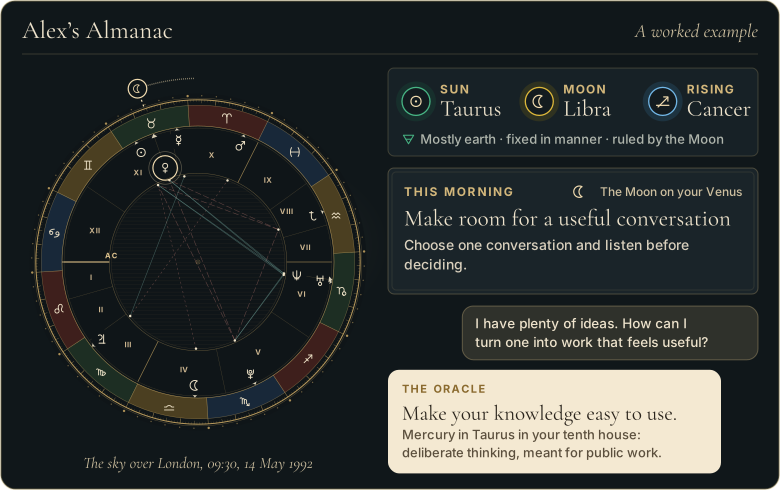
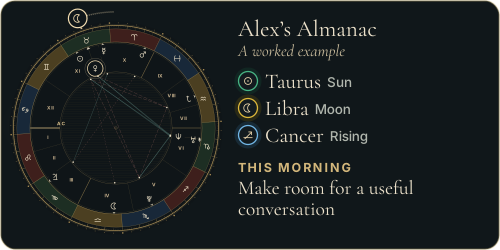
Walk through Alex’s whole example first
 The Road of AgesSee the turning points of your whole life, from your birth date
See your road's shape
The Road of AgesSee the turning points of your whole life, from your birth date
See your road's shape
Prefer to explore first?
 The Road of AgesThe turning points of your whole life, from your own chart
Walk my road
The Road of AgesThe turning points of your whole life, from your own chart
Walk my road
Free, by email
Your daily Almanac letter
One short letter at 7 each morning: the day’s theme read for your own chart, and one thing to do with it.
What waxing means astronomically
Sunlight always illuminates roughly half of the Moon. As the Moon orbits Earth, observers see different fractions of that lit hemisphere. Just after conjunction with the Sun, a thin crescent becomes visible; near first quarter, the Moon is about 90 degrees from the Sun and appears half lit; during waxing gibbous, more than half of the visible disk is illuminated; at opposition, it appears full. “Waxing” describes the increasing visible fraction, not Earth’s shadow and not a physical change in lunar size. Earth’s shadow matters during a lunar eclipse, not ordinary monthly phases.
A one-minute story
The Wandering Stars
How the moving planets were watched, named and found, and what a transit is.

When and where to look
A young waxing crescent is seen low in the western sky after sunset and sets relatively soon afterward. By first quarter, the Moon is high around sunset and sets near midnight. A waxing gibbous Moon rises during the afternoon, becomes prominent in the east or southeast around evening, and remains visible much of the night. Exact times depend on date, latitude, season, and orbital details. In the Southern Hemisphere the illuminated side appears reversed relative to common Northern Hemisphere diagrams, but the Moon is still waxing because its illuminated fraction is increasing.
How phase is calculated
A practical phase measure uses the elongation between geocentric solar and lunar longitudes. Near 0 degrees lies new Moon; near 90 degrees first quarter; near 180 degrees full Moon. During the waxing half, elongation increases through these values under a chosen directional convention. Exact phase moments require an ephemeris calculation rather than assigning every calendar day a fixed label. “Moon age” counts time since new Moon but varies slightly because lunar motion is not uniform. An almanac should give the time zone and distinguish an exact quarter event from the broader crescent or gibbous family.
Waxing Moon symbolism in astrology and ritual calendars
Astrological and folk traditions commonly associate waxing phases with increase, building, visibility, growth, attraction, and movement toward culmination. A natal waxing Moon may be discussed through phase relationships between Sun and Moon; electional traditions may prefer waxing light for matters intended to develop. These are symbolic conventions, not evidence that the Moon guarantees business growth, healing, conception, or success. The phase also cannot replace weather, agronomy, medical guidance, or project planning. Its most grounded use is as a memorable cycle marker for setting, reviewing, and completing ordinary intentions.
How to use Waxing Moon responsibly
Astrological terminology is most useful when the calculation and interpretive convention are stated separately. For Waxing Moon, a careful account identifies the chart factors, degrees, or classification rule first, then explains what astrologers have traditionally inferred from them. Different schools may use different orbs, planets, house systems, or symbolic vocabularies, so a borderline result should be described rather than forced into a label. Astrology is a historical divinatory practice, not a scientifically validated method for diagnosing personality or predicting events. Treat the interpretation as a bounded symbolic hypothesis, compare it with the full chart and lived evidence, and never use it to replace medical, legal, financial, mental-health, or safeguarding advice.
Sources and editorial method
Research and editorial references used for this page include:
- NASA Science: Moon Phases - Authoritative explanation of lunar illumination and the eight familiar phase names.
- NASA Scientific Visualization Studio: Moon Phase and Libration - Observed phase geometry, visibility, and detailed lunar visualizations.
These references support the factual, historical, textual, or interpretive claims on this page. Interpretive traditions are identified as such, and factual claims are kept separate from symbolic claims.
Related reading
Build with the Moon
Waxing Moon in a book is one thing; Waxing Moon in your own birth chart is your life. The Oracle casts your real chart and tells you what it means for your love, your work, and your year ahead, in conversation. It opens with the 7-day Seeker trial.
Speak with the OracleThe Cosmic Codex reads a whole year of transits against your own chart, Waxing Moon included where it touches your love, your work, your timing. Open the Cosmic Codex
More in Transits & Cycles
- Direct Motion
- Jupiter Cycle
- Mansions of the Moon
- Outer Planet Transit
- Post-Shadow Period
- Saturn Cycle
- Synodic Cycle
- Transit Window
From the reference page to your own chart
Every word here
is in your own chart.
- A personal reading about love, work or purpose, written from your chart
- A practical next step to consider
- It opens with 7 days free, with the AI Oracle and daily guidance
$0 today, then $12/month after 7 days. Cancel anytime.
Common questions
Does waxing mean the right side is lit?
That shortcut applies to a common Northern Hemisphere orientation; use increasing illumination, not screen direction, as the definition.
Is first quarter a half Moon?
The visible disk looks half illuminated, but “quarter” refers to the Moon being one quarter through its phase cycle.
How long does the waxing period last?
Roughly half of the 29.5-day synodic month, from new Moon to full Moon.
Free, by email
The Almanac, in your inbox at 7
One short letter at 7 each morning: the day’s theme read for your own chart, and one thing to do with it.
