Planetary cycles and phase
Synodic Arc
Direct answer
Name both bodies, viewpoint, zodiac or longitude frame, and subtraction order. Compute the second longitude minus the first and normalize the result to 0°–360°. Reversing the order changes an arc of 40° into 320°, even though the smallest unsigned separation remains 40°.
A synodic arc is the angular phase relationship between two celestial bodies as observed in a chosen coordinate system. It is usually measured directionally from one body to the other across a 0°–360° cycle, with conjunction at 0° and opposition at 180°.
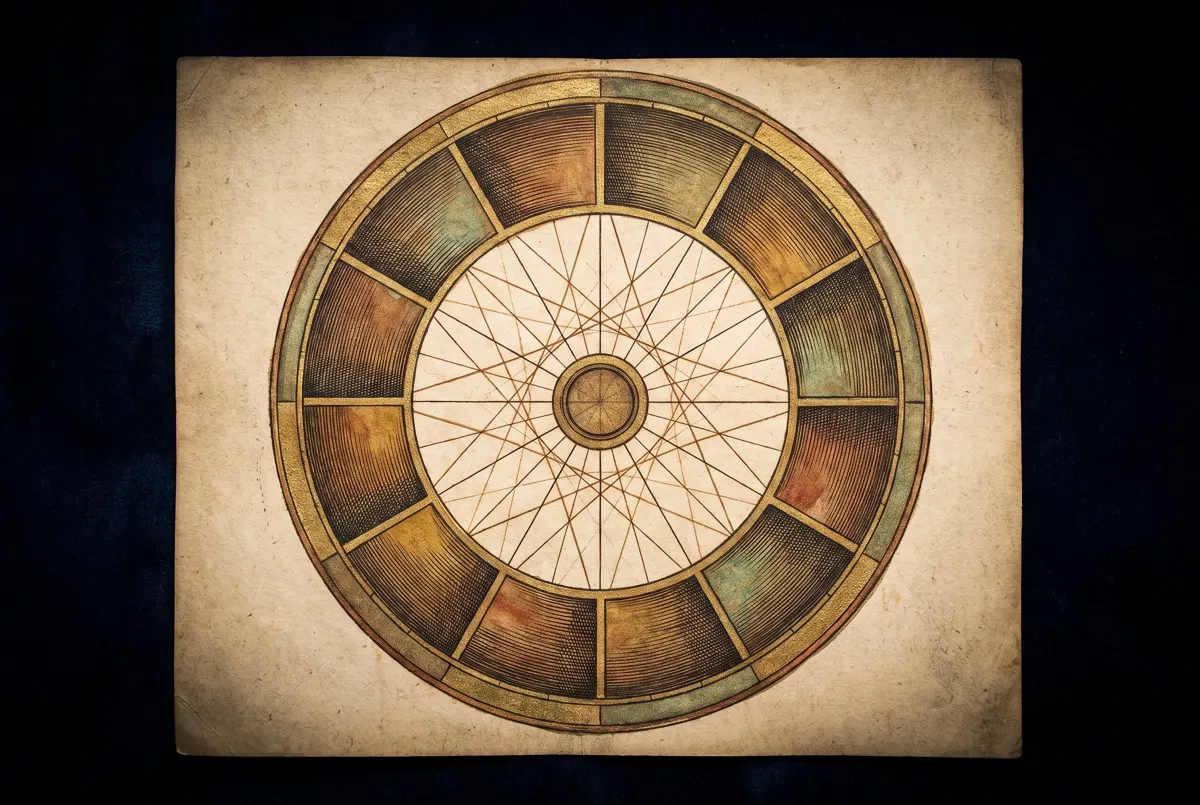
Synodic Arc means the angular distance between bodies within a shared cycle.
A structural orientation; exact placements depend on the chart or technique being discussed.Quick facts
| Phase point | Directed arc |
|---|---|
| Conjunction | 0° or 360°, the start and completion of a phase cycle. |
| Opening square | 90° when the faster body has advanced one quarter cycle from conjunction. |
| Opposition | 180°, maximum elongation in the abstract longitude cycle. |
| Closing square | 270°, equivalent to 90° in smallest separation but different in phase direction. |
The Instruments
Ten readings, worked out from your own birth chart
An instrument is a reading this house works out for you. Give your birth date, time and place once, and each one reads today’s real sky against the chart you were born under. Eight are personal; two are calendars anyone can open. A free account opens one instrument a day. The plans open every instrument, every day.
- Natal Chart Every planet, house and aspect in your chart
- Active Transits Where the planets are now, read against your chart
- Daily Counsel What to pursue today, and what to leave alone
- Personal Timing Your best days to decide, weeks ahead
- Fellowship Your chart and another, read side by side
- Theme of the Day The one thing today is asking of you
- Sacred Numbers Your life path, your cycles, your name in numbers
- Aeolian Harmonics Classical music chosen to match your chart
- Mercury Retrograde Every Mercury retrograde this year, with its dates Open to all
- Void-of-Course Moon When the Moon is between signs, hour by hour Open to all








Arc, phase, and synodic cycle
Synodic means relating to alignment or conjunction. As two bodies move at different angular rates, the arc between them grows, reaches opposition, closes, and returns to conjunction. The synodic period is the time from one equivalent alignment to the next; the synodic arc is the phase angle at a particular moment. For the Moon and Sun, this cycle underlies lunar phases. For Jupiter and Saturn, successive conjunctions divide a much longer cycle. The concept can be astronomical even when later interpretation is astrological.
How to calculate a directed synodic arc
Choose an ordered pair, often slower body first and faster body second. Convert both positions to the same kind of longitude and epoch. Subtract reference longitude from moving-body longitude, then add 360° to a negative result or reduce values of 360° and above. If Jupiter is at 110° and Saturn at 80°, Saturn-to-Jupiter is 30° while Jupiter-to-Saturn is 330°. A report that gives only “30° apart” loses whether the phase is opening or closing under the selected convention.
Geocentric, heliocentric, and observational distinctions
A geocentric ecliptic arc can differ from a heliocentric arc because the viewpoint changes. Tropical and sidereal longitudes shift both bodies by a similar reference offset at one time, usually preserving their mutual arc, but differing precession models and coordinate details should still be stated. Longitude phase is also not identical to the true three-dimensional angle on the sky when latitude or declination is substantial. For inner planets, observational elongation from the Sun has physical visibility constraints; a generic 0°–360° phase diagram should not imply every longitude geometry is equally observable.
Using synodic arcs in mundane and natal astrology
Astrologers study planetary pairs as cycles: conjunction initiates a shared sequence, the opening half develops outward, opposition brings culmination or confrontation, and the closing half integrates or releases. Some divide the full arc into aspects or phase families and compare a person’s birth phase with later returns. Interpretation must name the pair because Mars-Saturn and Venus-Sun cycles have different conventional symbolism. Exact astronomical calculation does not validate event prediction; historical correlations need defined samples, nonmatching cases, and avoidance of retrospective cherry-picking. Use the arc as an organized timing lens, not proof of fate.
Sources and editorial method
Research and editorial references used for this page include:
- Encyclopaedia Britannica: Synodic period - Astronomical definition of recurrence relative to the Sun or another reference alignment.
- NASA JPL: Horizons system manual - Technical reference for coordinate systems, observer centers, time scales, and ephemeris output.
These references support the factual, historical, textual, or interpretive claims on this page. Interpretive traditions are identified as such, and factual claims are kept separate from symbolic claims.
Related reading
Read it in your chart
Synodic Arc in a book is one thing; Synodic Arc in your own birth chart is your life. The Oracle casts your real chart and tells you what it means for your love, your work, and your year ahead, in conversation, free.
Speak with the OracleHow Synodic Arc lives in your own chart across your year, in love, in work, in timing, is written in the Cosmic Codex: the whole year, once. Open the Cosmic Codex
More in Astrology
- Accidental Dignity
- Bonification
- Decennials
- Esoteric Astrology
- Hayz
- Masculine Signs
- Oriental Planet
- Rulership
Common questions
Is synodic arc the same as synodic period?
No. Arc is the angular phase at a moment; period is the elapsed time between equivalent alignments such as conjunctions.
Why does subtraction order matter?
A directed cycle distinguishes opening from closing phases. Reversing the reference body produces the complementary angle, such as 40° versus 320°.
Is opposition always exactly maximum visible separation?
It is 180° in the chosen longitude cycle. Actual apparent angular separation on the celestial sphere can differ because of latitude and observing geometry.