
Astrology
Why Easter Moves
Direct answer
Why Easter Moves: Easter is the Sunday after the first full moon on or after the spring equinox, a rule that grew from the Council of Nicaea in 325, which is why its date moves from year to year.
7 days free, $0 today. Your reading is written from your chart, then opens with a Seeker trial: payment details required, then $12/month. We email you 2 days before it ends; cancel on your billing page before then and you pay nothing.
At a glance
- Also called
- how is the date of easter set, easter equinox, when is easter decided, easter date rule
- In astrology
- The spring equinox is the moment the Sun crosses the celestial equator northward, the start of Aries.
- Found in
- Astrology
- Related
- March Equinox, Equinox, Aries, Lamb
Easter is the Sunday after the first full moon on or after the spring equinox, a rule that grew from the Council of Nicaea in 325, which is why its date moves from year to year.
A structural orientation; exact placements depend on the chart or technique being discussed.
What does your own chart say about you?
Choose love, work or purpose. Your reading is written from your chart. Your reading uses your own birth details.
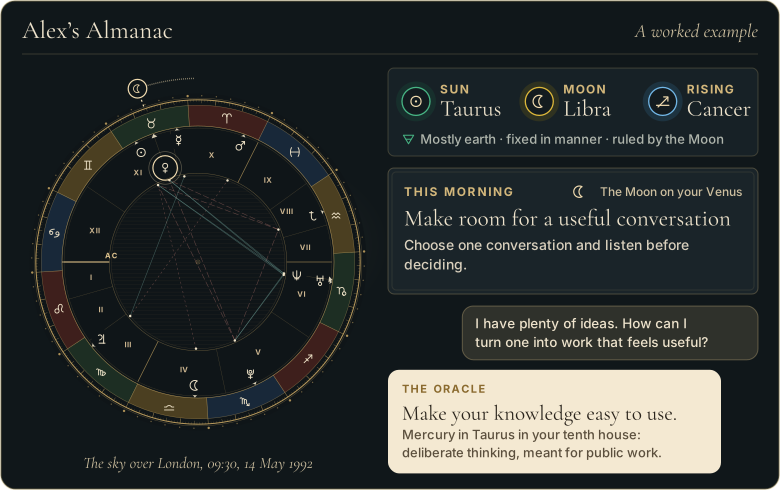
Walk through Alex’s whole example first
 The Road of AgesSee the turning points of your whole life, from your birth date
See your road's shape
The Road of AgesSee the turning points of your whole life, from your birth date
See your road's shape
Prefer to explore first?
 The Road of AgesThe turning points of your whole life, from your own chart
Walk my road
The Road of AgesThe turning points of your whole life, from your own chart
Walk my road
How is the date of Easter decided?
Easter has no fixed date because it is tied to both the Sun and the Moon. The Council of Nicaea in 325 required one common Sunday for all churches, and the Alexandrian reckoning that followed fixed it as the Sunday after the first full moon on or after the spring equinox, so it can fall at any time from late March to late April.
The sun-myth writers read the same date as a solar event. J. H. Hill, in the 1890s, set Passion Week at the equinox, three days of death around 21 March, the resurrection on 25 March, and the Annunciation on the same day.
A one-minute story
The Book of the Sky
How people learned to read the sky, from Babylon to the day you were born.

Nicaea and the full-moon rule
The Council of Nicaea in 325 did not invent the full-moon rule: it asked that all churches keep Easter on one Sunday, apart from the Jewish reckoning. The rule that later tables put into practice, worked out in Alexandria, sets that Sunday after the first full moon falling on or after 21 March. That ties it to the Sun, through the equinox, and to the Moon, through the full moon, so the date shifts each year, and the whole range runs from late March to late April.
Hill adds that Ash Wednesday, in his festival list, came from Nicaea.
Hill's passion week at the equinox
Hill reads the last week before Easter as an astronomical drama. He puts the culmination of Passion Week at the equinox, 21 March, as three days of death, which he sets beside the weeping for Tammuz and Adonis in Ezekiel 8:14 and the Prometheus Bound of Aeschylus, which he calls a passion play. He puts the resurrection on 25 March and says new fire was brought down by Perseus, the constellation at the vernal equinox in his count.
He also lists the Annunciation on 25 March, when the spring genius, Gabriel in his reading, greets Virgo, and the Ascension 40 days after Easter on 4 May, a chariot of fire as with Elijah in 2 Kings 2:11. Those are his arguments about the church calendar. They are not the documented history of the feasts.
The name, and the lamb
The English name Easter is traditionally linked to Eostre, a spring goddess, and Hill cites it. The older and more common Christian name for the feast, Pascha, comes from the Hebrew Passover.
Hill reads the Lamb of God of John 1:29 as an image of Aries, the sign of the spring equinox in the age he calls the Age of the Ram. See Lamb for his chain from bull to ram to fish.
The story behind Why Easter Moves
The council and the Alexandrian rule are documented history. The astronomical reading of the Passion and Resurrection as the death and return of the sun is Hill's, drawing on earlier writers such as Robert Taylor, and historians of religion do not accept it.
Why Easter Moves in astrology
The zodiac and the church year both begin their spring there.
Why Easter Moves in practice: an example
If the full moon falls on a Sunday, Easter is the following Sunday. If the full moon is on 20 March, before the equinox, the next full moon decides the year.
Sources and editorial method
This entry summarizes the tradition in the Almanac's own words; where no source is listed, it is an editorial summary rather than a primary text, and symbolic readings are named as the tradition's, not as fact.
- Source
- The Great Almanac Dictionary
- Category
- Astrology
- Aliases
- how is the date of easter set, easter equinox, when is easter decided, easter date rule, easter and the spring equinox
- Last updated
- 2026-09-26
See Why Easter Moves in your personal almanac
Why Easter Moves in a book is one thing; Why Easter Moves in your own birth chart is your life. The Oracle casts your real chart and tells you what it means for your love, your work, and your year ahead, in conversation. Your first ten written questions are answered free.
Speak with the OracleHow Why Easter Moves lives in your own chart across your year, in love, in work, in timing, is written in the Cosmic Codex: the whole year, once. Open the Cosmic Codex
Related terms
More in Astrology
- Grand Sextile
- Light of the Time
- Moon Sign
- Primary Motion
- Solar Arc
- Unaspected Planet
- Aspect Pattern
- Collection of Light
From the reference page to your own chart
Every word here
is in your own chart.
- A personal reading about love, work or purpose, written from your chart
- A practical next step to consider
- It opens with 7 days free, with the AI Oracle and daily guidance
7 days free, $0 today. Your reading is written from your chart, then opens with a Seeker trial: payment details required, then $12/month. We email you 2 days before it ends; cancel on your billing page before then and you pay nothing.
Common questions
How is the date of Easter decided?
It is the Sunday after the first full moon on or after the spring equinox. The Council of Nicaea in 325 asked for one common date, and the Alexandrian reckoning after it gave the rule.
Why does Easter change every year?
Because the Moon's phases do not repeat on the same calendar day each year, and the rule ties Easter to a full moon.
What did Hill say about Easter?
J. H. Hill read Passion Week as three days of the sun's death at the equinox, with the resurrection on 25 March, when he says new fire was brought down by Perseus.
Is Easter an equinox festival?
In its date, yes: the rule is tied to the equinox. The English name is thought by some to come from Eostre, a spring goddess, which Hill also cites.