
As grasshoppers
Twelve spies went up from the wilderness to search out Canaan. They came back with a cluster of grapes so heavy that two men carried it on a staff, and a report of giants at Hebron.
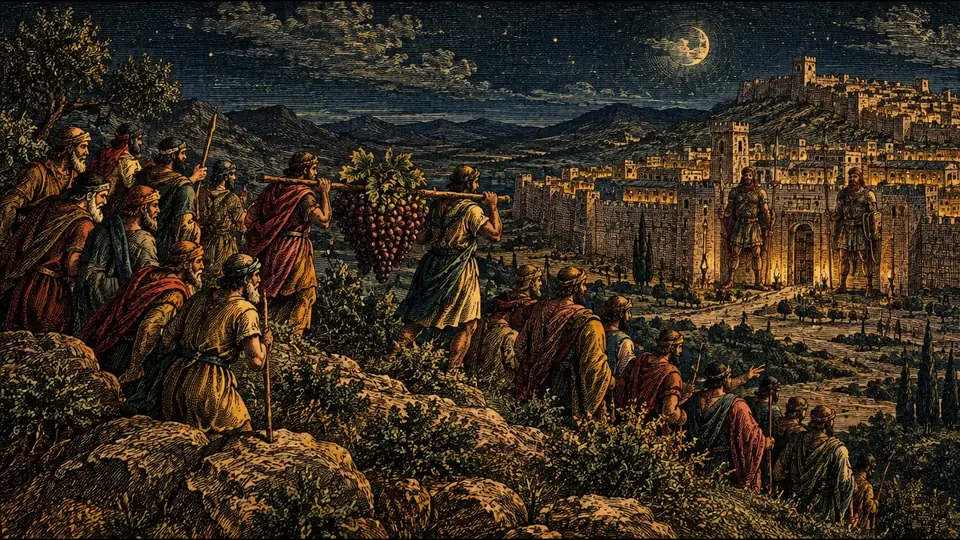
Press play: the paintings change with the story and the words come as the narrator reads them. The whole story is written out below.
Now playing: As grasshoppers
The whole story
The spies came to the brook of Eshcol near Hebron, where they cut the great cluster, and saw the children of Anak, the tallest men they had ever met. Ten of them called it “a land that eateth up the inhabitants thereof” (Numbers 13:32). But Caleb stilled the people and said, “Let us go up at once, and possess it; for we are well able to overcome it” (Numbers 13:30), and Joshua stood with him.
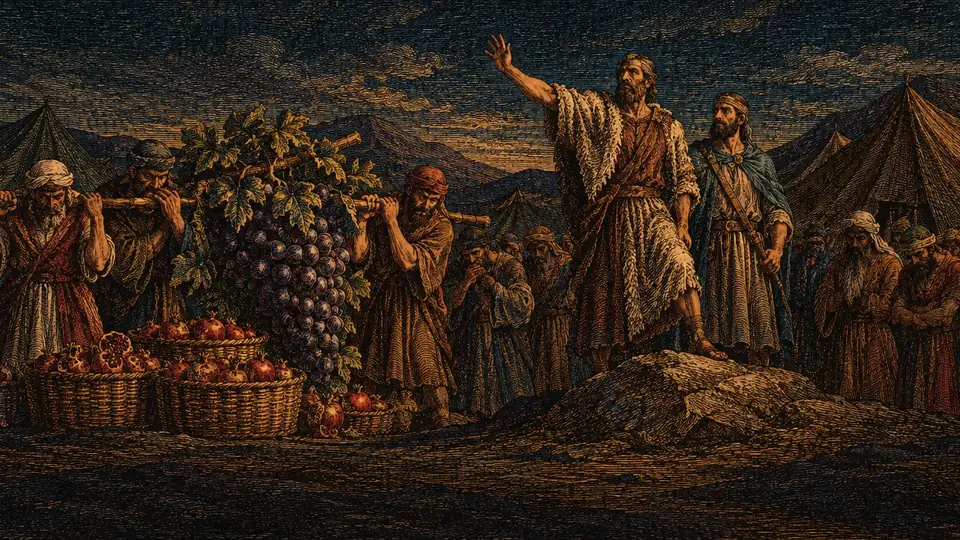
The people believed the ten, and for that the generation that left Egypt wandered forty years and died in the wilderness. Forty-five years later Caleb, at eighty-five, asked for Hebron and drove out the three sons of Anak, Sheshai, Ahiman and Talmai. “And the name of Hebron before was Kirjath-arba; which Arba was a great man among the Anakims” (Joshua 14:15).
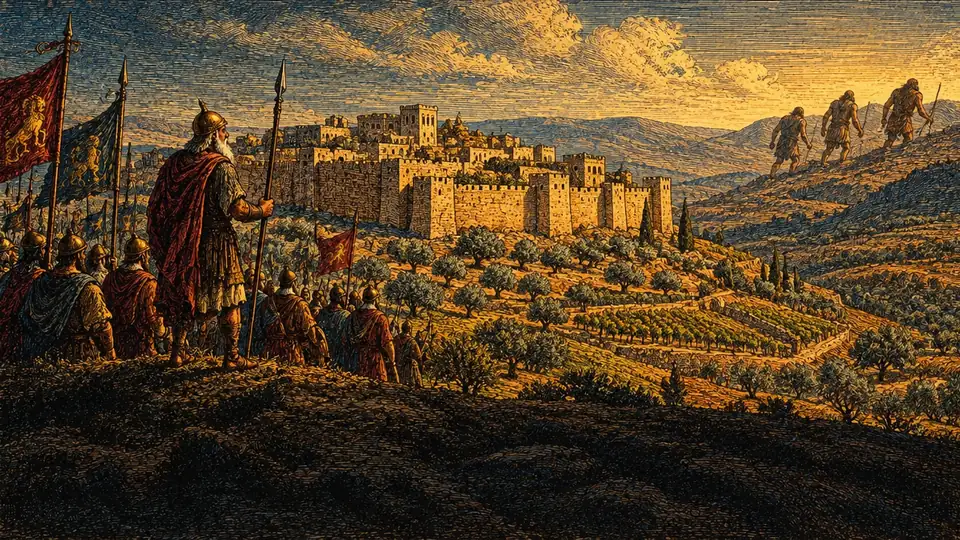
The spies used the same word as Genesis 6, Nephilim, and later readers wondered how giants could live after the flood. Some answered that the spies spoke in fear and made the most of what they saw, others that the word meant only men of great size, others that the giants’ line returned. Hebron is one of the oldest cities of the land, and its ancient walls still stand on the hill of Tel Rumeida.
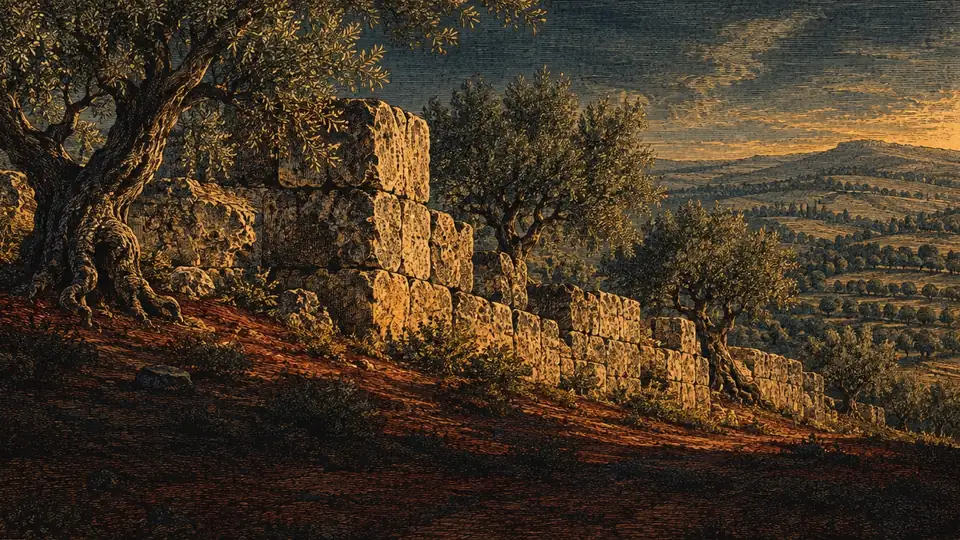
And there we saw the giants, the sons of Anak, which come of the giants: and we were in our own sight as grasshoppers, and so we were in their sight.
Numbers 13:33, KJV
Where it happened
Hebron (site by tradition).
Hebron is known. The cave of Machpelah has been honored for two thousand years under the great walled building there.
Every story stands at its place on the Worldwide Watch map: the Bible’s world, on the map.
More from the Exodus
Exodus to Joshua
Sources and editorial method
Research and editorial references used for this page include:
- The King James Bible, as published by bible-api.com
- The Book of Enoch, translated by R. H. Charles (1917), Project Gutenberg
Every story is told from the King James Bible, and from the Book of Enoch in R. H. Charles’s translation (1917) where a story names it. Every quotation was checked word for word against those texts. Where a place is not known, the page says so. The paintings and the narration were made for the house.

