
What are kirtan and the Sufi dhikr, and what does singing the divine names mean to those who do it?
What it is
Many traditions hold that the most direct prayer is to say or sing a name of God, again and again, often together. In India this is kirtan: a leader sings a line of divine names and the gathering sings it back, to drum, cymbals and harmonium, sometimes for hours. A bhajan is a devotional song of the same family, sung more freely. Sikh worship centres on kirtan of the hymns of the Guru Granth Sahib, which are arranged by raga, the melodic framework each is sung in. In Islam the Sufi orders practise dhikr, the remembrance of God, repeating phrases of the Qur'an and the divine names aloud or in the heart, each order in the manner its teachers handed down.
The teaching
As the devotional singing of the bhakti saints, the Sikh Gurus and the Sufis teaches it.
The name and the named
The devotional traditions hold that a name of God is not a label but a presence: to sing it is to be with the one named. A verse that Chaitanya made the motto of his movement says it three times over: the name of Hari, the name of Hari, the name of Hari alone; in this age of Kali there is no other way, no other way, no other way. Singing the names together, aloud, is for this teaching the practice best fitted to the present age.
Kirtan
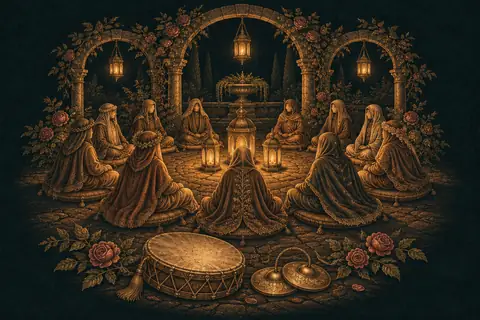
Kirtan is call and response. A lead singer sings a line of divine names and the gathering sings it back, again and again, to the clay drum, the hand cymbals and the harmonium. It usually begins slowly, gathers pace and volume as the singers are drawn in, rises to a height, and slows again to stillness, often closing with a prayer.
The best known chant is the great mantra of Chaitanya's tradition, Hare Krishna, Hare Krishna, Krishna Krishna, Hare Hare, Hare Rama, Hare Rama, Rama Rama, Hare Hare, in which Hare calls on the divine energy, Krishna names the all-attractive, and Rama the one who delights. Others sing Om namah shivaya, the five syllables of homage to Shiva, or sri ram jai ram jai jai ram, victory to Rama.
The bhajan
A bhajan is a devotional song with verses, freer than kirtan, often the work of a named poet-saint, who signs the song by naming themselves in its last line. Mirabai's songs end with Mira's lord, Giridhar Nagar, the Mountain Lifter; Kabir's with Kabir says; Surdas and Tulsidas sign theirs as well. In Maharashtra the Varkari pilgrims walk each year to the temple of Vitthal at Pandharpur singing the songs of Tukaram and Jnaneshwar as they go.
Kirtan in the gurdwara
For Sikhs kirtan is the singing of the hymns of the Guru Granth Sahib itself, which the Gurus set to the ragas in which the scripture is arranged, sung in the gurdwara by musicians with harmonium and tabla. The Gurus taught that in this dark age the singing of God's praise is the highest practice. The day has its own hymns, from Asa di Var sung at dawn to Kirtan Sohila at night. Beside the singing stands naam simran, the remembering of the name, Waheguru, within, and Guru Nanak's three rules for life: remember the name, earn by honest work, and share with others.
Dhikr
In Islam the remembrance of God is commanded by the Qur'an itself: remember Me and I will remember you; remember God with much remembrance. Every Muslim may keep the remembrance after the daily prayers that the Prophet taught, thirty-three times glory be to God, thirty-three times praise be to God, and thirty-four times God is greatest, counted on the fingers or on beads. The Sufi orders build on this, repeating the first half of the declaration of faith, there is no god but God, or the name Allah, or Hu, He, in forms that each order hands down.
The circle
In many orders the brethren stand or sit in a circle, the halqa, and the remembrance is sung and breathed together, the rhythm rising and the phrases shortening as it quickens, until the circle seems to breathe as one. The Naqshbandis keep it silent, in the heart. The masters set conditions for listening to music and poetry, sama: al-Junayd said that it needs the right time, the right place and the right brethren. A circle is entered at a teacher's invitation, and its forms are learned there.
The name kept unspoken
Judaism shows the same reverence by the opposite road. The four-letter name of God is not spoken at all: in prayer Adonai, my Lord, is said in its place, and in ordinary speech HaShem, the Name. The Mishnah tells that once a year, on the Day of Atonement, the high priest spoke the Name in the Temple, and the people who heard it fell on their faces and answered: blessed be the name of the glory of His kingdom for ever and ever. Jews still say those words, softly, after the first line of the Shema.
In the churches
Christian worship has its own repeated cries. The Kyrie eleison, Lord have mercy, is sung at every Mass, and the Orthodox repeat it forty times at certain points of their services. The Jesus Prayer is the repeated name at its most inward. In recent decades the community of Taizé in France has taught short chants of a line or two, sung over and over by gatherings of every church and of none, so that the words sink in as they are repeated.
Coming as a guest
In all these traditions the singing belongs to the gathering, and a visitor joins as a guest. Shoes are left at the door of a temple or a gurdwara, and in the gurdwara the head is covered. Food that has been blessed, the prasad of the temple or the langar of the gurdwara, is offered to all who come. One sits where others sit, joins the response when it feels right or simply listens, and leaves the leading to those whose practice it is.
How it is practised
These are gatherings of living faiths, and the way to know them is as a guest. Most temples, gurdwaras and kirtan groups welcome visitors: sit where others sit, cover the head or remove shoes as the house asks, and join the response when it feels right or simply listen. A Sufi circle is entered by invitation and under a teacher, so its dhikr is described here and not prescribed. At home, the part that travels is the form of call and response: singing a simple line back and forth with others, in any song a household shares, at an easy loudness.
Where it comes from
Devotional singing in the languages of the people spread through India with the bhakti movements, from the Tamil poet-saints of the sixth to ninth centuries to Kabir, Mirabai and Tukaram in the north and west. Chaitanya, in Bengal in the early sixteenth century, made the public singing of Krishna's names the centre of religious life, and his tradition took root in the West from 1966. Guru Nanak, who died in 1539, taught through sung hymns, and his companion Mardana played the rabab beside him. In the Islamic world the Sufi brotherhoods gave dhikr its settled forms from the twelfth century onward, the Qadiri and Mevlevi orders among them.
What is known, and what is not
That people feel closer to one another after singing together has some support in the study of music: several studies report a lift in mood and a higher tolerance of pain after group singing, which researchers link to the body's own opioids. A study from Oxford in 2015 found that singing classes bonded faster than other classes. These findings concern singing in company in general. What the name sung means, and whom it reaches, is the teaching of each tradition and lies outside what such studies measure.
Its words
 Kirtan
- Devotional singing in call and response: a leader sings a line of divine names or a hymn and the gathering sings it back.
 Bhajan
- A devotional song of the Indian religions, sung alone or together, freer in form than kirtan and often the work of a named poet-saint.
 Dhikr
- The remembrance of God in Islam: phrases of the Qur'an and the divine names repeated aloud or in the heart, in the manner each Sufi order hands down.
- Hare Krishna mantra
- Sixteen words made only of the names Hare, Krishna and Rama, sung in kirtan and counted on beads. Its tradition calls it the maha-mantra, the great mantra.
- Raga
- A framework for melody in Indian classical music: chosen notes, set ways of moving between them and a mood, inside which the player improvises.
Ask the Oracle further
What is the difference between kirtan and a bhajan?Why do so many faiths chant the names of God together?
Before you practise
Chant slows the breath and steadies the heart’s rhythm, and singing together lifts mood. No pitch, tone or “frequency” has been shown to heal anything. Keep it gentle and never loud: loud sound harms hearing for good. Sound is no substitute for a doctor’s care.
Its other branches
MantraThe syllable OmChant in the monasteriesBowls and gongsThe claims for a pitchWhat chanting does in the bodyThe whole artSearch the tree

