
Mantra
A sound, a word or a verse repeated: what the Indian traditions say a mantra is.
What is a mantra in the Indian traditions, and how is one used?
What it is
A mantra is a sound, a word or a verse that is repeated, aloud, under the breath or silently. The word is Sanskrit. In the Vedas a mantra is a verse of a hymn, chanted exactly in the rite. In later Hindu, Buddhist, Jain and Sikh practice it is more often a short formula given to be repeated, and the practice of japa counts the repetitions on a string of beads. Some mantras are sentences with a plain meaning, as the Gayatri mantra of the Rig Veda is. Others are single syllables, called bija or seed mantras, which the traditions say carry their force in the sound and not in any sense.
The teaching
As the Indian and Tibetan teaching of mantra teaches it.
What a mantra is
The word joins man, to think, with tra, an instrument: a mantra is an instrument of the mind, and an old gloss reads it as what delivers the one who dwells on it. A mantra may be a verse of a hymn with a full meaning, a short formula of praise or refuge, or a single seed syllable whose force, the teachers say, lies in the sound itself. In every case it is meant to be repeated, with attention, and the repetition is the practice.
The parts of a mantra
Before a mantra is repeated, the Tantric manuals name its parts. Its seer, rishi, is the sage who first heard it in meditation. Its metre, chandas, is the measure in which it is cast. Its deity, devata, is the presence it calls on. Its seed, bija, is the syllable at its core; its power, shakti, is the energy it carries; and its pin, kilaka, is what holds that power fast until the mantra is rightly received. As the seer, the metre and the deity are named, the practitioner touches the head, the mouth and the heart.
The Gayatri
The most revered of the Vedic mantras is the Gayatri, a verse of the Rig Veda addressed to Savitri, the Sun as the power that rouses all things. It is prefaced by Om and by three words for the earth, the middle air and the heavens, and its meaning is: we meditate on the glorious radiance of the divine Savitri; may he stir our minds. In orthodox families it is given at the sacred thread ceremony, from teacher to pupil, and recited at dawn, noon and dusk. Reform movements of the last two centuries open it to everyone, and both views are held today.
Counted repetition
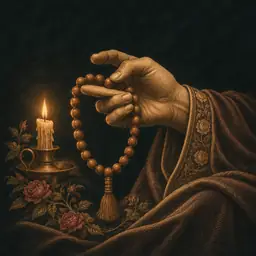
Japa is the repetition of a mantra a set number of times. It may be spoken aloud, whispered with moving lips, or said only in the mind, and the manuals rank them in that order, with the silent highest. The count is kept on a string of a hundred and eight beads with one larger bead, the meru, that marks the round; at the meru the string is turned and the count goes back the other way, without crossing it. In the Hindu custom the beads are drawn over the middle finger by the thumb, and the forefinger is kept away from them.
Patanjali gives the rule that governs all of it: repeat it, and dwell on its meaning. The pace is the mantra's own, set by an easy breath, and the voice is never louder than quiet speech. A practice that leaves one dizzy or strained has been pushed too hard.
Receiving a mantra
In the Tantric schools and many devotional ones a mantra is given at initiation, diksha, by a guru, who whispers it into the pupil's ear, and it is then kept private. The teaching is that a mantra received in this way is alive, carrying the force of the lineage that has repeated it, while one picked up from a book is only words. For this reason the house describes such mantras and does not hand them out.
Seed syllables
The bija mantras are single syllables, most ending in the nasal hum, each tied to a deity. Hrim is the seed of the Goddess as ruler of the worlds, Shrim of Lakshmi, Aim of Sarasvati, Klim of desire and of Krishna, Krim of Kali, and Gam of Ganesha. In the yoga of the body the five elements and the centres along the spine have seeds of their own: lam for earth at the base, vam for water, ram for fire at the navel, yam for air at the heart, ham for space at the throat, and Om between the brows. The teachers say these sounds work through the attention that rests in them. They are a path of attention, not a cure for anything.
Om mani padme hum
In Tibet the most loved mantra is that of Avalokiteshvara, the bodhisattva of compassion: Om mani padme hum, read as the jewel in the lotus, or as a call to the one who holds the jewel and the lotus. The jewel is taken for compassion and the lotus for wisdom. Tibetan teachers give each of its six syllables to one of the six perfections, generosity, ethics, patience, effort, concentration and wisdom, or to the closing of the door to one of the six realms of rebirth. It is spoken, sung, carved on stones and turned in prayer wheels, so that the whole land seems to repeat it.
Other mantras of the Buddhist lands
The Heart Sutra ends with a mantra that sums up the whole perfection of wisdom: gate gate paragate parasamgate bodhi svaha, gone, gone, gone beyond, gone altogether beyond, awakening, so be it. In the Pure Land schools of Japan the whole practice is the nembutsu, namu amida butsu, I take refuge in the Buddha of infinite light, said with trust rather than effort. In the Nichiren schools it is the title of the Lotus Sutra, namu myoho renge kyo.
The Jain and Sikh mantras
The great mantra of the Jains, the Navkar, bows to five kinds of being: the arihants who have conquered the passions, the siddhas who are wholly freed, the acharyas who lead the orders, the upadhyayas who teach, and all the monks and nuns of the world. It names no person, only the qualities worth honouring.
The Sikh scripture opens with the Mul Mantar, the root mantra, which sets out the nature of God: one, whose name is truth, the creator, without fear and without enmity, timeless in form, unborn, self-existent, known by the Guru's grace. Sikhs repeat the name Waheguru, wonderful Lord, as their meditation.
How it is practised
Where a tradition gives a mantra through a teacher, with an initiation, the house describes that and does not hand one out. What anyone may try is the bare form of the practice. Sit comfortably, choose a plain word that carries no charge, such as peace or one, and repeat it quietly on each slow out-breath for five minutes, at the loudness of ordinary speech or softer. When attention wanders, come back to the word. Public mantras such as the Hare Krishna maha-mantra belong to those who sing them, and the way to learn them is to go and listen.
Where it comes from
The oldest mantras are the verses of the Rig Veda, composed by about 1200 BCE and kept by memory with such care that reciters learned each hymn in several fixed patterns that repeat and reverse the order of its words. The Tantric traditions of the first millennium CE multiplied the short formulas and seed syllables, and taught that a mantra must be received from a teacher. Buddhism carried mantras across Asia: the six syllables Om mani padme hum belong to the bodhisattva Avalokiteshvara, and are spoken, sung and turned in prayer wheels wherever Tibetan Buddhism is practised. In 1966 the Hare Krishna movement brought one public mantra to the streets of Western cities.
What is known, and what is not
That the Vedic mantras were handed down by voice with great accuracy is documented, and the tradition of Vedic chanting is on UNESCO's list of the intangible heritage of humanity. That slow repetition changes breathing is measured: in a study of 2001, people reciting a yoga mantra breathed about six times a minute. Small trials of mantra repetition report less stress, with the usual limits of small trials. That a mantra's sound works apart from the attention and breath of the person repeating it is a teaching of the traditions, and has not been shown.
Its words
 Mantra
- A sound, a word or a verse that is repeated, aloud or silently. In the Vedas a verse of a hymn; in later practice more often a short formula given to be repeated.
 Japa
- The repetition of a mantra or a divine name a set number of times, aloud, in a whisper or in the mind, usually counted on a string of beads.
 Bija mantra
- A seed mantra: a single syllable such as Om, hrim or klim, which the Tantric traditions say holds its force in the sound and not in any meaning.
- Gayatri mantra
- A verse of the Rig Veda to Savitr, the Sun, asking that he stir the mind. It is named after its metre and recited by Hindus at dawn and dusk.
- Om mani padme hum
- The six syllables of Avalokiteshvara, the bodhisattva of compassion: the mantra that Tibetans say, cut into stones and turn in prayer wheels.
Ask the Oracle further
What is japa, the counted repetition of a mantra?Why do some traditions say a mantra must be given by a teacher?
Before you practise
Chant slows the breath and steadies the heart’s rhythm, and singing together lifts mood. No pitch, tone or “frequency” has been shown to heal anything. Keep it gentle and never loud: loud sound harms hearing for good. Sound is no substitute for a doctor’s care.
Its other branches
The syllable OmChant in the monasteriesSinging the namesBowls and gongsThe claims for a pitchWhat chanting does in the bodyThe whole artSearch the tree

