Astrology
Great Year
Direct answer
Great Year: The Great Year, or Platonic year, is the time the equinox points take to travel once around the zodiac through precession, about 25,800 years, though some traditions give 24,000.
7 days free, $0 today. Your reading is written from your chart, then opens with a Seeker trial: payment details required, then $12/month. We email you 2 days before it ends; cancel on your billing page before then and you pay nothing.
At a glance
- Also called
- platonic year, great platonic year, precessional year, cosmic year
- In astrology
- The Great Year is the unit behind the astrological ages, which divide it into twelve equal parts, one for each sign.
- Found in
- Astrology
- Related
- Precession of the Equinoxes, Age of Aquarius, Age of Pisces, Kali Yuga
The Great Year, or Platonic year, is the time the equinox points take to travel once around the zodiac through precession, about 25,800 years, though some traditions give 24,000.
A structural orientation; exact placements depend on the chart or technique being discussed.
What does your own chart say about you?
Choose love, work or purpose. Your reading is written from your chart. Your reading uses your own birth details.
Walk through Alex’s whole example first
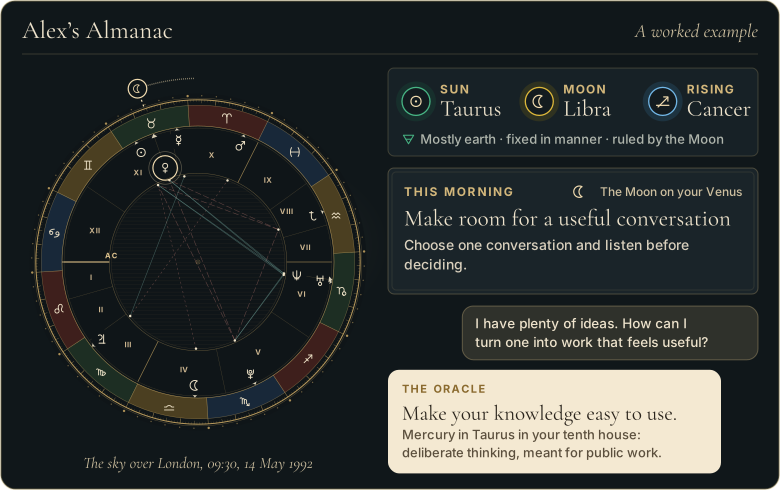
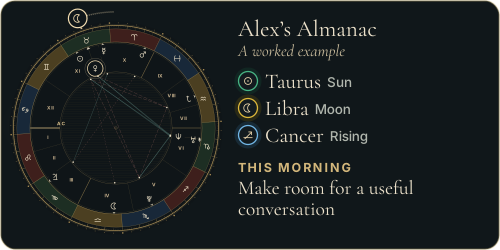
 The Road of AgesSee the turning points of your whole life, from your birth date
See your road's shape
The Road of AgesSee the turning points of your whole life, from your birth date
See your road's shape
Prefer to explore first?
 The Road of AgesThe turning points of your whole life, from your own chart
Walk my road
The Road of AgesThe turning points of your whole life, from your own chart
Walk my road
How long is the Great Year?
The Great Year is the full circuit of precession: the time it takes the March equinox point to move once around the zodiac. Divide the 360 degrees of the zodiac by the rate of precession and you get the length.
At the modern rate of about 50.3 arcseconds a year the circuit is about 25,770 years. The traditional round number is 25,920, which is 72 years a degree times 360. Sri Yukteswar, as Tara Mata reports him, used 24,000. An average age is one twelfth: about 2,150 years.
A one-minute story
The Book of the Sky
How people learned to read the sky, from Babylon to the day you were born.

The circuit in numbers
The length follows from one division: 360 degrees, which is 1,296,000 arcseconds, divided by the yearly rate. The sources give different rates, so they give different lengths. The figures below are computed from the rates stated, not copied.
- Modern value, 50.29 arcseconds a year: about 25,770 years, 71.6 years a degree, 2,148 years a sign
- Traditional round figure, 72 years a degree: 25,920 years, 2,160 years a sign
- Hill (50.25 arcseconds, 71 2/3 years a degree): about 25,800 years, 2,150 years a sign
- Hipparchus's rate as Tara Mata quotes it (50 2/3 arcseconds): about 25,580 years, 2,132 years a sign
- Sri Yukteswar and Tara Mata: 24,000 years, 2,000 years a sign
- G. E. Sutcliffe, quoted by Tara Mata: 23,892 years, about 1,991 years a sign
The spread is about eight percent between the highest and lowest. A date given for an age is only as firm as the rate behind it.
Plato, Firmicus and the older "great years"
The Great Year is older than the astrologers who number it. In the Timaeus Plato describes a perfect year, reached when all the planets complete their circuits and return to the same relative positions. He gives no number.
Firmicus Maternus, writing in the fourth century, speaks of a "greater year" that restores the five planets, the Moon and the Sun to their starting places, and gives it as 1,461 years (Mathesis, preface 5). That is a different cycle from the precessional one and sits close to the Egyptian Sothic period of 1,460 years.
So three things travel under one name: the planetary return of Plato and Firmicus, the precessional circuit of about 25,800 years, and the 24,000-year yuga cycle of Yukteswar. Check which one a source means.
The yuga reading: 24,000 years in two halves
In Sri Yukteswar's scheme, as Tara Mata presents it for Western readers, the circuit is 24,000 years, half descending and half ascending. Each half of 12,000 years holds four yugas in the ratio 4 : 3 : 2 : 1: Satya 4,800 years, Treta 3,600, Dwapara 2,400 and Kali 1,200. Each yuga is ten twelfths main period plus two transition periods (sandhis) of one twelfth each.
Tara Mata sets the lowest point of the cycle at 498 CE and the peak at 12,498 CE. She argues that the ancient Hindu records tied the yuga to a count that later calculators inflated. See Kali Yuga for the dates and for the competing 432,000-year count.
Why 72 shows up everywhere
The traditional figure of 72 years a degree has attracted a lot of numerology. Tara Mata links it to the human pulse of about 72 beats a minute, and to the breath of 18 a minute, which makes 72 breaths in four minutes. She argues that the body is a miniature zodiac, and that in the ascending Golden Age, when precession runs at 60 years a degree, the pulse will be 60. That is her own theory, and physiologists and astronomers do not accept it.
The number itself is simple: 72 times 360 is 25,920. It is also 2 to the third power times 3 squared, which is part of why it appears in so many traditions of counting. For other readings of 72, see Number 72.
The story behind Great Year
The idea of a cycle after which the heavens return to a starting arrangement is ancient. Plato speaks of a perfect year in the Timaeus, and Firmicus Maternus in the fourth century gives a "greater year" of 1,461 years. Precession itself was described by Hipparchus in the second century BCE.
Great Year in practice: an example
At 50.29 arcseconds a year, 1,296,000 arcseconds in a full circle divide to about 25,771 years, or about 71.6 years a degree.
Sources and editorial method
This entry summarizes the tradition in the Almanac's own words; where no source is listed, it is an editorial summary rather than a primary text, and symbolic readings are named as the tradition's, not as fact.
- Source
- The Great Almanac Dictionary
- Category
- Astrology
- Aliases
- platonic year, great platonic year, precessional year, cosmic year
- Last updated
- 2026-09-26
See Great Year in your personal almanac
Great Year in a book is one thing; Great Year in your own birth chart is your life. The Oracle casts your real chart and tells you what it means for your love, your work, and your year ahead, in conversation. Your first ten written questions are answered free.
Speak with the OracleHow Great Year lives in your own chart across your year, in love, in work, in timing, is written in the Cosmic Codex: the whole year, once. Open the Cosmic Codex
Related terms
More in Astrology
From the reference page to your own chart
Every word here
is in your own chart.
- A personal reading about love, work or purpose, written from your chart
- A practical next step to consider
- It opens with 7 days free, with the AI Oracle and daily guidance
7 days free, $0 today. Your reading is written from your chart, then opens with a Seeker trial: payment details required, then $12/month. We email you 2 days before it ends; cancel on your billing page before then and you pay nothing.
Common questions
How long is the Great Year?
About 25,770 years at the modern rate of precession. The traditional round figure is 25,920 years, and Sri Yukteswar used 24,000.
What is the Platonic year?
Another name for the Great Year, the time for the equinox points to circle the zodiac once.
Why is it 25,920 years?
Because tradition counts one degree of precession in 72 years, and 72 times 360 degrees is 25,920.
How long is an astrological age?
One twelfth of the Great Year, about 2,150 to 2,160 years.