Astrological aspects
Cradle Aspect
Direct answer
The complete Cradle used here has one opposition, two trines, and three sextiles. The opposition supplies the central tension; the two planets on one side of that axis create a supportive chain of aspects that can help the tension find expression.
A Cradle is a four-planet aspect pattern built around one opposition. Two additional planets connect the opposed pair through trines and sextiles, while also forming a sextile with one another.
$0 today, then $12/month after 7 days. Cancel anytime.
Quick facts
| Component | Required relationship |
|---|---|
| Opposition axis | One pair of planets approximately 180° apart. |
| Support pair | The two remaining planets are sextile to each other. |
| Four bridges | Each support planet connects to both opposition endpoints by a trine or sextile. |
| Full aspect count | One opposition, two trines, and three sextiles. |
A Cradle Aspect supports an opposition with softer connecting aspects.
A structural orientation; exact placements depend on the chart or technique being discussed.
What does your own chart say about you?
Choose love, work or purpose. Your reading is written from your chart. Your reading uses your own birth details.
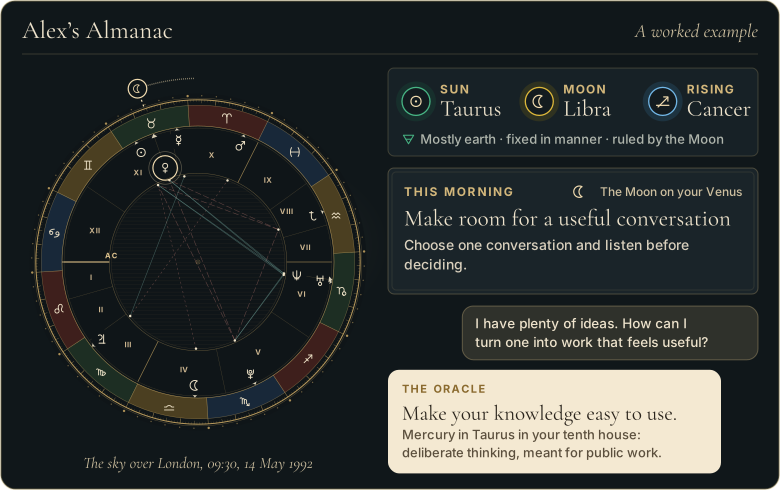
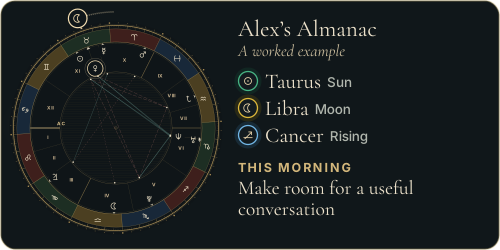
Walk through Alex’s whole example first
 The Road of AgesSee the turning points of your whole life, from your birth date
See your road's shape
The Road of AgesSee the turning points of your whole life, from your birth date
See your road's shape
Prefer to explore first?
 The Road of AgesThe turning points of your whole life, from your own chart
Walk my road
The Road of AgesThe turning points of your whole life, from your own chart
Walk my road
Free, by email
Your daily Almanac letter
One short letter at 7 each morning: the day’s theme read for your own chart, and one thing to do with it.
What forms a Cradle?
The Cradle is a closed four-planet configuration shaped like an open basket or cradle on one side of the horoscope. It begins with an opposition. Two other planets occupy the same side of that opposition and make a sequence of supportive trines and sextiles. In the full geometry defined here, all six pairwise links are present: one opposition, two trines, and three sextiles.
Online definitions are inconsistent. Some illustrations call looser collections of blue aspects a Cradle even when one bridge is absent; some use different allowable orbs; some include angles or asteroids. A trustworthy identification therefore shows the four bodies, all measured separations, the aspect assigned to every link, and the orb rules. The name alone is not enough.
A one-minute story
The Book of the Sky
How people learned to read the sky, from Babylon to the day you were born.

A transparent detection method
- Choose four planets and find exactly one opposition among the six possible pairs.
- Treat the other two planets as the support pair and confirm that they form a sextile.
- Check the four links from the support planets to the two opposition endpoints.
- Require every bridge to be either a trine or a sextile, with both aspect types represented across the completed figure.
- Confirm that the resulting totals are one opposition, two trines, and three sextiles.
- Apply a documented orb policy to every link; a weak sixth link should not be hidden by an attractive diagram.
Opposition and support planets
In astrological interpretation, the opposition describes two functions that demand awareness, balance, negotiation, or projection. It is the only traditionally hard aspect inside the figure. The trines and sextiles do not erase that conflict. Instead, they describe routes through which the opposed planets may communicate or find practical outlets.
Read the opposition first: planets, signs, houses, and topics. Then examine each support planet. A support planet connected by trine may describe a more familiar capacity; a sextile may describe an opening that needs deliberate engagement. Finally, read the support pair’s sextile as a cooperative relationship. If one planet is angular, rules several involved houses, or receives close outside aspects, it may carry more of the pattern’s weight.
Worked example
Consider Mars at 10 degrees Aries opposite Saturn at 10 degrees Libra. Add Jupiter at 10 degrees Gemini and Venus at 10 degrees Leo. Jupiter is sextile Mars and trine Saturn; Venus is trine Mars and sextile Saturn; Jupiter and Venus are sextile. Together these links create the full Cradle geometry.
An astrologer could begin with the Mars-Saturn polarity between immediate action and restraint. Jupiter and Venus may offer communication, perspective, relationship, pleasure, or value-based choices as ways to work with that tension. House placements would make the story specific. Nothing in the shape proves that conflict will be resolved automatically; supportive aspects can also make a familiar coping strategy easy to repeat.
Cradle versus similar patterns
| Pattern | Geometry | Difference |
|---|---|---|
| Cradle | Four planets; one opposition, two trines, three sextiles | Supportive links sit primarily on one side of the opposition. |
| Mystic Rectangle | Two oppositions, two trines, two sextiles | A balanced rectangle with a second opposition. |
| Kite | Grand Trine plus one opposition and two sextiles | Contains a complete three-trine foundation. |
| Grand Sextile | Six planets linked by six sextiles plus wider internal aspects | Forms a full hexagram rather than a four-point cradle. |
Interpretive limits
Cradle symbolism is an astrological convention and has not been scientifically demonstrated as a personality or event mechanism. Avoid claims that the pattern guarantees protection, talent, healing, or an easy life. It contains an opposition, and even the flowing links can describe habits that require consciousness. Treat the figure as a structured prompt: where is the polarity, what resources connect it, and how does the person actually experience those themes?
What sets Cradle Aspect apart
A Cradle is four planets in a chain across half the zodiac: three links of 60 degrees each, which together span 180. The outer two planets stand in opposition, and the two inner ones lie between them on the same side. The chain therefore holds three sextiles, two trines and a single opposition, which is half of a Grand Sextile.
- Planets: four, spaced about 0, 60, 120 and 180 degrees
- Aspects: 3 sextiles, 2 trines and 1 opposition
- Span: half the zodiac, 180 degrees
- Where support lies: both supporting planets fall on one side of the opposition
- Elements: the four signs run through two compatible elements in turn
Often mistaken for something else: The Mystic Rectangle has two oppositions and four corners on both sides of the wheel. The Cradle has one opposition and all its support gathered on one side.
How to recognize a Cradle in a chart
A Cradle is a four-planet pattern built on one opposition. Two further planets sit between the opposed pair on the same side of the chart, and the chain runs: each end of the opposition connects to its neighbor by sextile, the neighbors connect across by trine, and each neighbor also trines or sextiles the far end. Drawn on the wheel it forms a half-hexagon, a rocking-cradle shape holding the opposition like a hammock.
To find one, start with the opposition, then look for two planets roughly sixty degrees apart from the opposition's ends on one side. If both flanking planets aspect both ends harmoniously, the cradle is complete. A cradle missing one link is just an opposition with some support, which is common; the full closed shape is not.
How the pattern tends to behave
The traditional reading is comfort wrapped around tension. The opposition supplies the chart's live polarity, two needs that pull against each other, and the two flanking planets offer easy, talented routes for that tension to discharge: skills, friendships, and habits that soothe the strain without ever resolving it.
That is the pattern's gift and its trap in one. A cradle can make a person unusually resourceful under pressure, because relief is always structurally available. It can also let the central opposition go unworked for years, because the relief is always structurally available. The mature use of a cradle, in this tradition, is to spend its comforts deliberately on the opposition's actual work rather than on avoiding it.
Sources and editorial method
Research and editorial references used for this page include:
- Astrology King: Cradle Aspect Pattern - Modern illustrated discussion of the Cradle and the Huber-influenced aspect-pattern tradition.
- Astrodienst Astrowiki: Aspect Pattern - Background on reading closed aspect figures as integrated patterns.
These references support the factual, historical, textual, or interpretive claims on this page. Interpretive traditions are identified as such, and factual claims are kept separate from symbolic claims.
Related reading
Read your Cradle Aspect
Cradle Aspect in a book is one thing; Cradle Aspect in your own birth chart is your life. The Oracle casts your real chart and tells you what it means for your love, your work, and your year ahead, in conversation. It opens with the 7-day Seeker trial.
Speak with the OracleHow Cradle Aspect lives in your own chart across your year, in love, in work, in timing, is written in the Cosmic Codex: the whole year, once. Open the Cosmic Codex
More in Astrology
From the reference page to your own chart
Every word here
is in your own chart.
- A personal reading about love, work or purpose, written from your chart
- A practical next step to consider
- It opens with 7 days free, with the AI Oracle and daily guidance
$0 today, then $12/month after 7 days. Cancel anytime.
Common questions
How many planets are in a Cradle?
Four planets or eligible chart bodies form the standard pattern described here. Always state whether angles, nodes, or asteroids were allowed.
Is a Cradle the same as a Mystic Rectangle?
No. A Mystic Rectangle contains two oppositions, two trines, and two sextiles. The Cradle described here contains one opposition, two trines, and three sextiles.
Does a wide opposition still count?
Only if it fits the declared opposition orb. Because the opposition anchors the whole figure, stretching it beyond the chosen policy weakens the classification.
Free, by email
The Almanac, in your inbox at 7
One short letter at 7 each morning: the day’s theme read for your own chart, and one thing to do with it.
