
David and Goliath
In the valley of Elah, the shepherd boy David went out against the Philistine giant Goliath with a sling and five smooth stones.
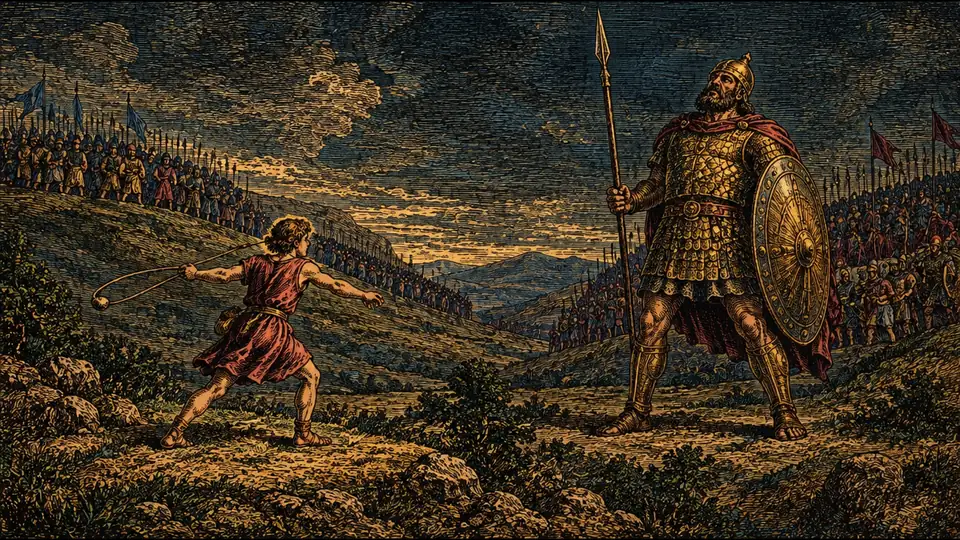
Press play: the paintings change with the story and the words come as the narrator reads them. The whole story is written out below.
Now playing: David and Goliath
The whole story
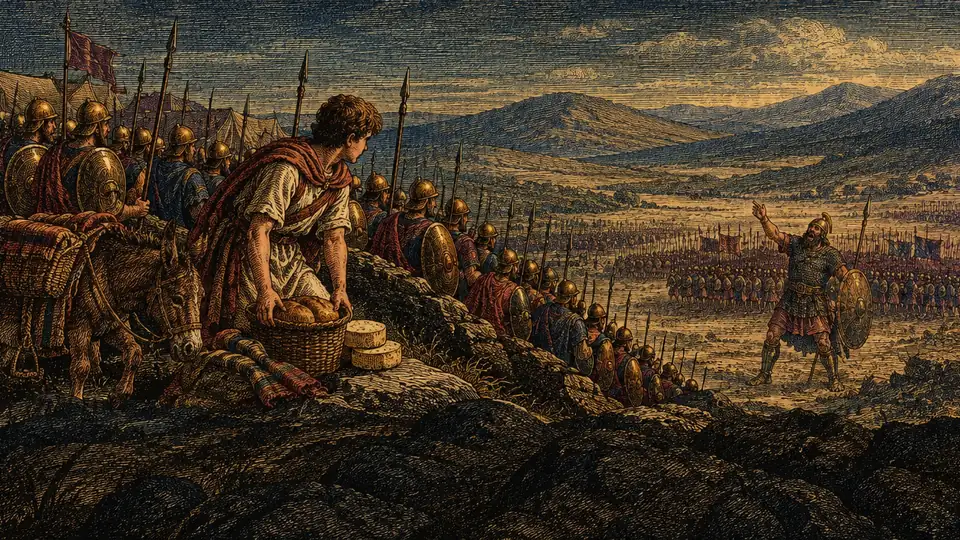
The Philistines stood on a mountain on one side and Israel on the other, with the valley between them. For forty days Goliath of Gath, six cubits and a span tall, in a coat of mail and a helmet of brass, came out morning and evening to defy the armies of Israel. David, sent by his father with food for his brothers, heard him.
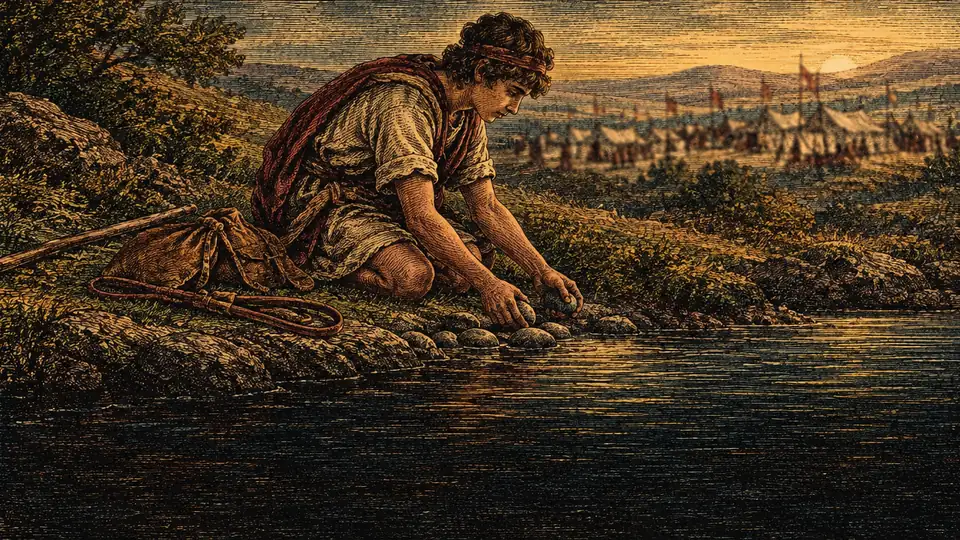
Saul dressed David in his own armor, but David put it off, for he had not proved it. He took his staff, chose five smooth stones out of the brook and went with his sling, saying, “Thou comest to me with a sword, and with a spear, and with a shield: but I come to thee in the name of the LORD of hosts” (1 Samuel 17:45).
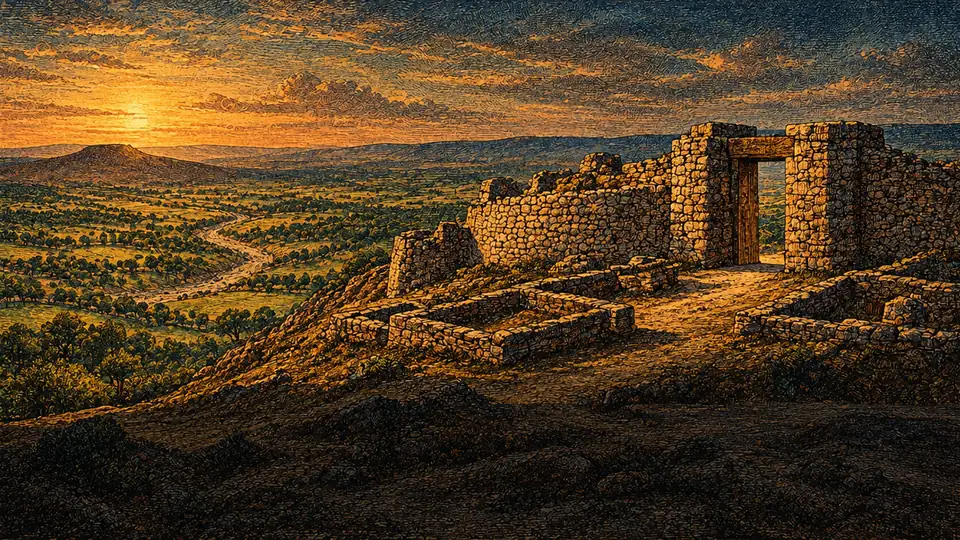
Goliath was not the last giant of Gath: the second book of Samuel tells of his kin felled by David’s men, among them a man of great stature with six fingers on each hand and six toes on each foot. Khirbet Qeiyafa, a fortified town above the valley of Elah from about David’s time, and Gath itself, at Tell es-Safi, have both been excavated.
And David put his hand in his bag, and took thence a stone, and slang it, and smote the Philistine in his forehead, that the stone sunk into his forehead; and he fell upon his face to the earth.
1 Samuel 17:49, KJV
Where it happened
The valley of Elah, Wadi es-Sunt, southwest of Jerusalem (site likely).
The valley keeps its place between the ruins of Shochoh and Azekah, where the chapter sets the two armies.
Every story stands at its place on the Worldwide Watch map: the Bible’s world, on the map.
More from the kingdom
Samuel and Kings
Sources and editorial method
Research and editorial references used for this page include:
- The King James Bible, as published by bible-api.com
- The Book of Enoch, translated by R. H. Charles (1917), Project Gutenberg
Every story is told from the King James Bible, and from the Book of Enoch in R. H. Charles’s translation (1917) where a story names it. Every quotation was checked word for word against those texts. Where a place is not known, the page says so. The paintings and the narration were made for the house.

