
The Emerald Tablet
The short text behind “as above, so below”, first known in Arabic.
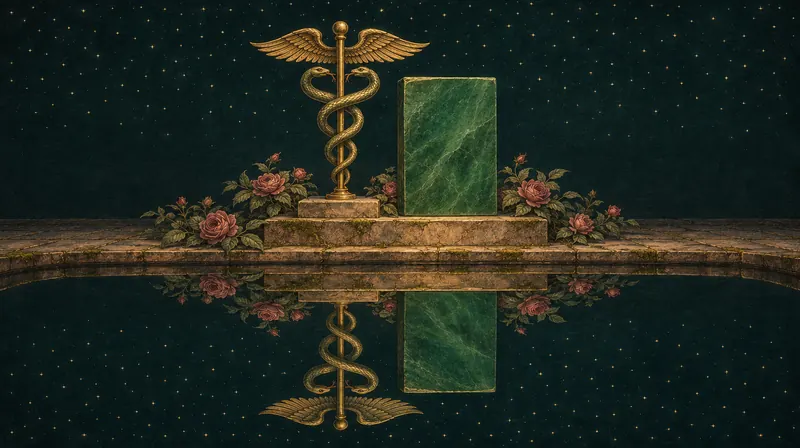
What does the Emerald Tablet of Hermeticism say, and where does it come from?
What it is
The Emerald Tablet is a text of about a dozen lines, said to have been found engraved on a green stone in the hands of Hermes Trismegistus. It speaks in riddles of one thing from which all things come, whose father is the Sun and whose mother is the Moon, carried by the wind and nursed by the earth. Its second line holds the saying known in short as 'as above, so below': what is below is like what is above, and what is above is like what is below, to accomplish the wonders of the one thing.
The teaching
As the Emerald Tablet in Isaac Newton's English teaches it.
True without lying
The tablet opens with an oath: “Tis true without lying, certain & most true.” Newton kept the old ampersands, and so does this page. What follows is one teaching about one thing, in about a dozen lines, and the alchemists who wrote commentaries on it took it line by line, as this page does.
As above, so below
“That which is below is like that which is above & that which is above is like that which is below to do the miracles of one only thing.” The famous saying is only the first half of the sentence. The likeness of above and below is not offered as a curiosity but for a purpose: it is what allows the wonders of the one thing to be worked. Because the two levels answer to each other, what is learned of the heavens can be done on earth, and what is done on earth repeats the heavens.
“And as all things have been & arose from one by the mediation of one: so all things have their birth from this one thing by adaptation.” Everything came from one source through one means, and in the same way everything is born from the one thing by being adapted from it. The Latin the alchemists read can be taken here as the meditation of one or the mediation of one; Newton chose mediation.
Its father, its mother, its nurse
“The Sun is its father, the moon its mother, the wind hath carried it in its belly, the earth its nurse.” The one thing has two parents: the Sun, which in the art is gold and the hot, active sulphur, and the Moon, which is silver and the cold, receptive mercury. It is carried by the wind, which the alchemists took for the vapour rising in their vessels, and nursed by the earth, in which it settles, grows and is fixed.
“The father of all perfection in the whole world is here. Its force or power is entire if it be converted into earth.” The one thing is the source of every perfection, but its power is whole only when it has been brought down into solid form: a power that stays a vapour does nothing. In the workshop this is fixation. Read for a life, the line says that what has been understood must be brought down into the body and into the day before it counts.
The separation
“Separate thou the earth from the fire, the subtle from the gross sweetly with great industry.” This is the first labour: to part the fine from the coarse, the volatile from the heavy. Two words govern how it is done. Sweetly means gently, with a mild fire and without force; with great industry means with patience and skill. A fire too strong spoils the work, the alchemists warn again and again, and the line asks for a discernment that sorts without tearing.
Rising and descending
“It ascends from the earth to the heaven & again it descends to the earth and receives the force of things superior & inferior.” The one thing rises and falls and rises again, and on each journey it takes in the power of both worlds. In the workshop this is distillation done over and over: the vapour rises in the vessel, cools, falls back on the matter and rises once more, so that the matter is refined by its circulation.
Read for a life, it is the double movement the tablet asks for: up toward what is higher, and back down to the earth with what was received there. Never only one of the two: the rising without the return is lost in vapour, and the return without the rising brings nothing down.
The glory and the force
“By this means you shall have the glory of the whole world & thereby all obscurity shall fly from you.” This is the tablet's promise, and it is given in the language of light: the reward of the work is that darkness leaves.
“Its force is above all force. For it vanquishes every subtle thing & penetrates every solid thing.” The alchemists read this as the double nature of the finished stone, which is both volatile and fixed: it overcomes what is fine because it has been made finer, and passes into what is solid because it has itself been made solid.
So was the world created
“So was the world created. From this are & do come admirable adaptations whereof the means (Or process) is here in this.” The work is creation in small. The one thing is made the way the world was made, from one, by separating, rising, falling and joining, which is why the tablet can speak of the workshop and of the making of the world in the same breath. Every marvel made after this pattern is an adaptation of the one thing, and the method for all of them is the one just given.
Thrice-great
“Hence I am called Hermes Trismegist, having the three parts of the philosophy of the whole world.” The speaker signs his name and explains it: he is thrice-great because he holds the three parts of the world's philosophy. Readers have taken the three in more than one way, among them the three kingdoms of mineral, plant and animal, and body, soul and spirit.
“That which I have said of the operation of the Sun is accomplished & ended.” The tablet closes by naming its subject, the work of the Sun, which the alchemists took for the work of gold, and by declaring the teaching complete.
How the tablet is worked with
The alchemists kept the tablet as the outline of their whole art: one matter, its two parents, separation, rising and descent, fixing in earth, and the finished stone. Its lines became pictures. Michael Maier's Atalanta Fugiens opens with two of them, the wind carrying the child in its belly and the earth nursing the child at her breast, each with a verse and a fugue to be sung.
For a reader today the order of the lines is itself the teaching. Begin from one thing; know its two parents; separate gently and with patience; let it rise and come back down, more than once; bring it into solid form; and only then look for the light that the tablet promises. The saying on above and below is a method within that order: it asks where a pattern seen in one place shows itself in another.
How it is practised
Because it is so short, the tablet is read line by line. A reader copies one line, then writes beside it what it could describe at three levels: in the sky, in a workshop and in a life. The line on above and below is the usual place to start, as a habit of asking whether a pattern seen in one place shows up in another. It is an exercise in comparison, and what it turns up is a question to test, not a result.
Where it comes from
No Greek original is known. The oldest version is Arabic, in the Book of the Secret of Creation, a work of the eighth or ninth century attributed to Balinus, the Arabic name for Apollonius of Tyana, who is said to find the tablet in a vault beneath a statue of Hermes. Hugo of Santalla translated it into Latin in the twelfth century, and it became the most quoted authority in European alchemy. Isaac Newton made his own English version, which survives among his papers.
What is known, and what is not
The Arabic source and the Latin translations are documented. The claim that the tablet is ancient Egyptian has no evidence behind it, and nothing earlier than the Arabic text has been found. The four-word motto is a later English shortening; the tablet's own sentence is longer and is about the making of one thing. Alchemists read it as a recipe for their stone, which is one interpretation among several.
Its words
- Emerald Tablet
- A text of about a dozen cryptic lines, first known in Arabic, that alchemists took for the summary of their art.
- As Above, So Below
- The short modern form of the Emerald Tablet's sentence that what is below is like what is above.
- Hermes Trismegistus
- The thrice-great Hermes: the legendary sage, Greek Hermes joined with Egyptian Thoth, under whose name the Hermetic books were written.
Ask the Oracle further
How do I read the Emerald Tablet line by line for my own life?Is "as above, so below" really what the Emerald Tablet says?
Before you practise
The seven principles come from The Kybalion (1908), a modern book; the ancient Hermetic writings do not list them. They are a way of looking at a life, not laws of physics.
Its other branches
The HermeticaThe seven principlesPoimandresFicino and the RenaissanceThe whole artSearch the tree

