

The inner life
Zener Cards
Direct answer
Zener Cards: Zener cards are a pack of twenty-five cards carrying five plain symbols, a circle, a cross, wavy lines, a square and a star, designed in the early 1930s for tests of extrasensory perception.
$0 today, then $19/month after 7 days. Cancel anytime.
At a glance
- Also called
- ESP cards, Zener deck, Rhine cards, ESP card test
- Found in
- Consciousness & Spiritual Psychology
- Related
- Extrasensory Perception, Parapsychology, Telepathy, Clairvoyance
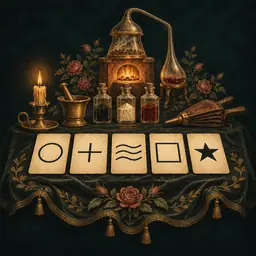
Zener cards are a pack of twenty-five cards carrying five plain symbols, a circle, a cross, wavy lines, a square and a star, designed in the early 1930s for tests of extrasensory perception.
A plain educational schematic; it does not diagnose a condition or replace professional care.
Understand the chapter you are in.
Your life’s turning points, measured from your birth.
Walk through Alex’s whole example first


Prefer to explore first?
 The Road of AgesThe turning points of your whole life, from your own chart
Walk my road
What are the five Zener card symbols?
A Zener pack holds five cards of each of five designs: a circle, a plus sign, three wavy lines, a square and a five-pointed star. In a standard run a subject names each of the twenty-five cards without seeing its face. Guessing alone gives five right on average, and scores from two to eight are common by chance. Only a steady surplus over many runs counts for anything.
The designs were chosen to be simple, easy to tell apart and free of the associations that playing cards carry. The cards made testing cheap and countable, which is why they became the emblem of the whole field. They also showed how easily an ordinary channel creeps in when the person guessing can see the pack.
On the tree of the hidden arts: The sixth sense.
What sets Zener Cards apart
The pack was built for arithmetic. Five designs in equal numbers make the chance of a right guess exactly one in five, so any score can be set against a known expectation, which playing cards with their fifty-two faces and familiar favourites do not allow as neatly. The designs are deliberately bare so that nobody prefers one. Their flaw was physical: early printed packs showed the design faintly through the back.
- Designed by: Karl Zener, psychologist of perception, Duke University
- Pack: twenty-five cards, five each of five designs
- Designs: circle, plus sign, three wavy lines, square, five-pointed star
- Chance score: five in twenty-five; runs of two to eight are ordinary
- Known flaw: some commercial packs of 1937 could be read from the back
Often mistaken for something else: Tarot and playing cards carry pictures and meanings to be read; Zener cards carry none and exist only to be guessed and counted.
The story behind Zener Cards
The perceptual psychologist Karl Zener designed the symbols at Duke University for his colleague J. B. Rhine, whose monograph of 1934 reported the first results. Commercial packs sold from 1937 turned out to be readable from the back in certain light, and critics also found scoring errors and weak shuffling. Later tests put screens or walls between subject and cards. The pack has since passed into popular culture as the sign of the psychic test.
Why Zener Cards matters
Zener Cards are the plainest picture of how such claims are tested: a fixed chance rate, a count, and many repetitions.
How to read Zener Cards
Experimenters score each run out of twenty-five against the five expected; a home test shows mainly how widely chance scores scatter.
Zener Cards in practice: an example
In a run of twenty-five, a guesser gets nine right. Over twenty runs the average settles back near five.
Where readings of Zener Cards go wrong
A high score in a single run means nothing; chance produces one regularly.
Sources and editorial method
This entry summarizes the tradition in the Almanac's own words; where no source is listed, it is an editorial summary rather than a primary text, and symbolic readings are named as the tradition's, not as fact.
- Source
- The Great Almanac Dictionary
- Category
- Consciousness & Spiritual Psychology
- Aliases
- ESP cards, Zener deck, Rhine cards, ESP card test
- Last updated
- 2026-09-26
See Zener Cards in your personal almanac
A definition tells you what it is; your own birth chart tells you what it means for you. The Oracle casts your real chart and answers for your love, your work, and your year ahead, in conversation. It opens with the 7-day Oracle trial.
Speak with the OracleRelated terms
More in Consciousness & Spiritual Psychology
- Catastrophizing
- Discernment Fatigue
- Freeze Response
- Intuition
- Nocebo Effect
- Reality Testing
- Sleep Paralysis
- The Secret
From the reference page to your own chart
Every word here
is in your own chart.
- Your life’s turning points, measured from your birth
- A practical next step to consider
- It opens with 7 days free: the AI Oracle on thirty hidden arts, and your daily horoscope
$0 today, then $19/month after 7 days. Cancel anytime.
Common questions
What are the five Zener card symbols?
A circle, a plus sign or cross, three wavy lines, a square and a five-pointed star. Each appears five times in a pack of twenty-five.
What score is chance on a Zener card test?
Five correct out of twenty-five on average. Single runs commonly fall anywhere from two to eight, so only a surplus that lasts over many runs would mean anything.
Who invented Zener cards?
Karl Zener, a psychologist of perception at Duke University, designed them in the early 1930s for the experiments of his colleague J. B. Rhine.


