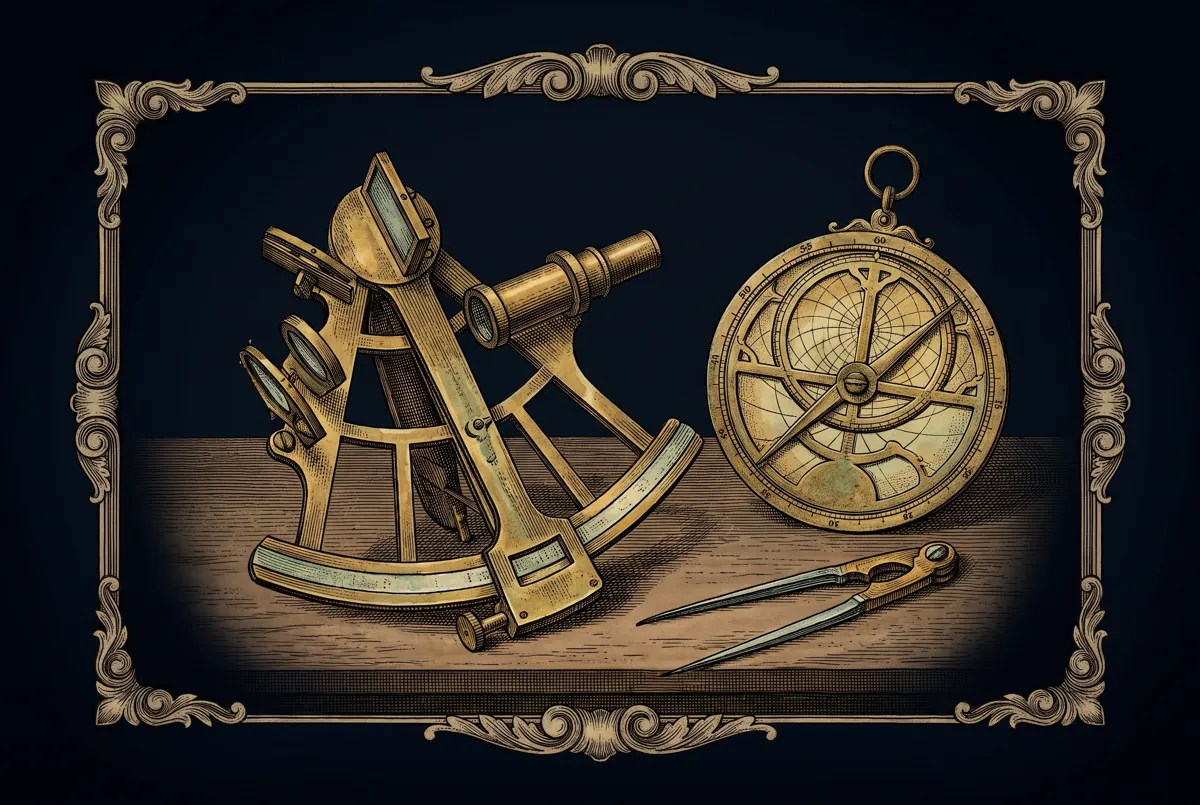
Old instruments
Sundial
Direct answer
Sundial: A Sundial is an instrument that indicates local apparent solar time from the position of a shadow or spot of light cast by the Sun onto a calibrated surface.
$0 today, then $12/month after 7 days. Cancel anytime.
At a glance
- Found in
- Historical Almanacs & Instruments
- Related
- Almanac, Astronomical Almanac, Nautical Almanac, Astrolabe
A Sundial tells local apparent solar time from the Sun's shadow.
An engraved functional orientation; the page explains the real instrument, method, or publication.
What does your own chart say about you?
Choose love, work or purpose. Your reading is written from your chart. Your reading uses your own birth details.
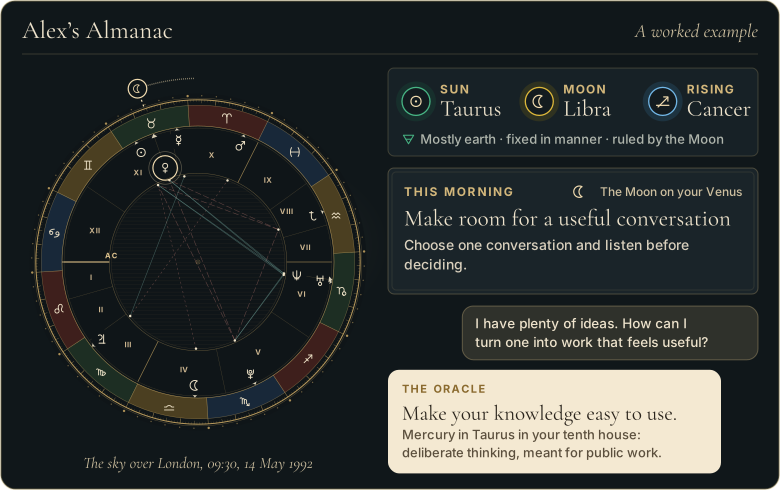
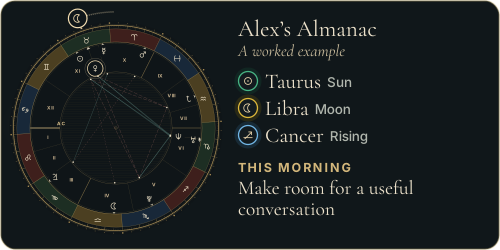
Walk through Alex’s whole example first
 The Road of AgesSee the turning points of your whole life, from your birth date
See your road's shape
The Road of AgesSee the turning points of your whole life, from your birth date
See your road's shape
Prefer to explore first?
 The Road of AgesThe turning points of your whole life, from your own chart
Walk my road
The Road of AgesThe turning points of your whole life, from your own chart
Walk my road
Free, by email
Your daily Almanac letter
One short letter at 7 each morning: the day’s theme read for your own chart, and one thing to do with it.
The story behind Sundial
Shadow clocks and sundials appeared in many ancient societies and developed into portable, architectural, and precision forms with specialized hour lines.
A one-minute story
The Book of the Sky
How people learned to read the sky, from Babylon to the day you were born.

Why Sundial matters
Sundial makes Earth's rotation and the Sun's changing apparent path visible, while exposing the difference between local solar time and standardized clock time.
How to read Sundial
a Sundial designed and aligned for its orientation and latitude, then account for longitude within the time zone, the equation of time, and daylight-saving rules comes up when comparing it with a clock.
Sundial in practice: an example
A correctly aligned horizontal dial may read solar noon when the Sun crosses the local meridian even though the civil clock does not show 12:00.
Where readings of Sundial go wrong
A decorative dial may be misaligned or latitude-specific, and no sundial can read the Sun through cloud or ordinary nighttime darkness.
Sources and editorial method
Research references used for this entry include:
- Royal Museums Greenwich: Horizontal Pedestal Dial - Museum documentation of a historical sundial, its gnomon, hour circle, meridian alignment, and latitude.
- NIST: Local Time Frequently Asked Questions - Official reference for civil time zones and daylight-saving rules.
- U.S. Naval Observatory: Universal Time - Official explanation of Universal Time and its relationship to Greenwich timekeeping.
- Source
- The Great Almanac Dictionary
- Category
- Historical Almanacs & Instruments
- Last updated
- 2026-09-26
Compare solar time with clock time
A definition tells you what it is; your own birth chart tells you what it means for you. The Oracle casts your real chart and answers for your love, your work, and your year ahead, in conversation. It opens with the 7-day Seeker trial.
Speak with the OracleRelated terms
More in Historical Almanacs & Instruments
- Almanac Ephemeris
- Astronomical Table
- Computus
- Filar Micrometer
- Local Hour Angle
- Meridian Table
- Pendulum Clock
- Right Ascension Table
From the reference page to your own chart
Every word here
is in your own chart.
- A personal reading about love, work or purpose, written from your chart
- A practical next step to consider
- It opens with 7 days free, with the AI Oracle and daily guidance
$0 today, then $12/month after 7 days. Cancel anytime.
Common questions
What is a Sundial?
A Sundial is an instrument that indicates local apparent solar time from the position of a shadow or spot of light cast by the Sun onto a calibrated surface.
What do people get wrong about a Sundial?
A decorative dial may be misaligned or latitude-specific, and no sundial can read the Sun through cloud or ordinary nighttime darkness.
Free, by email
The Almanac, in your inbox at 7
One short letter at 7 each morning: the day’s theme read for your own chart, and one thing to do with it.