Old instruments
Astrolabe
Direct answer
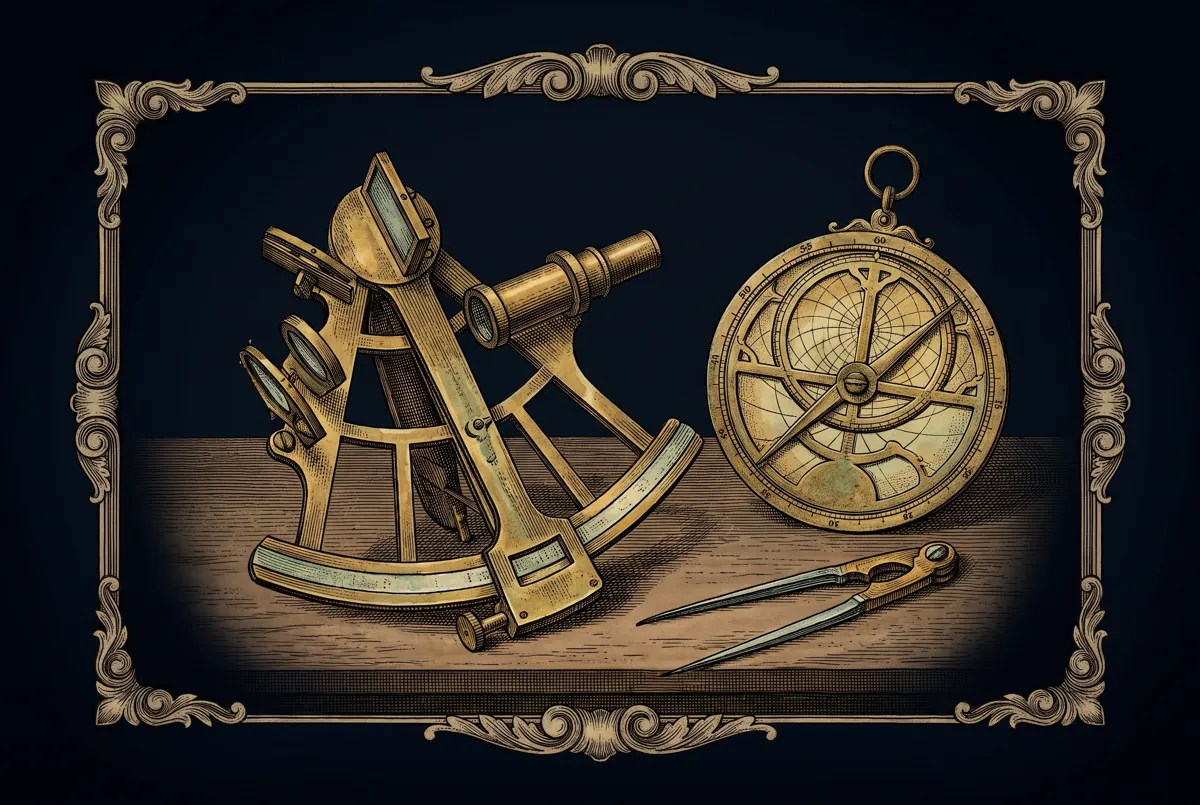
Astrolabe: An Astrolabe is a historical astronomical instrument that combines a star map, coordinate projection, sighting scale, and rotating parts to solve problems involving altitude, direction, and time.
An Astrolabe is a portable analog model and calculator for the sky.
$0 today, then $12/month after 7 days. Cancel anytime.
At a glance
- Found in
- Historical Almanacs & Instruments
- Related
- Almanac, Astronomical Almanac, Nautical Almanac, Armillary Sphere
An Astrolabe is a portable analog model and calculator for the sky.
An engraved functional orientation; the page explains the real instrument, method, or publication.
What does your own chart say about you?
Choose love, work or purpose. Your reading is written from your chart. Your reading uses your own birth details.
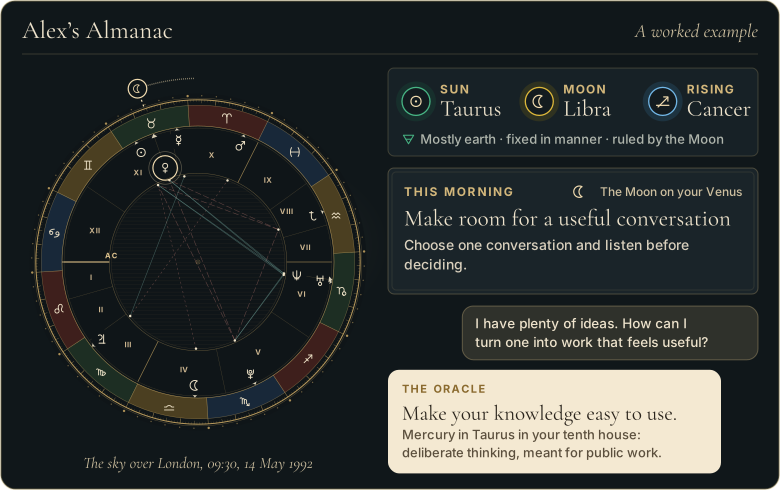
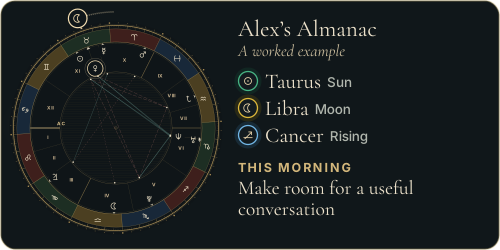
Walk through Alex’s whole example first
 The Road of AgesSee the turning points of your whole life, from your birth date
See your road's shape
The Road of AgesSee the turning points of your whole life, from your birth date
See your road's shape
Prefer to explore first?
 The Road of AgesThe turning points of your whole life, from your own chart
Walk my road
The Road of AgesThe turning points of your whole life, from your own chart
Walk my road
Free, by email
Your daily Almanac letter
One short letter at 7 each morning: the day’s theme read for your own chart, and one thing to do with it.
The story behind Astrolabe
Planispheric astrolabes were developed and refined across Hellenistic, Islamic, European, and other scholarly and craft traditions over many centuries.
A one-minute story
The Book of the Sky
How people learned to read the sky, from Babylon to the day you were born.

Why Astrolabe matters
Astrolabe compresses celestial geometry into a hand-held instrument and illustrates how observation and mathematical design worked together before electronic computation.
Where readings of Astrolabe go wrong
It is a mistake to see every astrolabe as a marine navigation instrument or imply that one surviving object represents all regional forms and uses.
Sources and editorial method
Research references used for this entry include:
- Smithsonian National Museum of American History: English Planispheric Astrolabe - Museum explanation of the astrolabe as an astronomical calculating and observing instrument.
- Royal Museums Greenwich: Astronomical and Navigational Instruments - Museum reference collection for astrolabes, armillary spheres, quadrants, nocturnals, sundials, and navigation instruments.
- Source
- The Great Almanac Dictionary
- Category
- Historical Almanacs & Instruments
- Last updated
- 2026-09-26
Explore how an astrolabe works
A definition tells you what it is; your own birth chart tells you what it means for you. The Oracle casts your real chart and answers for your love, your work, and your year ahead, in conversation. It opens with the 7-day Seeker trial.
Speak with the OracleRelated terms
More in Historical Almanacs & Instruments
- Celestial Navigation
- Declination Table
- Heliometer
- Magnetic Compass
- Nocturnal Instrument
- Plumb Line
- Sight Reduction
- Water Clock
From the reference page to your own chart
Every word here
is in your own chart.
- A personal reading about love, work or purpose, written from your chart
- A practical next step to consider
- It opens with 7 days free, with the AI Oracle and daily guidance
$0 today, then $12/month after 7 days. Cancel anytime.
Common questions
What is an Astrolabe?
An Astrolabe is a historical astronomical instrument that combines a star map, coordinate projection, sighting scale, and rotating parts to solve problems involving altitude, direction, and time.
What do people get wrong about an Astrolabe?
It is a mistake to see every astrolabe as a marine navigation instrument or imply that one surviving object represents all regional forms and uses.
Free, by email
The Almanac, in your inbox at 7
One short letter at 7 each morning: the day’s theme read for your own chart, and one thing to do with it.