
Grimoire demonology history
Sallos
Direct answer
Sallos is a character in an early modern demonological catalogue, not a being established by historical or scientific evidence. The catalogue’s imagery and claimed office can be studied without attempting evocation or treating modern anecdotes as proof.
Sallos, also spelled Saleos in some witnesses, is the nineteenth spirit in common editions of the Ars Goetia, where the figure is titled a duke and associated with love.
$0 today, then $12/month after 7 days. Cancel anytime.
Quick facts
| Question | Direct answer |
|---|---|
| Primary textual setting | The first book of the Lemegeton, commonly called the Ars Goetia. |
| Catalogue number | Nineteenth in the familiar seventy-two-spirit ordering. |
| Title in the text | A duke, with spelling and minor details varying by edition. |
| Claimed office | The grimoire associates the figure with producing love between women and men. |
What does your own chart say about you?
Choose love, work or purpose. Your reading is written from your chart. Your reading uses your own birth details.
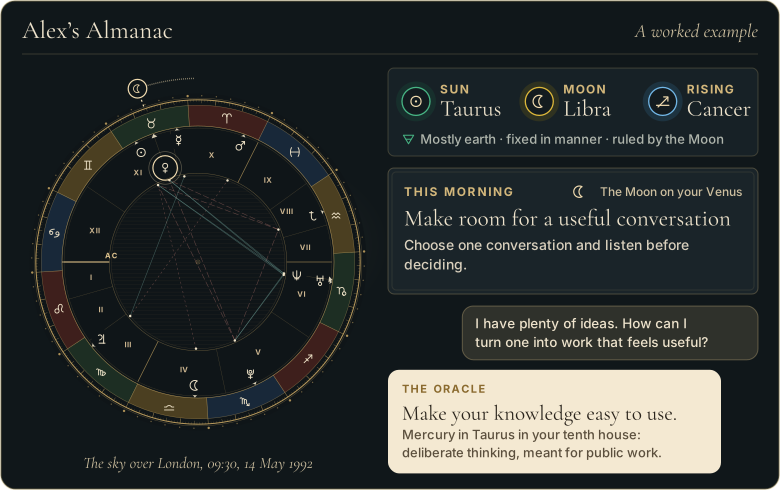
Walk through Alex’s whole example first
 The Road of AgesSee the turning points of your whole life, from your birth date
See your road's shape
The Road of AgesSee the turning points of your whole life, from your birth date
See your road's shape
Prefer to explore first?
 The Road of AgesThe turning points of your whole life, from your own chart
Walk my road
The Road of AgesThe turning points of your whole life, from your own chart
Walk my road
Free, by email
Your daily Almanac letter
One short letter at 7 each morning: the day’s theme read for your own chart, and one thing to do with it.
What the Ars Goetia says about Sallos
In widely used editions, Sallos or Saleos is listed as the nineteenth spirit. The brief entry gives the rank of duke, describes a soldier-like appearance associated with a crocodile and ducal crown, and assigns an office concerning love. It also gives a command over thirty legions, a conventional catalogue formula rather than a verifiable military count. Spelling differs because the English manuscripts transmit unusual names through difficult handwriting and repeated copying. A reliable quotation should identify its edition and manuscript basis instead of treating one standardized online spelling as the original form.
Sallos within a catalogue of seventy-two spirits
The Ars Goetia is the first part of the seventeenth-century compilation known as the Lemegeton. Its entries follow recurring patterns: a numbered name, noble rank, visual form, alleged powers, number of legions, and a seal. Those conventions help readers compare Sallos with nearby entries, but they do not create a coherent ancient biography. Later writers often attach planets, zodiac signs, colors, personalities, or moral lessons not present in the short manuscript description. Such additions can be studied as later occult reception only when their source is named.
Earlier catalogues and name variants
The Goetia draws on earlier European spirit catalogues, especially Johann Weyer’s sixteenth-century Pseudomonarchia Daemonum and material printed by Reginald Scot. Comparing those lists can reveal whether a name, office, or rank predates the Lemegeton and where compilers changed details. Sallos is commonly connected with Saleos, but superficial similarity to an unrelated deity or word is not proof of identity. Responsible historical work checks the actual entry, order, and wording. Unsupported etymologies are especially common because an unfamiliar name invites readers to reverse-engineer a dramatic meaning from modern languages.
Modern depictions and claims
Contemporary art often turns the sparse catalogue description into a detailed personality, patron, romantic archetype, or game character. These are creative developments, not recovered facts about an ancient religion. Claims that Sallos guarantees affection raise an additional ethical problem: another person’s consent cannot be treated as an obstacle to conquer. Historical study can examine why early modern texts joined desire with hierarchy and command, while a present-day relationship requires freely given interest, clear communication, and respect for refusal. Personal experiences may be meaningful to the teller but cannot authenticate the manuscript’s supernatural claims.
How to study Sallos in the Ars Goetia as history
The safest and most accurate way to approach Sallos in the Ars Goetia is as a textual, artistic, or social-history subject. Manuscripts and later printed editions often disagree, while modern websites freely combine material from unrelated periods. Check the date, language, manuscript family, editor, and provenance before repeating a claim. A description in a grimoire records what a text says; it does not establish that the named being or promised effect exists. This article therefore explains vocabulary, transmission, imagery, and reception without providing invocations, seals for use, coercive procedures, or instructions aimed at another person. Anyone experiencing fear, threats, stalking, coercion, or distress should address the observable situation and seek appropriate practical or professional support rather than escalating an occult explanation.
Sources and editorial method
Research and editorial references used for this page include:
- Joseph H. Peterson: Lemegeton, Ars Goetia - Manuscript-based transcription and notes for the catalogue containing Sallos.
- Project Gutenberg: The Lesser Key of Solomon - Public-domain historical edition useful for comparing the printed reception.
These references support the factual, historical, textual, or interpretive claims on this page. Interpretive traditions are identified as such, and factual claims are kept separate from symbolic claims.
Related reading
Keep love free
A definition tells you what it is; your own birth chart tells you what it means for you. The Oracle casts your real chart and answers for your love, your work, and your year ahead, in conversation. It opens with the 7-day Seeker trial.
Speak with the OracleThe Cosmic Codex offers a reflective map of your year, written from your chart, never a prediction. Open the Cosmic Codex
More in Demons & Fallen Beings
From the reference page to your own chart
Every word here
is in your own chart.
- A personal reading about love, work or purpose, written from your chart
- A practical next step to consider
- It opens with 7 days free, with the AI Oracle and daily guidance
$0 today, then $12/month after 7 days. Cancel anytime.
Common questions
Is Sallos the same as Saleos?
They are generally treated as spelling variants of the same catalogue entry, though an edition should preserve and note its source spelling.
Was Sallos worshipped in antiquity?
The cited evidence is an early modern grimoire tradition; claims of an ancient cult require separate evidence.
Does the historical description justify a love ritual?
No. The text’s claimed office is historical content, not evidence of efficacy or permission to override consent.
Free, by email
The Almanac, in your inbox at 7
One short letter at 7 each morning: the day’s theme read for your own chart, and one thing to do with it.
