
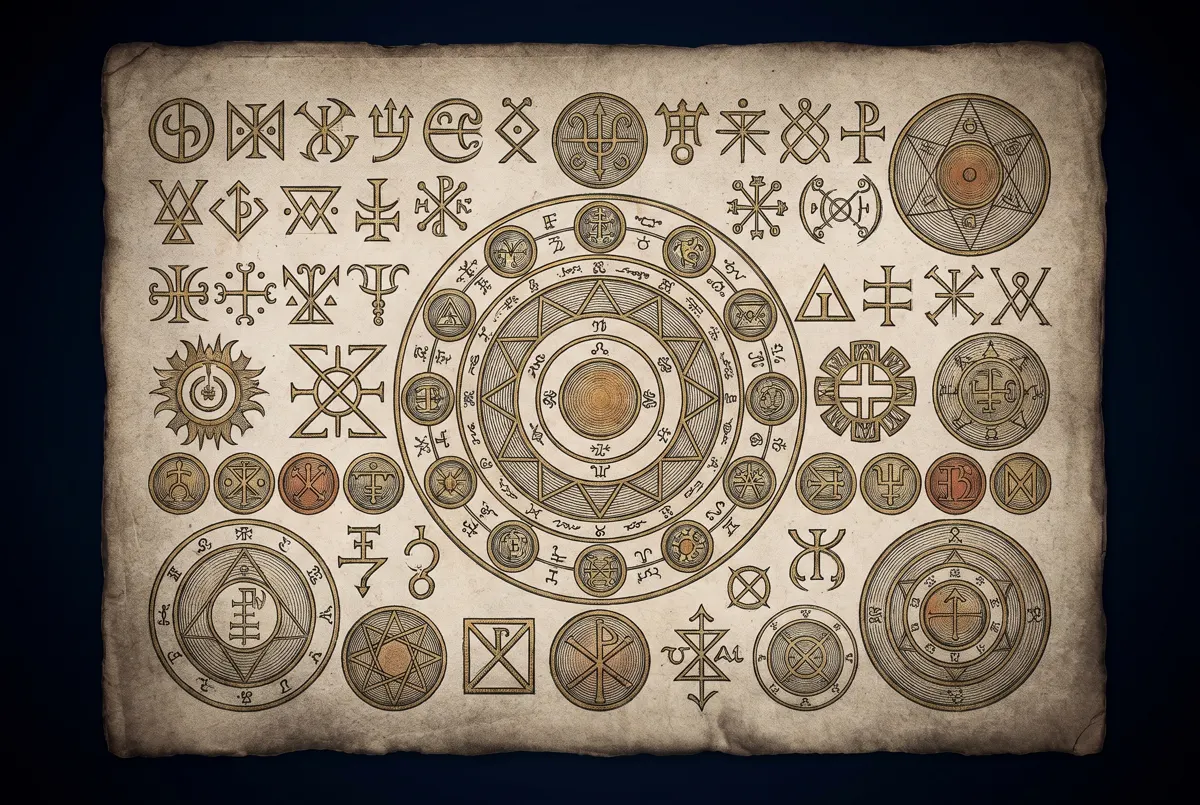
Symbols in religion and culture
Key Symbol
Direct answer
Interpret a key by asking what it opens, who holds it, whether it locks or unlocks, and what the surrounding culture says. A crossed pair in papal heraldry, a key in a prison scene, and a key received in a dream share an object but not one fixed meaning.
A key symbolizes the power to open or close, admit or exclude, reveal or conceal. Because a real key controls access, images of keys often convey authority, knowledge, custody, initiation, security, freedom, or responsibility.
Quick facts
| Context | Likely symbolic emphasis |
|---|---|
| Door or gate | Permission, threshold, privacy, opportunity, or exclusion. |
| Treasure or book | Hidden knowledge, interpretation, custody, or discovery. |
| Prison or chain | Release, control, captivity, pardon, or escape. |
| Religious office | Delegated authority and responsibility, defined by the tradition using it. |
Key Symbol means a symbol of access, authority, secrecy, binding, or release.
A conceptual orientation, not an exact historical reproduction of every mark or seal.
What does your own chart say about you?
Choose love, work or purpose for a personal insight and a useful next step. Your reading uses your own birth details.
Walk through Alex’s whole example first


 The Road of AgesSee the turning points of your whole life, from your birth date
Free first look
The Road of AgesSee the turning points of your whole life, from your birth date
Free first look
Prefer to explore first?
 The Road of AgesThe turning points of your whole life, from your own chart
Walk my road
The Road of AgesThe turning points of your whole life, from your own chart
Walk my road
Why keys carry so many meanings
A key is small, portable, and capable of changing access to a protected space. That practical asymmetry gives it symbolic force: the holder may know a secret, possess legitimate authority, inherit responsibility, or abuse control. Keys also work in pairs of opposites. They can open and lock, liberate and confine, welcome and exclude. Interpretation should preserve that ambiguity. An “opportunity” reading may be inappropriate when the image emphasizes surveillance or withheld access, while a “secret” reading may miss a ceremonial transfer of office.
Keys in Christian text and iconography
In Matthew 16:19, the keys of the kingdom are given to Peter alongside binding and loosing. Christian art consequently uses keys as an attribute of Saint Peter, and crossed keys became prominent in papal heraldry. Revelation also speaks of keys associated with death and Hades and of the key of David, giving the image authority over decisive thresholds. These meanings arise from specific passages and institutions. They should not be generalized into a claim that every ancient key secretly refers to Peter, heaven, or one esoteric initiation.
Keys in art, language, and dreams
Portraits may include keys to mark household office, civic guardianship, or control of a treasury. Folktales use forbidden keys to test obedience and curiosity. Everyday language extends the object into “the key to a problem,” a legend that decodes a map, a musical key, or a keyboard key. In a dream, the most useful clues are personal: Is the key lost, broken, stolen, inherited, or newly found? Does it fit? The emotional tone and waking situation matter more than a universal dream dictionary.
A context-first way to interpret the symbol
Identify the object’s type, age, material, owner, and target lock. Then examine action: carrying differs from turning, hiding, gifting, or refusing a key. Look for inscriptions, paired symbols, documented ritual, and the maker’s cultural setting. Separate three levels: the object’s practical function, a historically attested convention, and the viewer’s personal association. This prevents a generic keyword from replacing evidence. A key can inspire reflection on access or responsibility, but it does not prove that someone has received supernatural permission, discovered a destined partner, or unlocked guaranteed success.
Sources and editorial method
Research and editorial references used for this page include:
- Bible Gateway: Key passages in Matthew and Revelation - Primary texts underlying major Christian key symbolism.
- The Metropolitan Museum of Art: Key collection records - Museum catalog examples showing keys across periods, materials, and social functions.
These references support the factual, historical, textual, or interpretive claims on this page. Interpretive traditions are identified as such, and factual claims are kept separate from symbolic claims.
Related reading
Read the symbol with context
A definition tells you what it is; your own birth chart tells you what it means for you. The Oracle casts your real chart and answers for your love, your work, and your year ahead, in conversation, free.
Speak with the OracleYour year, written once from your chart alone: the Cosmic Codex reads the whole of it, month by month. Open the Cosmic Codex
More in Sigils, Seals & Symbols
- Medicine Wheel
- Protective Knot
- Serpent Symbol
- Tau Cross
- Wings
- Bee Symbol
- Crossroads Symbol
- Enochian Symbols
From the reference page to your own chart
Every word here
is in your own chart.
- Your chart and numbers, read for you in about a minute
- Ask the Oracle anything about them
- Every personal tool and daily guidance
Free reading, no card needed. Optional membership: payment details required, 7 days free, then $12/month. Cancel before it renews and you pay nothing.
Common questions
What does a key usually symbolize?
Access and control are the broadest themes. Depending on context, they become authority, knowledge, privacy, opportunity, release, custody, or exclusion.
Why is Saint Peter shown with keys?
The iconography refers chiefly to Matthew 16:19, where Peter receives the keys of the kingdom and authority to bind and loose.
What does finding a key in a dream mean?
No fixed meaning applies. Consider what the key opened, how it was acquired, the emotion in the dream, and which waking issue currently involves access or responsibility.