Renaissance manuscript history
Enochian Symbols
Direct answer
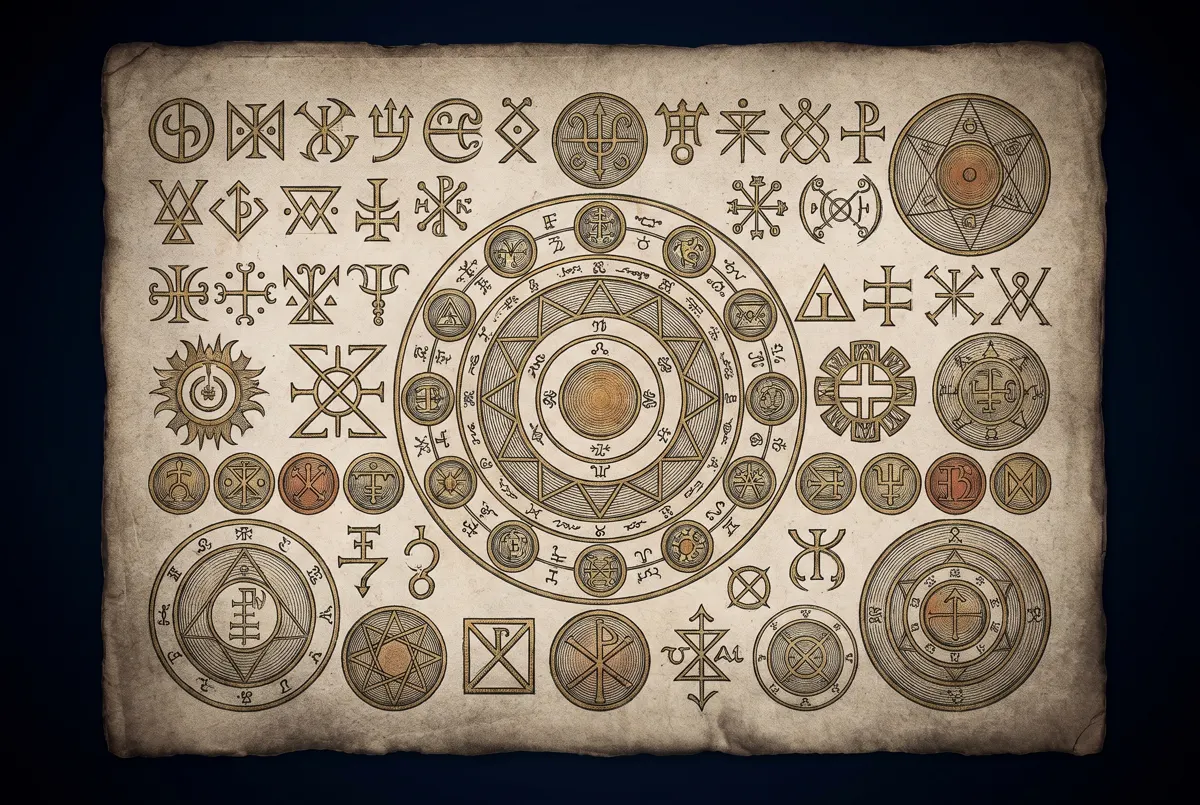
There is no single historical emblem called “the Enochian symbol.” The phrase usually covers the Enochian alphabet, the Holy Table, the Sigillum Dei Aemeth, lettered squares, and related diagrams preserved in different manuscripts.
Enochian symbols are letters, tables, names, seals, and diagrams recorded during John Dee and Edward Kelley’s late-sixteenth-century angelic conferences, then reorganized by later occultists.
$0 today, then $12/month after 7 days. Cancel anytime.
Quick facts
| Question | Direct answer |
|---|---|
| Who recorded the material? | English scholar John Dee and scryer Edward Kelley during conferences beginning in the 1580s. |
| Is Enochian an ancient language? | The surviving system is documented in early modern manuscripts; claims of primeval antiquity belong to the revelations themselves. |
| Are all diagrams from one manuscript? | No. The records are dispersed across several manuscripts with different dates and contents. |
| Why do modern versions differ? | Editors and occult orders regularized lettering, table layouts, names, and ritual arrangements. |
Enochian Symbols are Dee-Kelley occult symbols, not general angelic art.
A conceptual orientation, not an exact historical reproduction of every mark or seal.
What does your own chart say about you?
Choose love, work or purpose. Your reading is written from your chart. Your reading uses your own birth details.
Walk through Alex’s whole example first
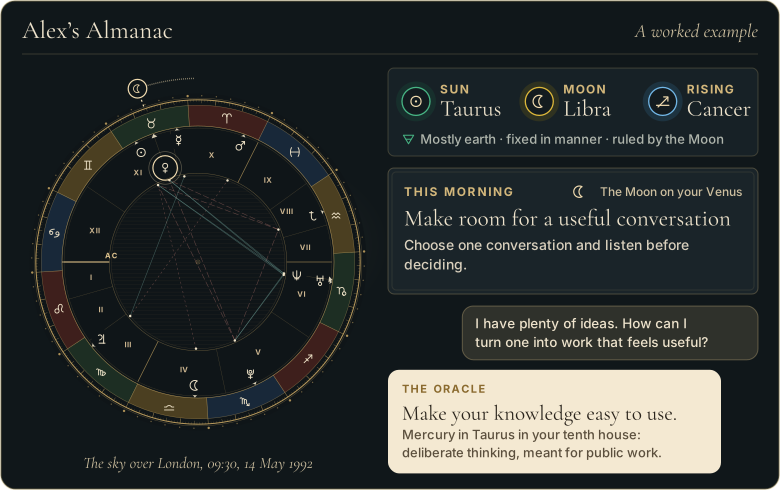
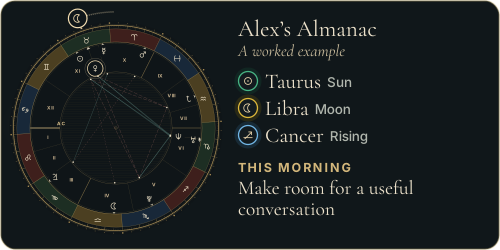
 The Road of AgesSee the turning points of your whole life, from your birth date
See your road's shape
The Road of AgesSee the turning points of your whole life, from your birth date
See your road's shape
Prefer to explore first?
 The Road of AgesThe turning points of your whole life, from your own chart
Walk my road
The Road of AgesThe turning points of your whole life, from your own chart
Walk my road
Free, by email
Your daily Almanac letter
One short letter at 7 each morning: the day’s theme read for your own chart, and one thing to do with it.
What the historical record contains
John Dee kept unusually detailed diaries of sessions in which Edward Kelley reported communications through a crystal or “shew-stone.” The surviving papers include ordinary prose, names said to belong to angels, an alphabet, long verbal “keys” or calls, numerical and letter tables, and elaborate material objects. The British Library catalogue describes Sloane MS 3188 as conferences from December 1581 to May 1583 and notes later copies by Elias Ashmole. Other manuscripts preserve later sessions and the 48 angelical keys. Calling the entire archive “Enochian” is convenient, but Dee himself used several terms and worked through changing stages.
Alphabet, tables, seals, and furniture
The best-known forms should not be collapsed into one design. The alphabet supplies distinctive letter shapes used to write received words. The Great Table arranges letters into a grid from which names were derived according to recorded procedures. The Holy Table and surrounding ensigns belong to a physical arrangement described in the diaries. The Sigillum Dei Aemeth is a complex diagram with names and geometric divisions that predates parts of Dee’s angelic work in related traditions. A museum label, manuscript folio, or modern reproduction should therefore be identified by its proper name rather than marketed vaguely as an Enochian sigil.
How later occultism reshaped the system
Dee’s papers did not pass intact into one continuous school. Seventeenth-century collectors such as Ashmole copied and preserved material; Meric Casaubon printed selected conversations in 1659 for polemical reasons. In the nineteenth century, the Hermetic Order of the Golden Dawn reorganized parts of the archive into a teachable magical system, and twentieth-century writers made further changes. Many color scales, elemental attributions, truncated tables, and pronunciation rules found online belong to these later receptions. They may be historically important in their own right, but they should not automatically be attributed to Dee or Kelley.
How to assess an image labeled Enochian
Start by looking for a shelfmark, folio number, editor, or photographed manuscript. Compare the letter forms and grid dimensions with a catalogued source, since modern fonts often smooth away scribal variation. Ask whether damaged or missing manuscript leaves affected the reconstruction. If an image combines a pentagram, planetary glyphs, Hebrew letters, and Enochian characters, it may be a modern synthesis rather than a Dee-era object. An accurate caption can say “modern design using Enochian-style letters” without denying its artistic value. Provenance is more informative than claims that a picture is universally powerful or dangerous.
How to study Enochian Symbols as history
The safest and most accurate way to approach Enochian Symbols is as a textual, artistic, or social-history subject. Manuscripts and later printed editions often disagree, while modern websites freely combine material from unrelated periods. Check the date, language, manuscript family, editor, and provenance before repeating a claim. A description in a grimoire records what a text says; it does not establish that the named being or promised effect exists. This article therefore explains vocabulary, transmission, imagery, and reception without providing invocations, seals for use, coercive procedures, or instructions aimed at another person. Anyone experiencing fear, threats, stalking, coercion, or distress should address the observable situation and seek appropriate practical or professional support rather than escalating an occult explanation.
Where the symbols actually come from
The Enochian material has an unusually well-documented origin. Between 1582 and 1587, John Dee, mathematician and adviser to Elizabeth I, held hundreds of scrying sessions with Edward Kelley, who reported visions in a crystal. From these sessions Dee recorded an alphabet of twenty-one letters with its own names and forms, long tables of letters, a language the angels were said to speak, and forty-eight Calls or Keys, invocations written in that language with English translations.
Dee's manuscripts survive, and a large portion was published in 1659 by Meric Casaubon as A True and Faithful Relation. The name Enochian attached later, from Dee's belief that he was recovering the language of the biblical patriarch Enoch. Whatever one concludes about the sessions, the paper trail itself is real history, and it is one of the most complete records of an early modern magical working in existence.
The alphabet, the tables, and the Watchtowers
The symbols people search for fall into three families. First, the Enochian alphabet: twenty-one angular letters, written right to left in Dee's records, each with a name such as Pa, Veh, or Ged. Second, the great letter tables, most famously the Great Table of the Watchtowers received in 1584, a grid of letters from which names of spirits were derived by tracing paths through the squares. Third, the seals and diagrams, above all the Sigillum Dei Aemeth, an intricate circular seal Dee was instructed to engrave in wax to support the shewstone.
Nearly all modern presentations of this material descend not from Dee directly but from the Hermetic Order of the Golden Dawn, which absorbed and reorganized the Enochian corpus in the late nineteenth century, and from Aleister Crowley after them. Much of what circulates online as ancient Enochian lore is Victorian synthesis.
The Almanac’s boundary on this material
The Great Almanac documents Enochian symbols as history, because the fascination is real and the record is remarkable. It does not present them as a working technology or endorse attempts to contact spirits through them. Dee himself, a devout man by his own lights, staked years and his reputation on voices he could not verify, and the sessions' fruit included Kelley's claim that the spirits commanded the two households to share wives, which Dee recorded with anguish.
That episode is the caution in miniature: claimed revelation that cannot be checked will eventually ask for something that should not be given. From a Christian standpoint, the tradition's counsel is straightforward: curiosity about the history is fine, prayer belongs to God, and authority over the unseen is not obtained through letter grids.
Sources and editorial method
Research and editorial references used for this page include:
- British Library Catalogue: Sloane MS 3188 - Catalogue description of Dee’s early angelic-conference manuscript.
- Cambridge Digital Library: The Private Diary of Dr John Dee - Digitized primary manuscript material associated with Dee.
These references support the factual, historical, textual, or interpretive claims on this page. Interpretive traditions are identified as such, and factual claims are kept separate from symbolic claims.
Related reading
Do not use angelic tables
A definition tells you what it is; your own birth chart tells you what it means for you. The Oracle casts your real chart and answers for your love, your work, and your year ahead, in conversation. It opens with the 7-day Seeker trial.
Speak with the OracleYour year, written once from your chart alone: the Cosmic Codex reads the whole of it, month by month. Open the Cosmic Codex
More in Sigils, Seals & Symbols
From the reference page to your own chart
Every word here
is in your own chart.
- A personal reading about love, work or purpose, written from your chart
- A practical next step to consider
- It opens with 7 days free, with the AI Oracle and daily guidance
$0 today, then $12/month after 7 days. Cancel anytime.
Common questions
Did John Dee call the language Enochian?
The modern label became standard later. Dee’s records use terms such as Angelical, Adamical, or the language of angels.
Is the Sigillum Dei Aemeth the same as the Enochian alphabet?
No. One is a complex seal-like diagram; the other is a set of letter forms. They occur within overlapping but distinct textual material.
Can an unattributed internet symbol be dated from style alone?
Rarely. A reliable identification needs comparison with a manuscript, early print, or documented later occult source.
Free, by email
The Almanac, in your inbox at 7
One short letter at 7 each morning: the day’s theme read for your own chart, and one thing to do with it.
