
Renaissance esotericism
Enochian Calls
Direct answer
Historically, the Calls are not a free-standing ancient scripture discovered intact. Dee’s diaries present them as material delivered through Kelley’s scrying within a Christian learned-magic project; later occult orders rearranged, translated, and used that material in new systems.
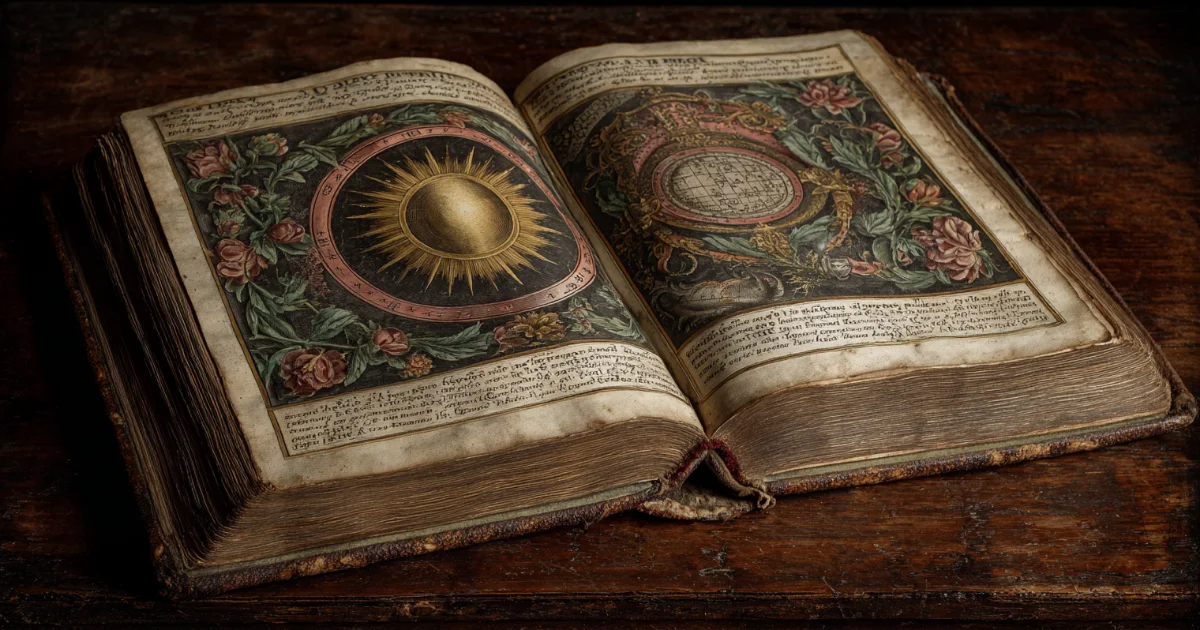
The Enochian Calls, also called Keys, are a set of ritual texts recorded during the angelic-action sessions of John Dee and Edward Kelley in the 1580s. They survive within a larger manuscript record of tables, prayers, visions, and a purported angelic language.
$0 today, then $12/month after 7 days. Cancel anytime.
Quick facts
| Question | Documented context |
|---|---|
| Who recorded them? | English scholar John Dee, chiefly from sessions in which Edward Kelley served as scryer. |
| When? | During the 1580s, amid Dee’s broader angelic conversations. |
| How many? | Common modern arrangements speak of nineteen Calls, although numbering and the relation of the final Call to thirty aethyrs require explanation. |
| Is “Enochian” Dee’s term? | The label became standard later; Dee used several descriptions for the revealed language and materials. |

What does your own chart say about you?
Choose love, work or purpose. Your reading is written from your chart. Your reading uses your own birth details.
Walk through Alex’s whole example first


 The Road of AgesSee the turning points of your whole life, from your birth date
See your road's shape
The Road of AgesSee the turning points of your whole life, from your birth date
See your road's shape
Prefer to explore first?
 The Road of AgesThe turning points of your whole life, from your own chart
Walk my road
The Road of AgesThe turning points of your whole life, from your own chart
Walk my road
Free, by email
Your daily Almanac letter
One short letter at 7 each morning: the day’s theme read for your own chart, and one thing to do with it.
The Calls in Dee’s angelic records
John Dee was a mathematician, court adviser, astrologer, collector, and Christian natural philosopher. Seeking wisdom that he believed exceeded ordinary learning, he held a series of “spiritual actions.” Edward Kelley reported what he saw or heard in a crystal or showstone, while Dee wrote extensive accounts. The Calls emerged within this collaborative and often difficult process; the surviving diaries preserve changes, uncertainties, interruptions, and theological concern rather than a polished revelation arriving all at once.
The texts are linked with other materials now grouped under the modern label Enochian: letter tables, the Great Table, divine or angelic names, and the thirty aethyrs. Their manuscript context matters because later printed extracts can make a passage appear more settled than Dee’s notebooks suggest. Historians study date, hand, sequence, correction, and surrounding dialogue before deciding how one page relates to another.
Numbering, language, and translation
Modern sources commonly list eighteen Calls followed by a nineteenth associated with thirty aethyrs or airs. The final text is reused with a different aethyr name, so “nineteen” does not mean nineteen wholly unrelated compositions. Numbering can also shift among editions. A reader should identify the manuscript or editorial system instead of assuming that “the fifth Key” points to identical wording everywhere.
The language has a distinctive vocabulary and grammar, but its status is debated. Believers may regard it as angelic; historians can describe the claim without endorsing it; linguists can ask whether the surviving corpus behaves like a constructed or received language. Translations largely depend on glosses and English equivalents recorded in the Dee material. Pronunciation systems heard in modern occultism are later reconstructions because the manuscripts do not supply a complete, unambiguous phonology.
From manuscripts to the Golden Dawn and beyond
Dee’s papers passed through collectors and libraries, and portions were published after his death. In the nineteenth century, the Hermetic Order of the Golden Dawn incorporated selected Enochian elements into a new ceremonial framework. Aleister Crowley and later practitioners developed further interpretations, especially of the aethyrs. These influential systems are part of the reception history, but they should not be projected backward as if Dee designed every later color scale, grade attribution, elemental arrangement, or pronunciation.
Popular summaries also call the material “the language of angels” as though that settles provenance. A historically precise account uses layers: what Dee’s diary says occurred, what Kelley reported, what a particular manuscript records, what an editor reconstructed, and what a later order taught. Keeping those layers separate makes the subject more interesting, not less, because it shows how an unstable archive became a major modern occult tradition.
How to study the Calls as historical texts

Begin with manuscript transcriptions, Dee’s dated diaries, and scholarly editorial notes. Compare a translation line by line only after checking which source and numbering it follows. Useful research questions include how revelation was recorded, how authority was negotiated between Dee and Kelley, which biblical ideas shaped the sessions, and how later editors handled damaged or contradictory passages. This approach does not require repeating the text aloud or treating it as an operational manual.
Claims that a mispronounced word automatically causes supernatural danger are not historical conclusions supported by the manuscripts. At the same time, the material can be psychologically intense for some readers. Study in daylight, pause if it produces fear or compulsion, and favor contextual scholarship over sensational videos. This entry intentionally describes the documents and their reception without reproducing Calls, invocations, or instructions for ritual use.
Sources and editorial method
Research and editorial references used for this page include:
- John Dee Publication Project - Scholarly project providing research context and resources for Dee’s works and manuscripts.
- British Library: Sloane MS 3191 - Institutional catalog record for a major manuscript containing Dee’s angelic material.
These references support the factual, historical, textual, or interpretive claims on this page. Interpretive traditions are identified as such, and factual claims are kept separate from symbolic claims.
Related reading
Do not recite occult calls
A definition tells you what it is; your own birth chart tells you what it means for you. The Oracle casts your real chart and answers for your love, your work, and your year ahead, in conversation. It opens with the 7-day Seeker trial.
Speak with the OracleYour year, written once from your chart alone: the Cosmic Codex reads the whole of it, month by month. Open the Cosmic Codex
More in Spells & Occult Terms
From the reference page to your own chart
Every word here
is in your own chart.
- A personal reading about love, work or purpose, written from your chart
- A practical next step to consider
- It opens with 7 days free, with the AI Oracle and daily guidance
$0 today, then $12/month after 7 days. Cancel anytime.
Common questions
Are the Enochian Calls from the biblical Book of Enoch?
No direct textual descent has been established. The later name evokes Enoch and angelic wisdom, but the Calls are documented in Dee and Kelley’s early modern records.
Did John Dee invent the word Enochian?
The surviving Dee record uses other names for the language and revelations. “Enochian” became the standard umbrella label through later reception.
Why do editions disagree on pronunciation and numbering?
The manuscripts leave pronunciation incomplete, and editors organize the final Call and related aethyrs differently. Always identify the edition and convention being used.
Free, by email
The Almanac, in your inbox at 7
One short letter at 7 each morning: the day’s theme read for your own chart, and one thing to do with it.
