

Personal Year Business TimingWhat to Build in Each Cycle
A Personal Year can help choose the emphasis of a business season: begin, partner, communicate, build, adapt, care, study, steward, or complete. It does not create a lucky date. Operational readiness, customer demand, cash, obligations, and risk still decide what action is responsible.
Direct answer
Short version
Calculate the Personal Year by adding the reduced birth month, the reduced birth day, and the reduced digits of the calendar year, then reducing the total, keeping 11, 22, or 33 as master years in the Almanac’s method. Use the result as an annual review theme. Do not postpone a necessary filing, safety fix, customer repair, or sound opportunity because the number seems unfavorable.

What could this mean for your working life?
Explore your strengths, what matters at work, and a next step to consider. Your reading uses your own birth details.
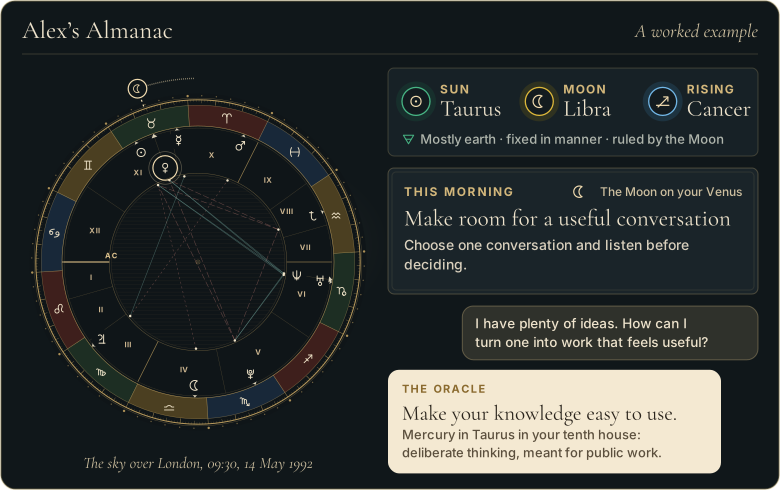
Walk through Alex’s whole example first
 The Road of AgesSee the turning points of your whole life, from your birth date
Free first look
The Road of AgesSee the turning points of your whole life, from your birth date
Free first look
Prefer to explore first?
 The Road of AgesThe turning points of your whole life, from your own chart
Walk my road
The Road of AgesThe turning points of your whole life, from your own chart
Walk my road
Quick facts
| Year | Business emphasis | Watch for |
|---|---|---|
| 1 | Begin, choose, prototype, set direction | Launching before listening |
| 2 | Partner, negotiate, refine, build trust | Waiting silently or avoiding conflict |
| 3 | Communicate, publish, sell, create | Attention without conversion or delivery |
| 4 | Systemize, budget, document, improve quality | Perfectionism and rigid process |
| 5 | Experiment, reposition, travel, adapt | Scattered offers and uncontrolled risk |
| 6 | Serve, retain, train, repair reputation | Overgiving and weak scope |
| 7 | Research, audit, specialize, step back | Analysis that never reaches a customer |
| 8 | Price, negotiate, lead, manage resources | Status, leverage, or scale without safeguards |
| 9 | Complete, simplify, release, transfer learning | Destroying useful assets just to feel finished |
A one-minute story
The Music of Number
From a blacksmith's hammers to your Life Path: the story of number.

Calculate the cycle clearly and keep the method visible
The Almanac adds the reduced birth month, the reduced birth day, and the Universal Year (the calendar year’s digits, reduced), then reduces the total, keeping 11, 22, and 33 at every stage; the cycle changes on January 1. For example, a May 14 birthday in 2026 gives 5 + 5 + 1 = 11, a master year read through its root 2. Other methods differ on whether master numbers are retained at intermediate stages and whether the cycle changes on January 1 or the birthday. State the method before interpreting it. Changing methods whenever a different answer feels better makes the cycle impossible to evaluate.
Write the arithmetic next to the interpretation. That simple habit prevents mystical vagueness and lets another person reproduce the result. If the calculation is uncertain, the business decision should not become more certain. The cycle is a reflective calendar, not an external force that grants permission.
Read the nine years as a sequence of business questions
Year 1 asks what deserves a beginning. Year 2 asks which relationships and negotiations support it. Year 3 asks whether the message is understood. Year 4 asks whether the work can be repeated. Year 5 asks what needs adaptation. Year 6 asks what customers, team, and reputation require. Year 7 asks what the evidence says. Year 8 asks how resources and authority are being stewarded. Year 9 asks what should be finished or released.
This sequence is most helpful as a set of neglected questions. A business in an 8 year may still need a 4-style process repair. A 1 year may be the right time to close an old offer before beginning another. Use the annual theme to widen attention, not to ban the activities associated with other numbers.
Put readiness gates in front of high-stakes actions
Before a launch, confirm the customer, problem, promise, delivery path, price, payment process, support plan, and required legal or regulatory steps. Before hiring, confirm the work, economics, supervision, classification, and runway. Before a major investment, confirm the downside, alternatives, source of funds, decision rights, and professional advice needed. A favorable cycle does not replace any gate.
Use green, amber, and red evidence. Green means the condition is demonstrated: customers have paid and delivery works. Amber means promising but incomplete: interviews are positive but no one has committed. Red means a known blocker: the name conflicts, the economics fail, or an obligation is not met. Choose the next action by the evidence color, then use the number theme to shape how you approach it.
Move from annual theme to monthly and weekly action

An annual interpretation is too broad unless it becomes a schedule. Select one ninety-day objective that fits the business stage, then define a monthly milestone and a weekly lead measure. A Year 3 communication theme might become twelve customer interviews in a month and three invitations each week. A Year 4 systems theme might become one documented delivery process and a weekly defect review.
Do not force every day into numerological productivity. Rest, family needs, health, worship, emergencies, and ordinary administration remain real. A healthy timing practice reduces anxiety by making priorities clearer. If it causes repeated checking or fear of acting on the “wrong” date, stop using the finer cycles and return to a simple calendar and the facts of the decision.
Close the cycle with a business review
At the end of each quarter, compare the theme with results. What began, strengthened, sold, repeated, changed, repaired, clarified, grew, or ended? Which result came from deliberate work, and which was outside your control? What did customers do, not merely say? How did cash, capacity, and personal wellbeing change?
Then write a counter-reading: where did the year not fit? This prevents confirmation bias from turning every event into evidence for the number. The goal is not to prove the cycle. The goal is to use a memorable rhythm to ask better planning questions while staying free to follow evidence, counsel, and responsibility.
Sources and editorial method
Research and editorial references used for this page include:
- U.S. Small Business Administration: Plan your business - Practical reference for market research, competitive analysis, business planning, startup costs, and testing demand.
- U.S. Small Business Administration: Launch your business - Practical reference for business names, registration, structure, licenses, banking, and insurance.
The timing cycle is described as a symbolic planning method. Practical launch, cost, customer, and readiness guidance follows official small-business resources; the page makes no claim that a calendar number causes business outcomes.
Related reading
From the method to your own numbers
Your numbers,
worked out for you.
- Your chart and numbers, read for you in about a minute
- Ask the Oracle anything about them
- Every personal tool and daily guidance
Free reading, no card needed. Optional membership: payment details required, 7 days free, then $12/month. Cancel before it renews and you pay nothing.
Common questions
What is the best Personal Year to start a business?
Year 1 is traditionally associated with beginnings, but a business should start when its evidence, preparation, obligations, and risk make the next step responsible. Any year can contain a beginning.
Is Personal Year 8 guaranteed to bring money?
No. Eight is commonly associated with resources and authority, not guaranteed profit. It may be better used for pricing, governance, negotiation, and financial discipline.
Should I wait for a better year before launching?
Do not delay a sound, time-sensitive action solely because of numerology. Use the cycle as a planning theme and let readiness decide.
Can I use Personal Months for launch dates?
You can use them as a reflective scheduling layer after practical constraints are satisfied. They cannot make an unready launch safe or effective.
When does a Personal Year begin?
Some schools use January 1 and others emphasize the birthday transition. State which method you use and apply it consistently.