
Psychokinesis
Moving things by thought: dice, random numbers and bent spoons, and what the checks found.
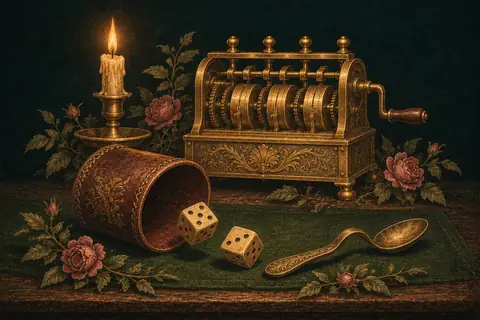
What is psychokinesis, and has moving things by thought ever been shown?
What it is
Psychokinesis is the claim that the mind can move or alter matter without any bodily contact: tip a falling die, bend a key, nudge the output of a machine. The older word telekinesis is still used for the large effects of the sitting room and the stage, moving tables and bending spoons. Researchers part the claim in two. Large effects, seen with the eye, have always turned out on inspection to be conjuring or to vanish under controls. Small effects are a matter of statistics: a faint bias in thousands of random events, far too small to see, which can only be argued from totals.
The teaching
As parapsychology's study of psychokinesis, from Rhine's dice to Princeton teaches it.
Mind on matter
Psychokinesis, PK for short, is the claim that the mind can affect matter directly, without touch or any known force. Parapsychology divides the claim in two. Macro-PK is the large effect, visible to the eye: an object moved, a spoon bent, a table raised. Micro-PK is the small effect, invisible to the eye and claimed only from statistics: a faint bias in the fall of thousands of dice, or in the output of a machine that produces random events.
The dice
Rhine's first PK tests used dice. The subject chose a target, a particular face or a high or low total, and willed the dice to fall that way, and the throws were counted against what chance gives. To take skill out of the throwing, dice were soon thrown from a cup against a wall, then rolled down an inclined board, and later tumbled by machine.
One safeguard in the dice tests teaches a general lesson. Any real die is slightly biased, so that one face comes up a little more often than the others. If the target were always six, a biased die could produce a seeming PK effect all by itself. So each face is made the target equally often, in turn, and the bias of the die cancels out across the series.
The decline across the page
Rhine's laboratory taught that a true PK effect should carry the marks of a mind. Scores should be highest at the start of a session or a page of the record and fall away toward its end, as interest flags, just as they do in card tests. A mechanical bias does not tire, so a decline of this kind was read as the sign of a person at work.
Placement
A second design asks not which face will come up but where an object will come to rest. In a placement test, dice or cubes are released down a chute onto a table divided into halves, and the subject wills them to the left side in one series and to the right in the next, alternating so that any slope of the table cancels out. The measure is how far, on average, the objects land toward the side willed.
Machines of chance
Helmut Schmidt, a physicist, built machines to take the place of dice: generators driven by radioactive decay, whose timing quantum physics holds to be truly random. The generator produces a stream of two outcomes, like heads and tails, shown to the subject as lights or clicks, and the subject tries to make one outcome come more often than the other. The machine counts every event, so that no error of scoring or of memory can enter.
Schmidt carried the claim further with targets recorded beforehand: random events were generated and stored unseen, and only later played to a subject who tried to influence them. In his reading, a mind could act on an event already recorded, so long as no one had yet observed it.
Intention high, intention low
At Princeton's engineering school, Robert Jahn and Brenda Dunne ran such tests for many years under a protocol they called tri-polar. In each session the operator, as they called the subject, tried in turn to make the machine's output run high, to make it run low, and to leave it alone as a baseline, the three interleaved. The measure was the shift of the average from what chance predicts, plotted as a running total that drifts up or down with any persistent bias.
The large effects and the moving hand
The large effects have a long history in the séance room: tables tipping and turning under the sitters' hands, objects moving in the dark. Michael Faraday tested table-turning with a simple device placed between the sitters' hands and the table top, which showed whether the hands moved first or the table did. The hands moved first. The sitters were pushing without knowing it, by what William Carpenter named the ideomotor effect: small movements the body makes in response to an idea, below awareness. The same effect moves the pointer of a talking board, the dowser's rod and the swinging pendulum.
Testing a demonstration
A visible effect can only be tested by people who know how such effects are faked. The rules are plain. A conjuror should help to design the test and should watch it. The testers supply every object, and nothing is handled out of sight, even for a moment. The whole of it is filmed from more than one angle, and the conditions are agreed in writing beforehand, so that they cannot be changed when the effect fails to appear.
The poltergeist
Parapsychology reads the poltergeist through PK as well. William Roll called it recurrent spontaneous psychokinesis: objects thrown, noises and breakages centred on one living person, often a young person under strain, and held to be that person's unconscious PK rather than the work of a spirit. The investigator's method is to watch closely, film continuously, and note who is present when each event happens. A household in distress needs calm and care more than an audience.
Nothing to practise
This branch teaches no exercise of its own, and the house offers none for moving things by thought. One caution belongs with this branch. Some people come to fear that their thoughts can cause harm, that thinking of an accident might make it happen, and they check and undo to prevent it. That fear is not psychokinesis; it is a recognised pattern of anxiety, sometimes part of obsessive worry, and a doctor can help with it.
How it is practised
There is nothing here to practise, and the house suggests no exercise for moving things by thought. What a reader can do is learn how the well known effects are made. A bent spoon is the classic case: the bending is done by hand in a moment when the audience is looking elsewhere, and the slow melting that follows is a way of revealing a bend already there. Magicians have published the method many times. Watching one such explanation is worth more than any number of films of the effect, because it shows how readily the eye is led.
Where it comes from
The word psychokinesis was coined in 1914 by the American writer Henry Holt; telekinesis is from 1890. Rhine began dice tests in 1934 and published them in 1943, reporting that subjects could wish for high faces and get slightly more of them. From 1969 the physicist Helmut Schmidt replaced dice with electronic random number generators. A laboratory at Princeton University's engineering school ran such tests from 1979 to 2007 and reported a tiny but persistent bias. In 2000 a joint attempt by three laboratories, Princeton among them, to repeat its central result did not find it.
What is known, and what is not
A review in 2006 of about 380 random number studies found an overall effect so small, and so tied to the size of the study, that the authors judged unpublished failures a likely explanation, which is the file-drawer problem at work. When the performer Uri Geller, who says his abilities are real, appeared on American television in 1973 with props chosen on a conjuror's advice, he did not produce the effect. No large effect is on record under conditions set by people who know the conjuring methods, and parapsychology has no accepted demonstration of a small one.
Its words
 Psychokinesis
- The claimed power of the mind to move or change matter without touching it. The word dates from 1914; the older telekinesis from 1890.
 Parapsychology
- The experimental study of claims such as telepathy and psychokinesis. Rhine took the name from the German and gave it to his laboratory at Duke University.
 File-Drawer Problem
- The bias that arises when studies that find nothing stay unpublished, so that the printed record looks stronger than the whole. Named by Robert Rosenthal in 1979.
- Spoon Bending
- The apparent bending of cutlery or keys by the mind alone, famous on television in the 1970s and a standard effect of stage conjuring.
Ask the Oracle further
What did the Princeton laboratory find about psychokinesis and random numbers?What is the difference between psychokinesis and telekinesis?
Before you practise
The Oracle tells what has been claimed for telepathy and second sight, what was tested, and what held: small effects have been reported and have not been reliably repeated. It will not tell you that you are psychic, or that a premonition is true. If you feel your thoughts are being read, please see a doctor.
Its other branches
TelepathyClairvoyance and remote viewingPremonitionsWhat intuition isFrom Rhine to the ganzfeldCold readingThe whole artSearch the tree

