

The inner life
Wake Back to Bed (WBTB)
Direct answer
Wake Back to Bed (WBTB): Wake back to bed, or WBTB, is a lucid dreaming method in which a person sleeps five or six hours, gets up for a short while, then returns to bed hoping to become lucid. It costs sleep.
$0 today, then $19/month after 7 days. Cancel anytime.
At a glance
- Also called
- WBTB technique, wake back to bed method, WBTB lucid dreaming
- Found in
- Consciousness & Spiritual Psychology
- Related
- MILD, REM Sleep, Lucid Dreaming, Dream Journal
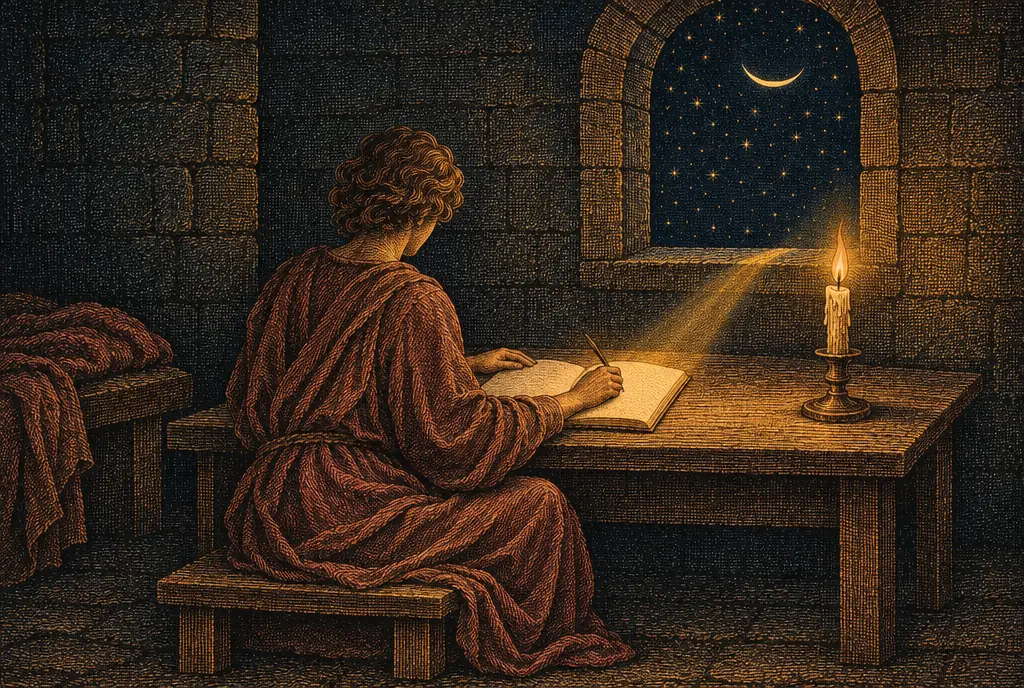
Wake back to bed, or WBTB, is a lucid dreaming method in which a person sleeps five or six hours, gets up for a short while, then returns to bed hoping to become lucid. It costs sleep.
A plain educational schematic; it does not diagnose a condition or replace professional care.
Understand the chapter you are in.
Your life’s turning points, measured from your birth.
Walk through Alex’s whole example first


Prefer to explore first?
 The Road of AgesThe turning points of your whole life, from your own chart
Walk my road
What does WBTB mean?
The method uses the shape of the night. REM periods grow longer and closer together towards morning, so a person who wakes after about five hours and goes back to sleep re-enters dreaming quickly, with a mind that has just been fully awake. People who use it stay up for anything from ten minutes to an hour, quietly, reading over their dreams or thinking about lucidity, before going back to bed.
Wake Back to Bed (WBTB) is seldom used alone. It is the frame into which other techniques are fitted, above all MILD. In controlled studies the combination of an awakening with an intention technique is the pairing with the most consistent results. The price is a broken night, and the lost sleep is real.
On the tree of the hidden arts: Lucid dreaming.
What sets Wake Back to Bed (WBTB) apart
WBTB is a schedule, not a mental technique. It does nothing inside the mind directly; it changes when the attempt is made. Two things follow from the interruption. The return to sleep lands in the longest REM periods of the night, and the period awake restores the alertness that ordinary dreaming lacks. Experiments suggest the wakeful interval needs to be real, with the person out of bed and occupied, and that falling asleep again fairly quickly afterwards favours success.
- Sleep before waking: about five to six hours
- Time awake: from ten minutes to an hour in different studies
- Usual partner: the MILD intention technique
- Why it helps: REM periods are longest and closest together near morning
- Laboratory test: Erlacher and Stumbrys, 2020
Often mistaken for something else: MILD is what the dreamer does with the mind; WBTB is when in the night they do it.
The story behind Wake Back to Bed (WBTB)
Stephen LaBerge's group at the Lucidity Institute reported in the 1990s that lucid dreams were far likelier in a morning nap after a period awake than in unbroken sleep. A 2012 review of induction studies by Tadas Stumbrys and colleagues rated the approach among the more promising. Denholm Aspy's trials of 2017 and 2020, and a sleep laboratory study by Daniel Erlacher and Stumbrys in 2020, tested it combined with MILD.
Why Wake Back to Bed (WBTB) matters
Wake Back to Bed (WBTB) explains why timing counts as much as technique, and why most reported successes come in the last hours of sleep.
How to read Wake Back to Bed (WBTB)
Practitioners keep it for nights before a free morning, and pair it with MILD or SSILD on returning to bed.
Wake Back to Bed (WBTB) in practice: an example
On the night before a free morning a practitioner gets up before dawn, sits a while with his dream journal, and goes back to bed; he is tired the next afternoon.
Where readings of Wake Back to Bed (WBTB) go wrong
Wake Back to Bed (WBTB) breaks the night on purpose, so it costs sleep; it is unsuited to people who sleep poorly and is not something to do every night.
Sources and editorial method
This entry summarizes the tradition in the Almanac's own words; where no source is listed, it is an editorial summary rather than a primary text, and symbolic readings are named as the tradition's, not as fact.
- Source
- The Great Almanac Dictionary
- Category
- Consciousness & Spiritual Psychology
- Aliases
- WBTB, WBTB technique, wake back to bed method, WBTB lucid dreaming, WBTB meaning
- Last updated
- 2026-09-26
See Wake Back to Bed (WBTB) in your personal almanac
A definition tells you what it is; your own birth chart tells you what it means for you. The Oracle casts your real chart and answers for your love, your work, and your year ahead, in conversation. It opens with the 7-day Oracle trial.
Speak with the OracleRelated terms
More in Consciousness & Spiritual Psychology
- Bell's Theorem
- Copenhagen Interpretation
- False Awakening
- Implementation Intention
- Projection
- Self-Observation
- Spoon Bending
From the reference page to your own chart
Every word here
is in your own chart.
- Your life’s turning points, measured from your birth
- A practical next step to consider
- It opens with 7 days free: the AI Oracle on thirty hidden arts, and your daily horoscope
$0 today, then $19/month after 7 days. Cancel anytime.
Common questions
What does WBTB mean?
Wake back to bed. The sleeper wakes after roughly five or six hours, stays up briefly, and then goes back to sleep intending to have a lucid dream.
How long do people stay awake in WBTB?
Studies and guides vary from about ten minutes to an hour. The aim described is to become properly alert without making it hard to fall asleep again. Either way the night is shortened, which is the method's cost.
Does wake back to bed work on its own?
It can, but the evidence is strongest when it is combined with an intention technique such as MILD. On its own it mainly places the dreamer in REM-rich sleep with a wakeful mind.


