Sky science
Light-Time Correction
Direct answer
Light-Time Correction accounts for the finite interval required for light to travel between an event, observer, and reference point.
It aligns an observed signal with its emission geometry.
$0 today, then $12/month after 7 days. Cancel anytime.
At a glance
- Found in
- Astronomy & Skywatching
- Related
- Proper Motion, Radial Velocity, Orbital Elements, Semimajor Axis
It aligns an observed signal with its emission geometry.
A scientific orientation to scale, light, or motion; the article supplies the precise definition.
What does your own chart say about you?
Choose love, work or purpose. Your reading is written from your chart. Your reading uses your own birth details.
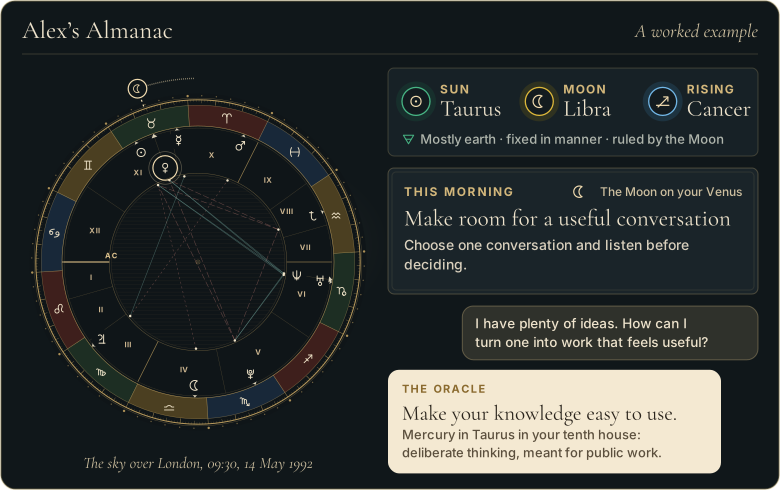
Walk through Alex’s whole example first
 The Road of AgesSee the turning points of your whole life, from your birth date
See your road's shape
The Road of AgesSee the turning points of your whole life, from your birth date
See your road's shape
Prefer to explore first?
 The Road of AgesThe turning points of your whole life, from your own chart
Walk my road
The Road of AgesThe turning points of your whole life, from your own chart
Walk my road
Free, by email
Your daily Almanac letter
One short letter at 7 each morning: the day’s theme read for your own chart, and one thing to do with it.
The story behind Light-Time Correction
Increasing timing precision made finite light travel an operational correction rather than a curiosity.
A one-minute story
The Wandering Stars
How the moving planets were watched, named and found, and what a transit is.

Why Light-Time Correction matters
Light-Time Correction is essential when positions or periodic events require precise timing.
How to read Light-Time Correction
the appropriate geometric, heliocentric, or barycentric correction speaks to the task.
Light-Time Correction in practice: an example
A planetary observation records where the planet was when its light departed, not at reception.
Where readings of Light-Time Correction go wrong
A common error is to apply one correction indiscriminately to every reference frame.
Sources and editorial method
Research references used for this entry include:
- U.S. Naval Observatory: Astronomical Almanac Glossary - Definitions for astronomical coordinates, time, reference systems, and observable phenomena.
- International Astronomical Union: Standards of Fundamental Astronomy - IAU-maintained standards and algorithms for astronomical reference systems and coordinate transformations.
- Source
- The Great Almanac Dictionary
- Category
- Astronomy & Skywatching
- Last updated
- 2026-09-26
Account for light’s travel time
A definition tells you what it is; your own birth chart tells you what it means for you. The Oracle casts your real chart and answers for your love, your work, and your year ahead, in conversation. It opens with the 7-day Seeker trial.
Speak with the OracleRelated terms
More in Astronomy & Skywatching
- Orbital Inclination
- Protostar
- Skyglow
- Superior Conjunction
- Altitude and Azimuth
- Atmospheric Extinction
- Dark Nebula
- Geometric Albedo
From the reference page to your own chart
Every word here
is in your own chart.
- A personal reading about love, work or purpose, written from your chart
- A practical next step to consider
- It opens with 7 days free, with the AI Oracle and daily guidance
$0 today, then $12/month after 7 days. Cancel anytime.
Common questions
What is Light-Time Correction?
Light-Time Correction accounts for the finite interval required for light to travel between an event, observer, and reference point.
What do people get wrong about Light-Time Correction?
A common error is to apply one correction indiscriminately to every reference frame.
Free, by email
The Almanac, in your inbox at 7
One short letter at 7 each morning: the day’s theme read for your own chart, and one thing to do with it.